Opinion
Global Corruption Is Getting Worse – and Africa’s Divide Has Never Been Starker
The world is becoming less clean. The data is unambiguous, and the consequences are profound.


By Mark-Anthony Johnson
In the grand ledger of global governance, the ink is increasingly smudged. According to the latest Corruption Perceptions Index (CPI) from Transparency International, the world is not just standing still on graft; it is sliding backward.
The 2025 index, which scores nations from 0 to 100 based on the perceived cleanliness of their public sectors, paints a sobering picture. The global average has slumped to a dismal 42.
More strikingly, 122 of the 182 countries assessed scored below 50, placing them firmly in the failing half of the governance spectrum. The global heat map tells a stark geographical tale, stretching from the pristine probity of Denmark (89) to the institutional void of Somalia (9).
But to view these numbers merely as a scoreboard is to miss the deeper structural shifts at play. For the African continent—a diverse tapestry of 54 sovereign nations – the data offers a profound lesson in the economic dividend of institutional integrity.
The Shrinking Club of the Incorruptible
Perhaps the most alarming finding of the 2025 CPI is the rapid contraction of the world’s “clean” tier. In 2015, a dozen countries boasted a score above 80. By 2025, that exclusive club has shrunk to just five.
This is not merely a story of developing nations struggling with statecraft; it is a crisis of the advanced world. Transparency International rightly points to rising political polarization, eroding institutional trust, and intense pressure on checks and balances as the culprits dragging down scores in several mature democracies.
The implicit warning is clear: democratic institutions are not self-sustaining. Without active, disciplined maintenance, the machinery of accountability rusts.
Africa’s Divergence: Statecraft vs. State Collapse
When it comes to Africa, global narratives often default to a monolithic pessimism. This is a profound analytical failure. Africa is not a country, nor is its corruption a singular cultural phenomenon; it is a reflection of vastly different political choices and historical trajectories.
The continent’s bottom five – Sudan, Eritrea, Libya, Somalia, and South Sudan – do not represent an inherent regional flaw. Rather, they are the predictable symptoms of state collapse, protracted conflict, and institutional vacuums. You cannot measure the transparency of a public sector that barely functions.
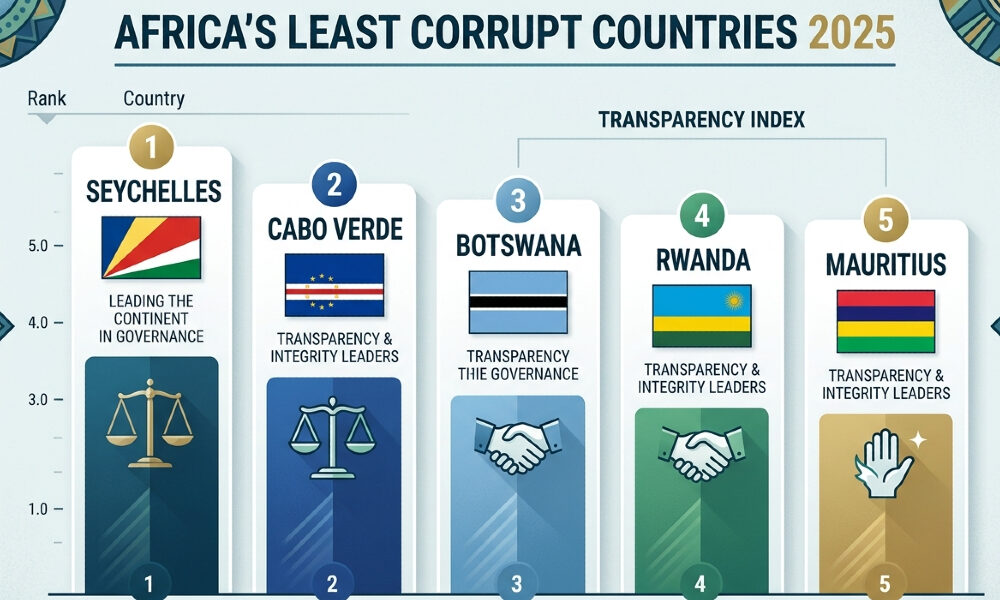
Conversely, the continent’s top performers represent a deliberate architectural choice toward good governance. The vanguard of African integrity includes:
- Seychelles
- Cabo Verde
- Botswana
- Rwanda
- Mauritius
These nations have recognized that transparency and accountability are not merely boxes to tick for Western donors; they are the foundational prerequisites for economic sovereignty and domestic resource mobilization.
The Dividend of Decency: Monetizing Stability
There is a profound, often overlooked, economic dividend to institutional integrity. Nowhere is this more evident than in the sun-drenched archipelagos and coastal stretches of Africa’s tourism sector.
The nations leading the charge on transparency are precisely the ones reaping the rewards of the global tourist dollar.
Africa’s most tourism-dependent economies rely heavily on international visitor spending for their GDP, employment, and foreign exchange earnings. Unsurprisingly, the continent’s cleanest island-nations dominate this list, leveraging their stability to build world-class hospitality sectors:
- Seychelles: Tourism contributes a staggering 55.4 percent of the GDP. Pristine beaches, marine biodiversity, and a reputation for safety and luxury drive this massive share, making it the most tourism-reliant nation in Africa.
- Cabo Verde: Travel and hospitality account for 27.9 percent of the GDP. This Atlantic archipelago successfully capitalizes on its political stability to attract European travelers seeking year-round sunshine.
- The Gambia: Tourism contributes about 18.4 percent of the GDP. This West African nation utilizes its Atlantic coastline and natural reserves to draw seasonal visitors, relying on a relatively stable democratic transition.
- Mauritius: The sector provides 14.7 percent of the GDP. Upscale resorts and eco-tourism anchor this Indian Ocean island’s economic stability, underpinned by strong rule of law.
- Morocco: While possessing a highly diversified economy, tourism remains a massive generator of employment and a significant pillar of its GDP, driven by strategic state investment and security.
The Mainland Giants: Volume vs. Dependence
It is vital, however, to distinguish between dependence and volume. While the island and coastal nations are the most dependent on tourism as a percentage of their total economic output, the sheer scale of the mainland giants cannot be ignored.
Larger economies such as Egypt, South Africa, and Kenya generate the highest total tourism revenue and absolute visitor numbers on the continent. For these nations, tourism is a massive economic engine, but it is one cog in a much larger, more complex industrial machine.
The Mandate for the Future
The dual data sets from the 2025 CPI and the tourism sector offer a clear, undeniable mandate for African policymakers. The era of survival-driven improvisation must give way to structured, growth-focused statecraft.
Institutional integrity is the ultimate competitive advantage in the 21st-century global economy. Whether a nation is looking to attract foreign direct investment in agribusiness, retain its brightest minds, or build a high-yield tourism sector, the foundation remains the same.
Africa’s future depends not on defending itself to the world, but on the disciplined, intentional building of transparent institutions at home. The cleanest countries are not just morally superior; they are economically smarter. And in the race for Africa’s demographic dividend, that is the only metric that truly matters.
Mark-Anthony Johnson is the founder and CEO of JIC Holdings, a global asset and investment management firm founded in 2009. With over 30 years of experience and strong ties to Africa, his investments span mining, infrastructure, power, shipping, commodities, agriculture, and fisheries. He is currently focused on developing farms across Africa, aiming to position the continent as the world’s breadbasket.