Opinion
Ghana’s Debt Reset Offers Africa a New Test of Economic Credibility
Ghana’s early debt repayment and Namibia’s leap up a continental performance index point to the same lesson: markets are no longer pricing Africa’s economies on size alone. They are pricing what governments do when no one is forcing their hand.


By Gregory September
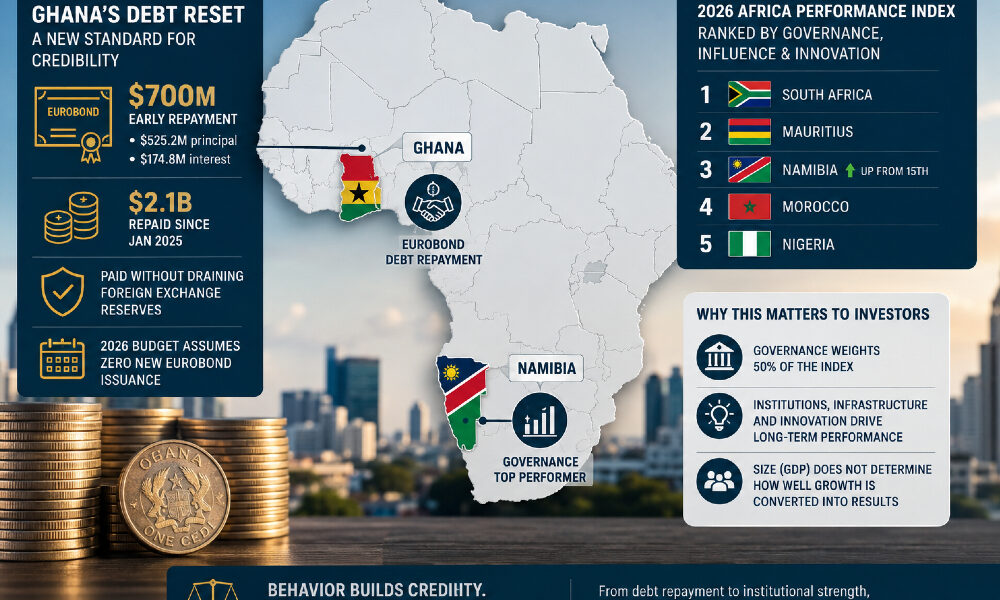
Four years ago, Ghana suspended payments on most of its external debt. This month, the same government prepaid US$700 million to Eurobond holders – US$525.2 million in principal, US$174.8 million in interest – years ahead of schedule, using its own reserves rather than fresh borrowing. Since January 2025, Accra has now returned US$2.1 billion to commercial creditors. It did not draw down foreign exchange reserves to do it, and its 2026 budget assumes zero new Eurobond issuance.
That is not merely a fiscal footnote. It is a signal, and in frontier debt markets, signals travel faster than balance sheets.
Markets Price Behavior, Not Just Numbers
Sovereign default is common enough in the developing world that investors have grown almost clinical about it. What is rare is what comes after: a government that, once solvent again, chooses to pay down debt early rather than spend the fiscal space on politically popular alternatives. Ghana is the first member of the 2022 default cohort – a group that also includes Zambia and Ethiopia – to prepay creditors using reserves it did not have eighteen months ago.
That makes Ghana a benchmark, whether it intended to be one or not. Zambia and Ethiopia are now being evaluated against a standard that did not exist before this year: not “will you restructure credibly,” but “will you overperform on what you restructured to.” For bondholders weighing whether to return to any post-default African market, Ghana has just answered the only question that matters – not with a growth forecast, but with a wire transfer.
Three things changed in Accra, and they are worth naming plainly:
- A default cohort with no precedent for early repayment now has one.
- A government prepaid debt it wasn’t obligated to prepay yet – a choice, not a requirement.
- A signal was sent directly to bondholders ahead of the next issuance cycle, which is when it will matter most.
The open question is whether this is replicable or simply Ghanaian discipline meeting a favorable commodity cycle. Either way, the bar for “credible post-default economy” has moved, and it moved without help from the IMF’s press office.
Governance Is Now Worth More Than Size
A parallel story is unfolding in how Africa ranks itself. The 2026 Africa Performance Index, published by Jeune Afrique and The Africa Report, delivered a ranking that should unsettle anyone still using GDP as a proxy for opportunity. South Africa placed first. Mauritius came second. Namibia – a country with a population smaller than metropolitan Accra – vaulted from fifteenth place to third. Nigeria, the continent’s largest economy by population, landed fifth. Ethiopia and Kenya, both economically larger than Namibia, lost ground.
The index’s methodology explains the reshuffle: governance accounts for half of every country’s score, with influence and innovation splitting the remainder. Tax collection efficiency and institutional strength, in other words, move a country’s ranking more than the size of its economy does. Namibia’s rise wasn’t accidental – it was earned through the same category that decided most of the index’s surprises.
The top five tell the story concisely:
| Rank | Country | Driver |
|---|---|---|
| 1 | South Africa | Academic, diplomatic, and innovation weight |
| 2 | Mauritius | Institutional stability |
| 3 | Namibia | Jumped from 15th; governance-led |
| 4 | Morocco | Infrastructure and manufacturing investment |
| 5 | Nigeria | Market size and regional influence |
The Same Lesson, Told Twice
Put Ghana’s debt behavior next to Namibia’s ranking leap and a single thesis emerges: African economies are increasingly being judged – and increasingly differentiating themselves – on institutional conduct rather than economic scale. Ghana didn’t out-grow its default; it out-behaved it. Namibia didn’t out-produce Nigeria or Ethiopia; it out-governed them.
For investors, this is more than an academic observation. It is a recalibration of due diligence. GDP size, population, and resource endowment remain useful filters, but they are no longer reliable predictors of either creditworthiness or institutional performance. A government’s willingness to prepay debt with no one watching, or a state’s capacity to collect taxes efficiently, now carries more predictive weight than the headline size of its economy.
This also maps cleanly onto the UN Sustainable Development Goals framework, for those tracking the policy dimension alongside the market one. SDG 16 (Strong Institutions) is effectively the load-bearing variable in both stories – it is literally half the Africa Performance Index’s methodology, and it is the implicit subject of every Eurobond prepayment. SDG 9 (Industry, Innovation and Infrastructure) explains Morocco’s and Namibia’s climbs. SDG 10 (Reduced Inequalities) is the quieter reminder that a country’s size has never determined how well it converts growth into durable national performance.
The Question Worth Asking
Two questions now follow both stories, and they are really the same question asked from different sides of the ledger:
What would it take for another post-default economy – Zambia, Ethiopia, or the next country to restructure – to make the same move Ghana made? And should investors start weighting governance scores as heavily as GDP when deciding where frontier capital goes next?
The market’s answer, increasingly, is yes. Behavior compounds. So does its absence.
Gregory September is a South African academic, author, and geopolitical analyst with extensive experience in government and Parliament. He is the founder and CEO of SAUP (Sustainability Awareness and Upliftment Projects NPC), which focuses on sustainability education and community development. He previously served as Head of Research and Development for the Parliament of South Africa. His work centers on sustainability, African geopolitics, and economic development, and he regularly contributes to analysis of global political and economic affairs.