Zina’s Youth View on Africa
Ghana–Zimbabwe: Africa’s Quietest Trade Corridor Is Also Its Most Overlooked Opportunity
Political goodwill between Accra and Harare is mounting. The economics have yet to follow – and that gap is precisely where opportunity lives.


By Godfred Zina
Ghana–Zimbabwe relations are undergoing a subtle but consequential transformation: a deliberate shift from symbolic Pan-African solidarity toward a results-driven economic partnership. Both governments are increasingly aligning diplomacy with commercial outcomes, signaling that the relationship is maturing beyond rhetoric.
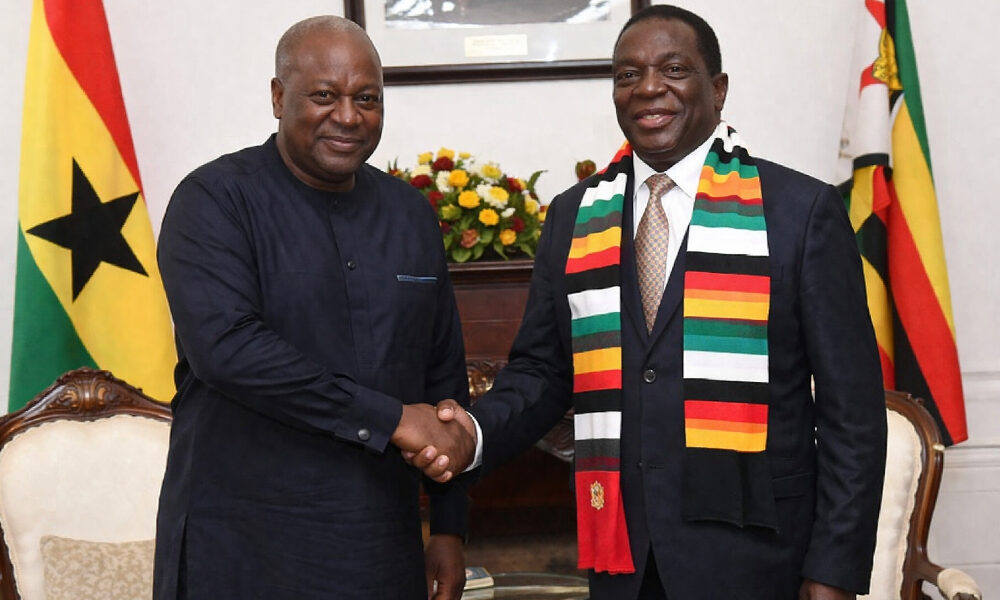
President Emmerson Mnangagwa’s recent three-day state visit to Ghana was more than ceremonial. It represented a policy-level commitment to deepen cooperation across trade, agriculture, energy, and infrastructure – all anchored within a revitalized bilateral framework.
The optics were unmistakable. The economic substance, however, remains a work in progress.
The Numbers Tell an Uncomfortable Truth
Despite a shared historical legacy forged by two of Africa’s most towering ideological figures – Ghana’s Kwame Nkrumah and Zimbabwe’s Robert Mugabe – the economic fundamentals between the two nations are, frankly, underwhelming. Trade volumes are minimal. Supply chains are underdeveloped. Private sector participation is almost nonexistent.
The data confirms it: Ghana exported approximately US$542,000 worth of goods to Zimbabwe in 2023 and imported roughly US$579,000 in return. These are not the figures of a functioning bilateral trade corridor – they are the figures of two countries that have barely begun to do business with each other.
Even optimistic projections, which suggest Zimbabwe’s imports from Ghana could surpass US$1.25 million by the end of 2026, demand scrutiny rather than celebration. Modest growth from a near-zero baseline is still modest growth.
The pattern is clear: commercial engagement between Accra and Harare is emerging, but it remains structurally underdeveloped and nowhere near the scale that either nation’s economic ambitions – or Africa’s broader integration agenda – would require.
So What Does This Actually Mean?
The most important takeaway is not that Ghana and Zimbabwe are failing each other. It is that Pan-African political alignment has consistently failed to translate into meaningful economic integration.
This is not a bilateral anomaly – it is a systemic weakness in African diplomacy, where policy intent routinely outpaces trade execution. Memorandums of understanding are signed. Corridors are announced. Frameworks are endorsed. And then, in far too many cases, nothing moves.
The Ghana–Zimbabwe corridor is a microcosm of this broader dysfunction. Both nations possess complementary strengths: Ghana’s relative macroeconomic stability, its established position within ECOWAS, and its agro-processing capacity sit alongside Zimbabwe’s mineral wealth, its agricultural potential, and its strategic location within SADC.
The pieces exist. The architecture to connect them does not – yet.
The Opportunity Hidden in Plain Sight
This is precisely where the strategic argument becomes compelling. For investors, supply chain architects, and regional trade developers, an underdeveloped corridor between two politically aligned, geographically distinct economies is not a deterrent. It is an invitation.
First movers who enter this space now have a rare opportunity to shape supply chains before they solidify, capture early value in agro-processing and logistics, and build cross-regional positioning that spans both ECOWAS and SADC – two of Africa’s most significant economic blocs – under the expanding framework of the African Continental Free Trade Area (AfCFTA).
The bilateral trade figure may sit below US$1 million today, but that number obscures the corridor’s true strategic value. This is not a mature market with entrenched competitors. It is an early-stage trade route with institutional backing, political momentum, and a structural gap that rewards those willing to move before the crowd does.
The Verdict
Ghana and Zimbabwe have the diplomatic foundation. They have the political will. What they lack is the economic infrastructure, private sector energy, and investor conviction to convert intention into integration.
Africa has seen too many corridors announced and too few built. The question is not whether the Ghana–Zimbabwe trade relationship can grow – it almost certainly will.
The question is who will be positioned to benefit when it does, and whether both governments can resist the familiar pattern of letting summits substitute for strategy.
Watching this corridor closely is no longer optional for anyone serious about African trade. The quiet ones, historically, tend to be the ones worth listening to.
Godfred Zina is a freelance journalist and an associate at DefSEC Analytics Africa, a consultancy specializing in data and risk assessments on security, politics, investment, and trade across Africa. He also serves as a contributing analyst for Riley Risk, which supports international commercial and humanitarian operations in high-risk environments. He is based in Accra, Ghana.