Opinion
Ghana Opens Its Doors: A Bold Step for African Free Movement
A bold move by President Mahama on Africa Day signals that Pan-African free movement may finally be crossing from aspiration into policy.


By Dishant Shah
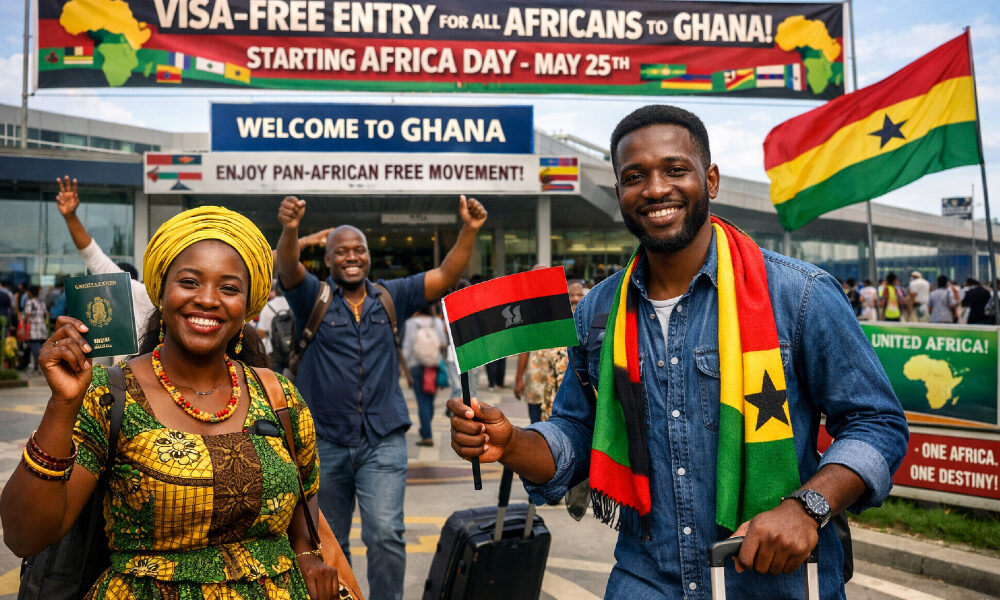
On April 2, 2026, during a state visit by Zimbabwe’s president, Ghana’s President John Mahama said something that should have stopped every African policymaker mid-sentence. Effective May 25 – Africa Day – Ghana will grant visa-free entry to every African passport holder on the continent.
With that announcement, Ghana becomes only the fifth African country to extend this welcome to fellow Africans, joining Benin, Rwanda, The Gambia, and Seychelles. Five countries out of fifty-four.
That number tells you nearly everything about how far this continent still has to travel – and precisely why it matters when a country of Ghana’s size and strategic weight decides to move.
This is not a tourism promotion. It is a political statement rooted in a very specific history.
The Birthplace of a Dream
Ghana under Kwame Nkrumah was the cradle of Pan-Africanism: the first sub-Saharan nation to gain independence, and the loudest early voice insisting that African countries must integrate or remain individually weak. That argument was made in 1957.
Nearly seven decades later, most Africans still need a visa to visit their neighbors. The gap between the vision and the reality has never been more visible – or more embarrassing.
The economic stakes of closing that gap are not modest. Africa’s 1.4 billion people generate intra-African trade that accounts for roughly 15 percent of the continent’s total trade, compared with over 60 percent within Europe.
A significant share of that disparity exists because moving people and goods across African borders carries friction that moving them outside the continent often does not. African businesspeople frequently find it easier to fly through European hubs than to connect directly across the continent.
African professionals require visas for neighboring countries that European tourists enter freely. This is not a natural condition. It is a policy failure – and one that can be reversed.
Why Ghana, and Why Now
Ghana’s decision matters for West Africa in particular because of the country’s gravitational pull in the region. Accra is already one of West Africa’s most connected cities: a hub for finance, the creative industries, diaspora return investment, and continental institutions, including the African Continental Free Trade Area (AfCFTA) Secretariat.
Opening it fully to African movement deepens that gravity further and sends an unambiguous signal to the region – that one of its anchors has chosen openness as a deliberate competitive strategy, not merely a diplomatic gesture.
The timing is equally deliberate. Announcing the policy on Africa Day, in front of a visiting head of state, is an act of public accountability.
It transforms a domestic administrative decision into a continental declaration. Other governments will now be asked, explicitly or implicitly, why they have not done the same.
The Power of Demonstration
Policy in Africa, as elsewhere, travels through demonstration. Rwanda proved that a country can rebuild both its reputation and its economy through consistent, deliberate decisions made over years.
Ghana is now proving that a large West African economy can absorb the domestic politics of open borders and commit to them publicly. That is not a trivial thing.
The political economy of immigration is difficult everywhere. Leaders who move first on free movement accept short-term controversy in exchange for long-term credibility.
The precedent may be the most consequential element of this decision. If three more countries of comparable economic weight make the same commitment over the next two years, the conversation about African free movement shifts from aspiration to momentum.
The AfCFTA framework provides the architecture. What it has lacked is the cascade of national decisions required to give that architecture life.
The Door Is Open
Fifty-four countries. 1.4 billion people. Fifteen percent intra-African trade. These numbers represent both an indictment of the status quo and an argument for the scale of what is possible.
The African Union’s Agenda 2063 envisions a continent where Africans move freely. Right now, most cannot. Ghana has just moved the needle.
The door in Accra is open. The question – and it is an urgent one – is which government walks through it next.
Dishant Shah is a partner at Legion Exim, a company specializing in facilitating the export of high-quality engineering products directly sourced from manufacturers in India to Africa. His areas of expertise include new business development and business management.