Business
Ghana Bets $60 Billion on Becoming Africa’s Energy Linchpin
A massive new petroleum hub in Jomoro promises to transform West Africa’s energy landscape. But can Accra turn a $28 billion blueprint into black gold?


By Mark-Anthony Johnson
Few countries announce an energy project on this scale and expect to be believed. On October 19, Ghana did exactly that. Its Petroleum Hub Development Corporation (PHDC) signed a US$28 billion build-own-operate agreement with an international consortium led by Global Sphere, a company based in the United Arab Emirates, with technical partners from South Korea and Mali. The deal covers Phase 2 of the Jomoro Petroleum Hub, a three-phase project on the country’s Western Region coast that officials now put at US$60 billion in total.
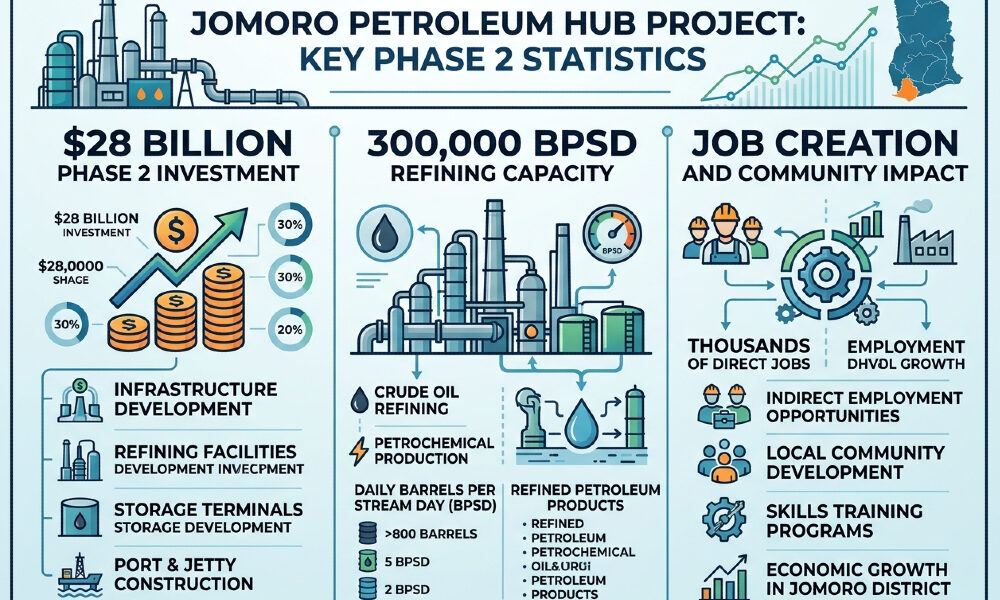
The numbers are designed to impress. Phase 2 envisions a refinery processing 300,000 barrels per stream day, two multipurpose petrochemical plants, a multi-berth marine jetty and 4 million cubic meters of specialized storage. The timeline is brisk: preliminary construction is slated to begin in the first quarter of 2027, with all three phases complete by 2036. Phase 1, a US$12 billion agreement with the TCP-UIC Consortium, was signed in mid-2024.
A Hub in Search of a Market
The logic behind Jomoro is easy to grasp. West Africa has long exported crude and imported the fuel refined from it, paying a premium for the privilege. By the government’s own account, more than 90 percent of the region’s petroleum consumption is imported. A refinery of this size, paired with petrochemicals and deep-water storage, would let Ghana capture value it now watches sail past. The sales pitch, “the Rotterdam of Africa,” is shorthand for that aspiration: a port where the world’s cargoes are stored, refined, traded and re-exported.
The promised returns are correspondingly grand. Officials project that the complex will eventually create 700,000 to 780,000 direct and indirect jobs, generate nearly US$1.6 billion a year in export taxes by 2030, and make Ghana a primary energy trading node for the region. Some claims go further still, suggesting the hub could contribute as much as 70 percent of national GDP.
Reading the Fine Print
That last figure deserves scrutiny. No single industrial complex, however large, has any realistic claim to seven-tenths of an economy that spans agriculture, gold, cocoa, services and more. Job projections of this size also tend to count indirect and induced employment generously. Refineries are capital-intensive and employ relatively few people directly. Voters hoping for hundreds of thousands of new positions should treat such numbers as a ceiling, not a forecast.
Ghana also has reason for caution in its own recent history. The country defaulted on its external debt in 2022 and has spent the years since restructuring it. A project of this magnitude, in a country whose public finances are still mending, depends heavily on private capital and on lenders’ confidence. Nigeria’s Dangote refinery, at 650,000 barrels a day, shows both that a mega-refinery can be built in West Africa and how long and costly the effort can be.
The Hurdles are Local
The most immediate obstacles are not geopolitical but terrestrial. Ghana’s Energy Minister and independent energy watchdogs have stressed that two problems must be solved before heavy machinery arrives in 2027: securing final structural financing, and resolving land acquisition and community compensation disputes across a site of some 20,000 acres. Both are the kind of issues that have stalled large African infrastructure projects before. Communities that feel shortchanged on compensation can delay a project for years, and an announcement does not close a financing gap.
There is also a matter of terminology. Some coverage describes the document as a binding agreement; other reports, and the minister’s own caution, treat it more like a memorandum of understanding. The distinction matters. A signed framework is a milestone. A financed, permitted, community-backed project is a refinery.
The Verdict
Ghana is right to want more from its hydrocarbons than a royalty check, and a refining hub could genuinely reshape regional fuel supply. But the test of Jomoro will not be the size of the number at the signing ceremony. It will be whether financing closes, whether displaced families are fairly compensated, and whether the first phase delivers on schedule. The government has won a diplomatic victory. Turning it into steel, jobs and fuel is the harder work, and the real scorecard begins in 2027.
Mark-Anthony Johnson is the founder and CEO of JIC Holdings, a global asset and investment management firm founded in 2009. With over 30 years of experience and strong ties to Africa, his investments span mining, infrastructure, power, shipping, commodities, agriculture, and fisheries. He is currently focused on developing farms across Africa, aiming to position the continent as the world’s breadbasket.