Zina’s Youth View on Africa
Ghana and India Reinforce Strategic Ties Amid Shifting Global Alliances


By Godfred Zina
As the dynamics of global geopolitics continue to evolve, Ghana and India are deepening their bilateral relationship through a renewed strategic partnership. This growing alliance underscores the importance of South-South cooperation in shaping a multipolar world order.
Indian Prime Minister Narendra Modi’s recent two-day state visit to Ghana marked a historic milestone – the first visit by an Indian prime minister in three decades. The trip symbolizes a significant recalibration of India’s engagement with West Africa and highlights Ghana’s growing role in regional and international affairs.
During the visit, key agreements were signed across critical sectors including trade, agriculture, security, and counter-terrorism. Both nations reaffirmed their shared commitment to combating terrorism, recognizing it as a global threat that demands coordinated action.
These discussions laid the groundwork for enhanced intelligence sharing and joint security initiatives, positioning Ghana as a pivotal partner for India in the fight against extremism in West Africa.
Economic Ambitions and Developmental Support
Economically, Ghana and India have set ambitious targets: to double their current US$3 billion trade volume within five years. To date, Indian companies have invested approximately USUS$2 billion across nearly 900 projects in Ghana, spanning infrastructure, energy, and technology.
This robust investment climate reflects India’s confidence in Ghana’s economic resilience and reform agenda.
In support of Ghana’s International Monetary Fund (IMF)-backed economic recovery plan, India has pledged technical and financial assistance aimed at modernizing Ghana’s digital finance infrastructure. Of particular note is India’s offer to help implement a Unified Payments Interface (UPI)-inspired system, which could revolutionize Ghana’s digital payment landscape and promote financial inclusion.
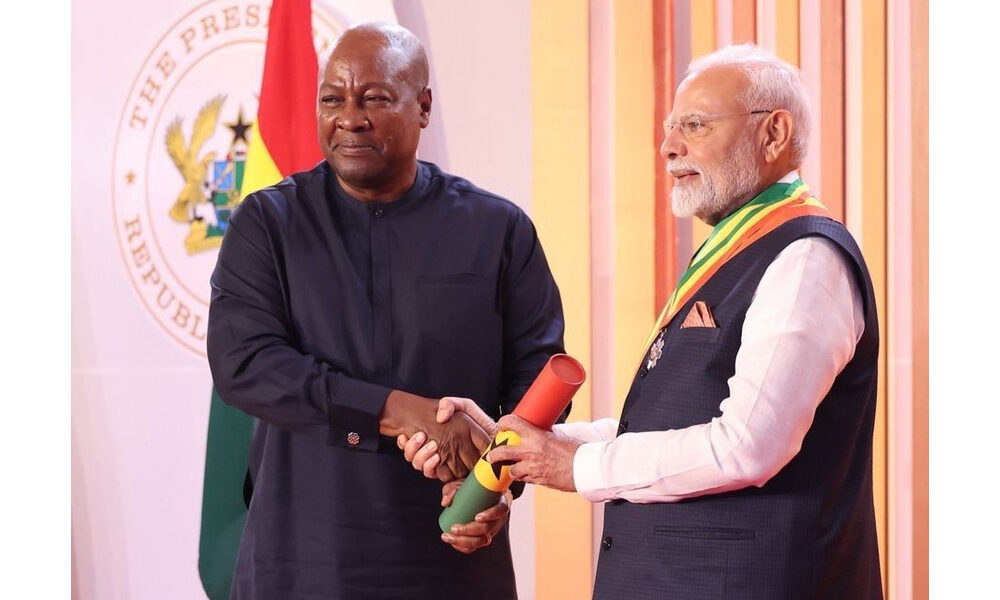
The depth of this bilateral relationship was further underscored when Prime Minister Modi was conferred with Ghana’s highest national honor, a gesture recognizing India’s longstanding contributions to Ghana’s development and nation-building efforts.
Historical Foundations and Shared Values
Historical ties between the two nations run deep, rooted in the visionary leadership of Kwame Nkrumah and Jawaharlal Nehru, who co-founded the Non-Aligned Movement during the Cold War era. Modi’s visit to the Kwame Nkrumah Mausoleum and his anticipated address to Ghana’s Parliament serve as powerful reminders of this enduring legacy and shared values of sovereignty, mutual respect, and non-interference.
This ideological alignment continues to influence contemporary diplomacy between the two nations, offering a firm foundation upon which to build future collaboration in multilateral forums and global governance structures.
Strategic Significance in a Multipolar World
Strategically, Modi’s visit also comes ahead of the 2025 BRICS Summit, signaling India’s broader pivot toward Africa amid intensifying geopolitical competition on the continent. By strengthening ties with Ghana, India not only enhances its diplomatic footprint in West Africa but also reinforces its position as a key global player advocating for inclusive multilateralism.
This momentum follows high-level engagements such as the visit of Ghanaian Foreign Minister Samuel Okudzeto Ablakwa to India earlier this year for the Raisina Dialogue, where he held productive talks with Indian External Affairs Minister Subrahmanyam Jaishankar.
In sum, the evolving Ghana-India relationship reflects a convergence of strategic interests, economic aspirations, and shared democratic values. As both nations navigate complex global challenges, their renewed partnership offers a model of cooperative diplomacy rooted in equity, mutual benefit, and long-term vision.
Godfred Zina is a freelance journalist and an associate at DefSEC Analytics Africa, a consultancy specializing in data and risk assessments on security, politics, investment, and trade across Africa. He also serves as a contributing analyst for Riley Risk, which supports international commercial and humanitarian operations in high-risk environments. He is based in Accra, Ghana.