Zina’s Youth View on Africa
Ghana and Germany: A Strategic Partnership Amid West Africa’s Shifting Security Landscape


By Godfred Zina
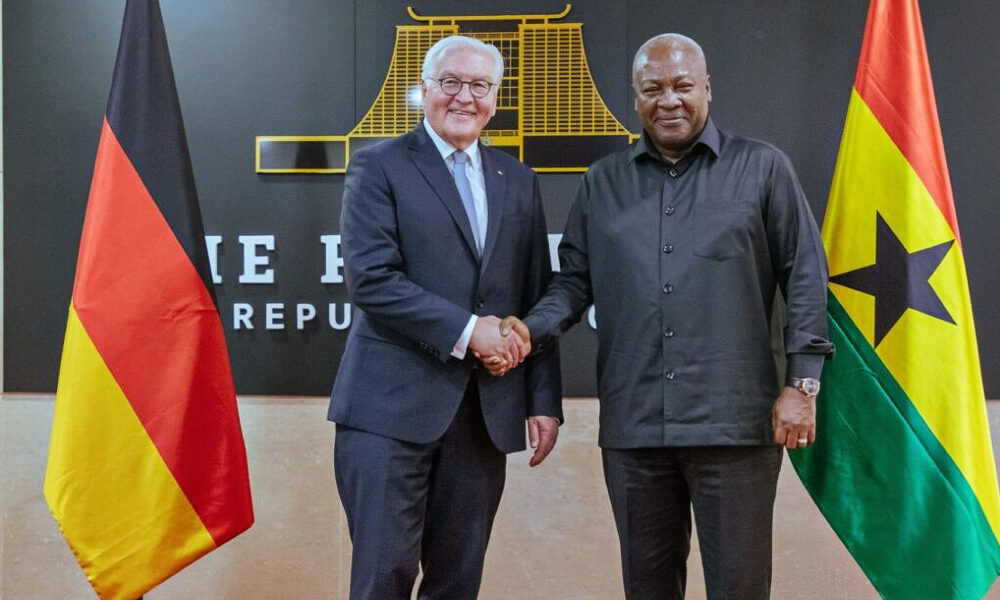
In early November 2025, German President Frank-Walter Steinmeier concluded a landmark three-day state visit to Ghana, underscoring a strategic bilateral relationship that is evolving beyond development assistance toward co-investment, technological collaboration, and mutual security interests. At a time when several African states are re-evaluating traditional Western alliances, Ghana’s partnership with Germany offers a compelling model of pragmatic, forward-looking engagement – one that could shape the contours of Europe-Africa relations in the years ahead.
A Partnership Anchored in Shared Priorities
Discussions during Steinmeier’s visit centered on four pillars: skilled migration pathways, youth employability, renewable energy, and regional security. Germany reaffirmed its confidence in Ghana’s diplomatic leadership and pledged continued support for counter-terrorism efforts in the Sahel – a critical endorsement as West African states increasingly distance themselves from former colonial powers and seek more equitable partnerships.
Concretely, Germany unveiled a new €65 million (US$75 million) funding commitment aligned with Ghana’s 2025 national priorities, adding to the €149.7 million (US$173 million) development package announced in late 2023. The fresh support targets job creation, agricultural transformation, health systems resilience, and the energy transition – areas essential to Ghana’s ambition to become a regional hub for green industrialization.
Trade figures tell a compelling story of deepening economic interdependence. In Q1 2025 alone, bilateral trade reached €180.9 million (US$209 million) – a 44 percent year-on-year increase – building on 2023’s robust flow of €252 million (US$292 million) in German exports to Ghana and €241 million (US$279 million) in Ghanaian exports to Germany. While still dominated by traditional commodities, this trade is gradually shifting toward higher-value sectors, reflecting Ghana’s push for industrial diversification and Germany’s search for reliable, ethical supply chains.
Industrial and Green Innovation Gains Momentum
German private-sector engagement is increasingly visible on the ground. Volkswagen Ghana, celebrating its fifth anniversary, has expanded its model lineup and assembly capacity – directly supporting Ghana’s auto policy and catalyzing local supply chains.
Meanwhile, in Tema, a pioneering solar-to-green-hydrogen mini-grid under the GH2GH initiative is demonstrating how decentralized, clean-energy systems can power communities and industries alike. If scaled, such pilots could position Ghana as a testbed for Africa’s green-tech leapfrogging.
Equally significant is the GIZ Skills Partnership (2023–2027), which connects Ghana and Senegal with German vocational training standards and labor-market demands. By aligning curricula with real-world needs in construction, manufacturing, and digital services, the program creates a two-way street: it eases Germany’s skilled labor shortages while equipping West African youth with globally relevant credentials and dignified employment pathways.
Strategic Minerals: Opportunity or Mirage?
Ghana’s recent designation of lithium as a strategic mineral adds a new dimension to the relationship. With the EU’s demand for critical raw materials surging – driven by its own green and digital transitions – German and European firms are eyeing investment opportunities in Ghana’s mining sector.
But this moment demands caution. To avoid repeating the extractive patterns of the past, Ghana must insist on domestic value addition: local processing, battery assembly, and technology transfer must be non-negotiable components of any mineral partnership.
The Limits of External Dependence
For all its promise, the Ghana-Germany partnership faces a structural challenge: sustainability. Overreliance on foreign capital and technical assistance – however well intentioned – risks creating fragile institutions and shallow economic linkages.
True resilience will come not from donor pledges, but from empowered Ghanaian enterprises, a dynamic private sector, and public investment in homegrown innovation.
This is especially urgent in security cooperation. While Germany’s backing of Ghana’s regional counter-terrorism role is welcome, lasting stability in West Africa cannot be outsourced.
As the African Union and ECOWAS recalibrate their security architecture, Ghana and its partners must prioritize African-led financing mechanisms and joint operational capacity – not perpetual dependence on external patrons.
The Road Ahead
Ghana and Germany are building more than a bilateral relationship; they are co-creating a template for 21st-century North-South cooperation – one grounded in mutual interest, not paternalism. Yet its ultimate test lies in whether it fuels Ghana’s own agency: Can this partnership catalyze a generation of Ghanaian engineers, clean-energy entrepreneurs, and mineral-processing firms?
Can it help turn Accra into a hub where African solutions meet global capital on African terms?
The answer will determine whether this alliance is remembered as a footnote in aid history – or as a catalyst for transformative, self-sustaining development.
Godfred Zina is a freelance journalist and an associate at DefSEC Analytics Africa, a consultancy specializing in data and risk assessments on security, politics, investment, and trade across Africa. He also serves as a contributing analyst for Riley Risk, which supports international commercial and humanitarian operations in high-risk environments. He is based in Accra, Ghana.