Opinion
From Oil Shock to Food Shock: The War That Could Redraw Global Inflation Maps


By Kelly Mua Kingsly
Before the latest escalation in the Middle East, the baseline forecasts looked manageable, if uneven. Global average food inflation was projected at around 3.2 percent.
The MENA region faced a more troubling 8.9 percent. Asia-Pacific looked relatively calm at 1 percent.
And at the extremes, Argentina was braced for 33 percent, Iran for a staggering 55 percent, while Niger, unusually, registered deflation at negative 18 percent.
Those forecasts are now historical artifacts.
A prolonged military conflict involving the United States, Israel, and NATO allies does not merely disturb inflation models. It rewrites them. The mechanisms are well understood, but their compounding effects are consistently underestimated – until the bill arrives.
War does not merely disturb inflation models. It rewrites them.
The Transmission Channels That Change the Math
The Oil Shock Multiplier
Food security and energy prices are inseparable. Modern agriculture runs on fertilizer, and fertilizer runs on natural gas.
Transport networks depend on diesel. Cold chains require electricity. When Brent crude spikes by 20 to 40 percent – as it did following the Russian invasion of Ukraine in 2022 – fertilizer costs follow with brutal efficiency.
The result is a global food inflation trajectory that no longer points toward 3.2 percent, but toward 5 to 7 percent and rising.
The Hormuz Risk Premium
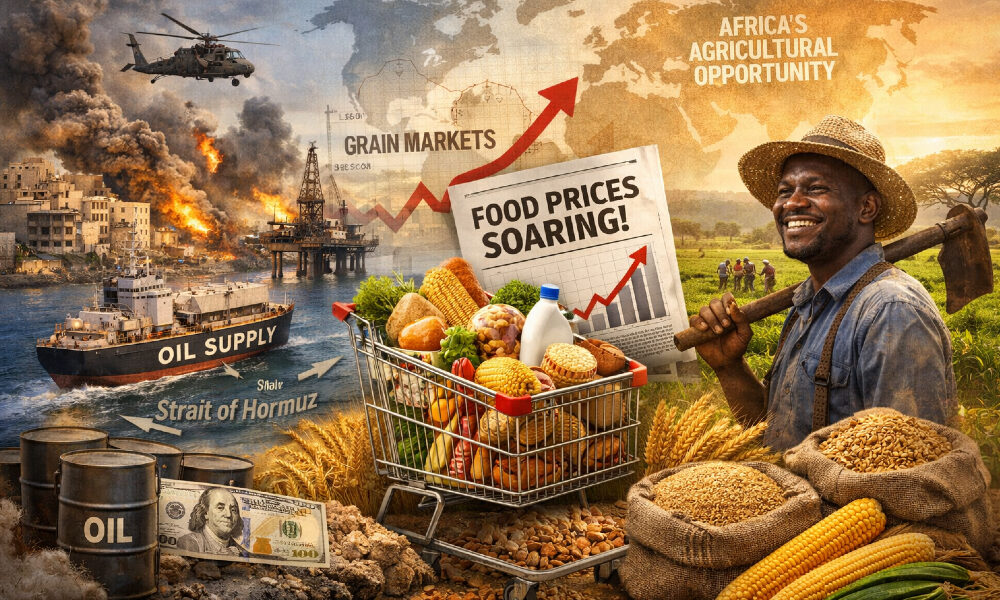
Roughly 20 percent of the world’s oil supply transits the Strait of Hormuz. Any credible disruption to that corridor – whether actual or merely threatened – sends freight insurance costs surging and delays shipping schedules across the globe.
For MENA nations already absorbing food inflation near 9 percent, the arithmetic worsens quickly. Analysts’ models suggest a plausible range of 12 to 15 percent under sustained conflict scenarios. That is not a tail risk. It is a central scenario.
Currency Volatility and Emerging Market Fragility
Conflict reliably strengthens the US dollar. For the dozens of nations whose currencies are under structural pressure, dollar appreciation is not merely a financial inconvenience – it is an inflation import mechanism.
Egypt, Lebanon, and Pakistan are among the most exposed. Iran, already at 55 percent food inflation before the current escalation, faces the prospect of that number becoming a structural floor rather than a cyclical peak.
Grain Markets and the Black Sea Effect
The Middle East does not produce the world’s grain, but it does not need to in order to move grain prices. Add a major regional conflict to the existing Eurasian supply disruption – still reverberating from the war in Ukraine – and wheat and corn futures react immediately.
The FAO Food Price Index reached record highs in 2022 for exactly this combination of reasons. History, as the saying goes, does not whisper.
Scenario Modeling: The Balance-Sheet Arithmetic
The scenario is not speculative. It is sequential. Assume oil rises 30 percent. Freight costs climb 15 percent. The US Dollar Index gains 8 points. The downstream consequences are calculable:
- Net food-importing nations across sub-Saharan Africa face an additional 4 to 6 percentage points of inflation pass-through.
- Current-account deficits widen, straining foreign exchange reserves already depleted by the post-pandemic cycle.
- Subsidy bills surge at precisely the moment that fiscal space is most constrained.
- Sovereign spreads widen by 50 to 150 basis points, raising the cost of the very borrowing needed to fund emergency relief.
This is not economic theory. It is balance-sheet arithmetic – and it has played out before.
Africa: Crisis or Strategic Inflection Point?
Here is where the analysis becomes counterintuitive. Africa imports between US$50 billion and US$70 billion in food annually, according to estimates from the African Development Bank.
It is, by that measure, acutely exposed to the dynamics described above. But it also holds approximately 60 percent of the world’s uncultivated arable land.
That is not a consolation statistic. It is a structural asset.
War-driven global food insecurity does three things simultaneously: it raises global food prices, it creates urgent demand for alternative and more stable suppliers, and it directs capital – sovereign, institutional, and private – toward food security assets. Each of those effects is an opportunity for African agriculture, if the policy architecture exists to capture it.
Africa holds 60 percent of the world’s uncultivated arable land. That is not a consolation statistic. It is a structural asset.
The continent stands at a rare leverage point. The question is whether it will be equipped to use it.
Strategic Lessons From Every Cycle
The current crisis reinforces lessons that commodity cycles have been teaching for decades, yet that policymakers repeatedly absorb too slowly.
- Food security is national security. The two cannot be disaggregated in a world where supply chains are weaponized.
- Foreign exchange buffers matter more than rhetoric. Nations with shallow reserves absorb external shocks; those without them transmit them domestically as inflation and social unrest.
- Commodity cycles reward producers and punish importers. The window to shift from one category to the other is narrow and rarely stays open long.
- Regional value chains are more durable than global dependency. Proximity and integration reduce exposure to choke points like Hormuz or the Black Sea.
What Africa Must Do – Now
The policy response required is neither novel nor complicated. It has been articulated in development frameworks for years. What has been missing is urgency. The current moment supplies that urgency in abundance.
- Accelerate the agricultural corridors envisioned under the AfCFTA framework, converting trade agreements into physical supply chains.
- Invest in domestic fertilizer manufacturing capacity, ending the self-defeating cycle of importing fertilizer to grow food for export.
- Expand irrigation infrastructure and mechanization, reducing vulnerability to rainfall variability and increasing yields on existing cultivated land.
- Structure agriculture-backed commodity bonds to attract sovereign and institutional capital into long-term food production assets.
- Hedge food import exposure through futures markets, using financial instruments that advanced economies take for granted.
- Build sovereign grain reserves to smooth the price volatility that conflict and climate alike will continue to generate.
The Forecast Has Changed. Has Strategy?
Inflation forecasts have ceased to be academic exercises. They are early warning systems – and the current warnings are unambiguous.
War shifts supply curves. Capital reallocates. Power realigns. Nations that position themselves ahead of those shifts accumulate leverage; those that react after the fact absorb costs.
The global food system is entering a period of sustained structural stress. The countries that navigate it best will not be those with the lowest baseline inflation numbers, but those with the most robust response architecture – the reserves, the production capacity, the trade connectivity, and the institutional discipline to act before the crisis fully materializes.
The numbers are moving. The question for Africa – and for every net food-importing nation watching this conflict unfold – is deceptively simple: will it remain a price-taker, or become a food price-maker?
The window is open. It will not stay that way indefinitely.
Kelly Mua Kingsly brings extensive expertise in public finance and strategic leadership. He currently serves as the Head of Finance Operations at the Ministry of Finance of Cameroon, while also holding a dual role as Project Finance Manager at the Ministry of Economy, Planning, and Regional Development, and Censor at the Central Bank of Central African States (BEAC). He has previously served as Chairperson of the Board of the African Trade & Investment Development Insurance (ATIDI) and as a Director on the Board of Quantum Blockchain Capital. Driven by a strong passion for Africa’s economic transformation, he is deeply committed to advancing the continent’s path toward industrialization.