Opinion
From Importer to Assembler: Tanzania’s Drive to Become Africa’s Next Auto Hub
A country long known for importing used vehicles now wants to make its own. The ambition is sound. The execution will decide everything.


By Des H. Rikhotso
For decades, the story of cars in East Africa has been a story of imports. Secondhand sedans arrive by the container load, trucks come ready-built from abroad, and the foreign-exchange bill grows with every shipment. Tanzania is now trying to change that story. Backed by an aggressive localization policy and a flurry of foreign investment, it is positioning itself as the region’s automotive assembly hub, with an official goal of becoming a leading African vehicle producer by 2030.
The goal is bold. The evidence that something real is underway is harder to dismiss.
A Crowded Showroom of Announcements
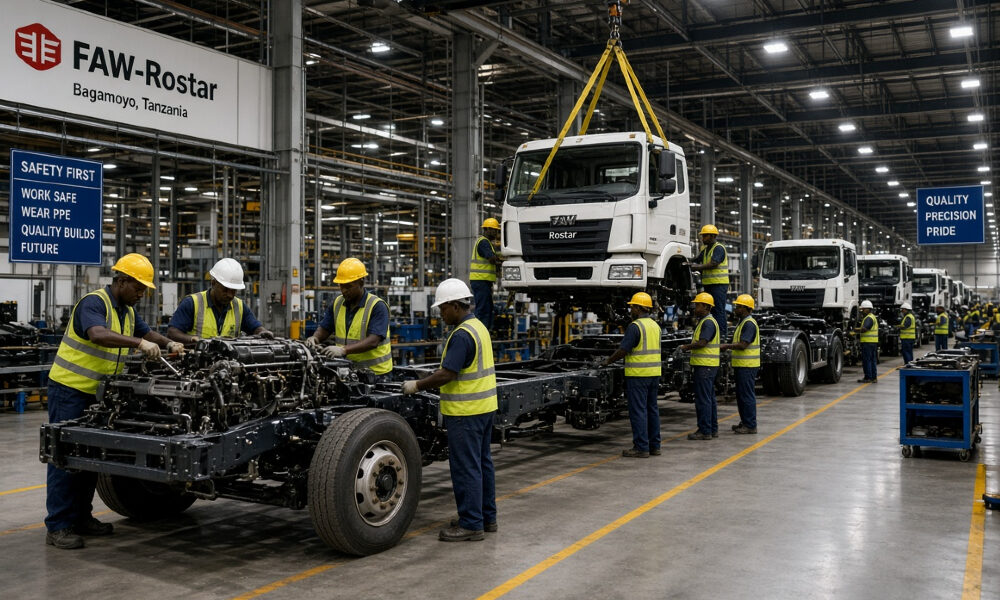
Start with the heavy end of the market. In Bagamoyo, a FAW commercial-vehicle plant has opened that is billed as East Africa’s largest, with capacity of up to 2,000 units a year. Nearby, Howo trucks, including models powered by compressed natural gas, are being assembled in Dar es Salaam. They also feature in a planned $3 billion industrial park at Bagamoyo Eco Maritime City, developed by HWTZ SEZ Limited.
Then comes the electric turn. This year Tanzania inaugurated its first electric-vehicle assembly plant, a joint venture between India’s Shakti Green Energy and the local firm Utegi Technical Enterprises, which trades as Plug & Ride. Its focus is sensible: electric motorcycles, three-wheelers and utility vehicles. These are the vehicles that move people and goods across African cities, rather than the premium models that dominate Western headlines.
BYD, the Chinese electric-vehicle giant, opened its first Tanzanian brand center in Dar es Salaam in January, introducing its Shark pickup. More interesting than the showroom is the company’s partnership with local vocational authorities to train technicians. A market for electric vehicles is built as much on mechanics who can repair them as on buyers who can afford them.
Defense is part of the picture too. In late 2025, the UAE’s Streit Group and the Tanzania Automotive Technology Centre launched an armored-vehicle facility at Kibaha, under the Nyumbu name. Tanzania now hosts roughly 13 vehicle assembly plants, including makers of complete trucks and trailers, with the Tanzania Investment and Special Economic Zones Authority (TISEZA) coordinating much of the effort.
Why Tanzania, and Why Now?
Three advantages explain the momentum.
The first is geography. Dar es Salaam and the emerging port at Bagamoyo sit at the mouth of the corridors serving East and Central Africa, including landlocked neighbors that depend on Tanzanian ports. Expanding harbors, industrial parks and cross-border transport links strengthen that position.
The second is market access. Tanzania belongs to the East African Community, the Southern African Development Community and the African Continental Free Trade Area. Together, these promise manufacturers preferential access to a continental market of more than 1.4 billion people. Investors should read that promise with care, because tariff liberalization under such agreements is phased and often subject to rules of origin. But the direction of travel favors anyone who builds locally and sells regionally.
The third is political will. Government policy openly rewards local value-addition and aims to shrink a vehicle import bill that drains scarce foreign currency. Import substitution has a mixed record across the developing world, yet in a region where cars are rarely made at all, the logic is easy to understand.
The Harder Questions
Enthusiasm should not obscure the distinction that matters most: assembly is not manufacturing. Bolting together kits shipped from abroad creates jobs and teaches skills, but it captures only a sliver of a vehicle’s value. The prize lies in local content, meaning the suppliers of seats, wiring, glass, tires and steel that grow around an assembly plant. Without them, Tanzania risks becoming a place where foreign vehicles are finished rather than a place where they are made.
Scale is a second test. A plant with a capacity of 2,000 units a year is a serious start, but not an industry. Volume, steady demand and reliable power are what turn a showpiece into a business. Skills are a third. BYD’s technician training is encouraging, and the whole sector will need more of it.
Finally, there is the risk common to every industrial policy: that announcements outrun output. Capacity on paper is not production on the factory floor, and investors will watch closely to see whether policy remains stable once the ribbon-cutting photographs fade.
Verdict
Tanzania is not yet Africa’s Detroit, or even its Tangier. But it has assembled the ingredients that matter: a strategic coastline, regional trade rights, foreign partners from China, India and the Gulf, and a government that has made vehicles a priority. If it can deepen local supply chains, train its workforce at scale and keep its promises to investors, the 2030 ambition will look less like a slogan and more like a forecast.
For a continent that has spent a century importing its mobility, that would be a change worth watching.
Des H. Rikhotso is a business commentator and C-suite executive with more than 28 years of leadership experience across Southern, East, and West Africa. He has held senior roles at BMW Group Africa, Volkswagen Group Africa, Toyota/Lexus South Africa, Nissan Group of Africa, and other leading automotive and industrial companies. Rikhotso is the recipient of South Africa’s NAAMSA Accelerator Award as the 2026 Automotive Industry Social Commentator and Influencer of the Year. He writes on business, mobility, industrial policy, and leadership in Africa and the Middle East. He holds undergraduate and postgraduate business degrees from the University of the Western Cape, Wits Business School, and the University of South Africa. He contributes opinion articles in a private professional capacity. He can be reached via email at: hdr7619@gmail.com.