Opinion
From Congo’s Cobalt to Continental Industry: Can the AfCFTA Deliver?
The DR Congo sits on the raw materials of a green industrial age. Whether the AfCFTA can turn them into continental value chains is the real test of African integration.


By Danilo Desiderio
Africa has long been good at digging things up and bad at doing anything with them. The Democratic Republic of the Congo (DR Congo) is the clearest example. It is among the continent’s largest producers of copper and cobalt, and it also holds substantial deposits of lithium, tin and coltan. In principle, these are the raw ingredients of batteries, electrical equipment, machinery and much else besides. In practice, they have mostly left the continent in their rawest form, to be turned into valuable things somewhere else.
The African Continental Free Trade Area (AfCFTA) was meant to change that. Its promise is not merely lower tariffs but a different economic geography, one in which African countries produce together rather than trade past each other. Whether that promise is kept depends less on grand declarations than on a dull and technical subject: rules of origin.
The Quiet Power of Cumulation
Rules of origin determine whether a good counts as “made in Africa” and therefore qualifies for preferential treatment. They are where free-trade agreements succeed or quietly die. The AfCFTA’s most important tool here is cumulation, set out in Article 8 of Annex 2 to the Protocol on Trade in Goods. In essence, it lets originating raw materials and semi-finished products from one member state be used in production in another and still be treated as originating where the final qualifying processing occurs, subject to the applicable rules and documentation.
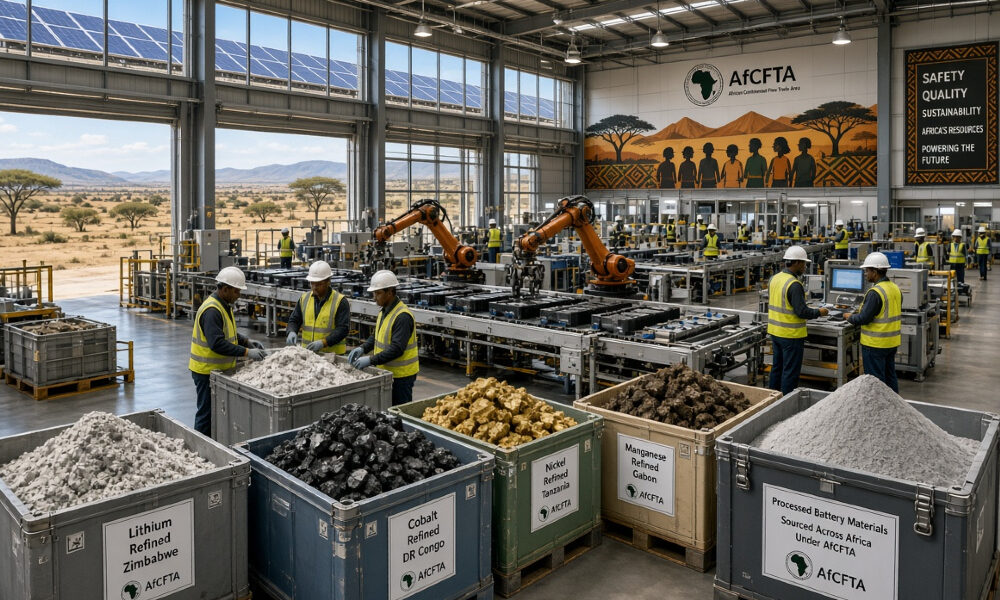
The logic is simple and powerful. No country has to source every input at home to qualify. Congolese copper and cobalt can be refined, shaped and assembled into components elsewhere on the continent, with each stage of production adding value in the country best placed to provide it. One economy supplies minerals, another refining capacity, a third engineering skill, a fourth logistics, and all of them gain access to a continental market. Cumulation, in short, turns an agreement about trading goods into a framework for making them.
The Distance Between Signing and Doing
The trouble is that a mechanism on paper is not a mechanism in operation. The DR Congo has ratified the AfCFTA, so it is not an outsider to the agreement. But the recently published Trade Policy Review report to the World Trade Organization (WTO) shows how far formal membership can sit from practical reality. It notes that the DR Congo has prepared its AfCFTA preferential tariff schedule, but that putting it into effect depends on completing the necessary regulatory and operational arrangements. Rules of origin are singled out as needing further work.
The consequence is stark. The DR Congo has not yet begun trading under the AfCFTA preferential regime, which means cumulation cannot currently work through its preferential trade with other members. A manufacturer elsewhere in Africa that wants to combine Congolese inputs with its own processing cannot yet count on the origin procedures and preferential treatment that make the arrangement commercially worthwhile. The agreement’s most valuable feature sits idle at the point where it could matter most.
This is a distinction worth dwelling on, because it is easy to miss. The problem is not exclusion. It is the gap between participation and implementation, and that gap is far harder to see, and far easier to tolerate, than a refusal to join.
What the Gap Costs
The price of delay is not merely a few missed shipments. If cumulation does not function, firms have little reason to organize production regionally. Mining companies will continue to export ore and concentrate. Manufacturers will continue to buy finished goods, or the inputs to make them, from suppliers outside Africa. The continent will carry on shipping raw materials in one direction and importing finished products in the other, a pattern that has persisted for generations and that the AfCFTA was designed to break.
The opportunity is real. Congolese minerals could anchor regional production networks, while other African economies contribute refining, component manufacturing, engineering, logistics and consumers. But markets alone will not produce this. Regional value chains do not emerge simply because tariffs fall. They emerge when firms can rely on rules that let inputs, processing and manufacturing connect across borders with confidence.
Making the Rules Real
That reliability has concrete requirements. It needs operational origin procedures that businesses can actually use, certification they can trust, customs authorities with the capacity to administer the system, and a predictable application of preferential treatment. None of this is glamorous. All of it is decisive. A rule that cannot be certified, or a preference that customs officers do not apply consistently, is worth little to an exporter deciding where to invest.
For the DR Congo, completing this work would be more than a bureaucratic housekeeping exercise. It would turn the country’s mineral wealth from a commodity into a strategic asset within a continental system, and give its neighbors a stake in its success. For the AfCFTA, it would be a test of whether the agreement can deliver on its central claim: that Africa can organize production across borders rather than merely open markets within them.
The ambition should be larger than free trade. Africa does not need only to sell to itself; it needs to build with itself. Cumulation is the mechanism that makes that possible, but only when it is switched on. Until the rules of origin work in practice, Africa will keep digging, and others will keep manufacturing.
Danilo Desiderio serves as the CEO of Desiderio Consultants Ltd in Nairobi, Kenya, specializing in African customs, trade, and transport policies and is a Senior Research Associate to the Horn Economic and Social Policy Institute (HESPI).