Opinion
From Aid to Asset Management: How Africa Must Reimagine Its Economic Future
Africa must stop approaching its future as a funding gap and begin governing it as a balance sheet. The collapse in global aid is not a crisis to be mourned – it is a clarifying moment to be seized.


By Daki Nkanyane
One of the most consequential shifts Africa must make this decade is not primarily economic. It is psychological. The continent must stop thinking of itself as a permanent recipient of outside generosity and begin governing itself as a custodian of vast, under-organized assets.
For too long, Africa has narrated its development story through the language of shortage – aid shortfalls, financing gaps, donor fatigue, concessional windows, and pledging conferences that yield promises more reliably than results. Some of those concerns are genuine. But a continent cannot build strategic maturity while defining itself exclusively through lack.
The old aid-centered framework is not simply fraying – it is collapsing. According to preliminary OECD data, official development assistance fell by 23.1 percent in 2025, the largest annual contraction on record, following an earlier decline in 2024.
This is not a temporary mood swing among donor governments. It reflects a fundamental reordering of fiscal priorities, geopolitical interests, and domestic political pressures across the world’s major economies.
That fact should not only worry Africa. It should wake it up.
The Right Lesson From a Shrinking Aid Landscape
OECD analysis published in 2025 had already projected a 9 percent to 17 percent fall in aid for that year, with bilateral ODA to sub-Saharan Africa at risk of declining by as much as 16 percent to 28 percent. UNCTAD has reinforced the warning, noting that the erosion of aid flows makes domestic resource mobilization, debt relief, and curbing illicit financial flows not merely desirable but urgently necessary.
Africa must therefore draw the right lesson from this moment. The lesson is not that aid is harmful. It is that aid is insufficient – and, more fundamentally, that no civilization should construct its long-term theory of progress on a financing mechanism it does not control.
Aid has played, and in some contexts still plays, an important role in humanitarian response, public health, institutional capacity-building, and fragile-state stabilization. But it was never designed to become the organizing philosophy of a continent’s development ambitions.
Once that happens, development degenerates into a politics of petition. Governments begin designing for fundability rather than for sovereignty.
Institutions measure success by access to external support rather than by their capacity to mobilize internal strength. Public discourse becomes fluent in appeals but thin on stewardship.
That is how dependency survives even inside modern policy vocabulary.
Ungoverned Assets, Not Absent Resources
The real challenge facing Africa is bigger than diminishing aid flows. It is the failure to fully recognize, value, organize, and deploy African assets.
Those assets extend far beyond what sits in a sovereign wealth fund or central bank reserve. They encompass land, minerals, energy potential, water systems, public balance sheets, pension pools, insurance assets, remittance flows, state-owned enterprises, telecom infrastructure, development finance institutions, logistics corridors, urban land value, biodiversity, data, diaspora networks, and the productive potential of one of the world’s youngest populations.
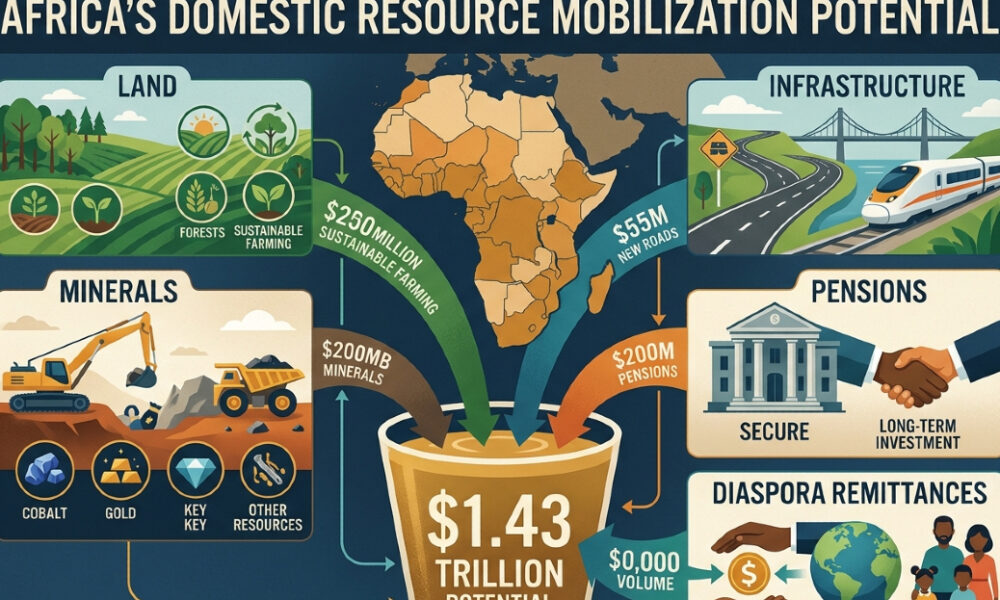
The African Development Bank’s 2025 outlook estimates that, with deep and properly sequenced reforms, Africa could mobilize an additional US$1.43 trillion in domestic resources from its own diverse asset base. That number should fundamentally change the tone of the development debate.
A continent that can plausibly unlock capital on that scale cannot continue speaking as though its future depends primarily on what others decide to spare. The more urgent question is not “Who will fund Africa?” but “How is Africa governing what it already has?”
Aid Thinking vs. Asset Thinking: A Critical Distinction
The difference between aid thinking and asset thinking is profound. Aid thinking begins with deficiency; asset thinking begins with stewardship.
Aid thinking asks how to close a gap; asset thinking asks how to organize value. Aid thinking tends to be short-cycle, programmatic, and externally legible; asset thinking is long-horizon, institutional, and intergenerational.
Aid thinking trains political systems to manage inflows; asset thinking forces societies to manage themselves.
The language of asset management matters precisely because it reframes prosperity as the product of disciplined custodianship rather than fortunate inflows. A serious nation does not merely possess resources – it manages them across time.
It does not simply celebrate its endowments – it structures them. It does not treat every revenue stream as an invitation to immediate consumption. It converts portions of today’s value into tomorrow’s capability.
Too many African states have not yet done this at sufficient scale.
The contrast is instructive. A country can earn substantially from commodities and still fail to build durable strategic assets.
It can borrow heavily for infrastructure and still fail to generate the productivity gains necessary to service that debt comfortably. It can receive significant donor support and still leave domestic tax systems weak, public procurement porous, and national savings under-mobilized.
It can speak endlessly about development while quietly allowing its most valuable assets to leak through undervaluation, corruption, capital flight, opaque contracting, and institutional decay.
This is why the aid debate remains incomplete unless joined to the governance debate. UNCTAD’s 2025 Trade and Development Report is direct on the broader principle: developing countries cannot meet their minimum investment needs through unstable or inadequate external flows alone, and economic resilience begins with domestic resource mobilization.
The same report warns that cuts in official development assistance will hit the most vulnerable African economies hardest.
Four Mindset Shifts Africa Must Make
Africa must build a development model that treats aid as supplementary, not foundational. Achieving that requires at least four fundamental shifts in mindset.
1. From Revenue to Assets
Governments must stop seeing every inflow primarily as fiscal breathing room and start viewing portions of it as convertible into long-term national strength. Commodity earnings, public land, infrastructure networks, pension pools, and state enterprise reform should all be evaluated through a balance-sheet lens.
The governing question should be: what can be preserved, leveraged, capitalized, or repositioned into productive systems rather than absorbed by administrative expenditure?
2. From Donor Dependence to Domestic Resource Seriousness
This is not a simplistic call for higher taxes alone. It is a broader imperative for credible tax administration, improved state capacity, reduced leakage, stronger customs systems, deeper local capital markets, and more intelligent deployment of institutional savings.
It is also a call to confront illicit financial flows and underpriced resource extraction far more aggressively. A continent cannot credibly cry scarcity in public while tolerating leakage in private. UNCTAD’s 2025 analysis explicitly identifies domestic resource mobilization and curbing illicit financial flows as central priorities in a world of dwindling aid.
3. From Consumption Logic to Intergenerational Logic
A society that spends every windfall as though history concludes with the current administration is not governing assets – it is liquidating them. Sovereign wealth thinking matters here, not merely in countries with large oil revenues, but as a broader governing philosophy: temporary earnings should be deployed to build permanent capability. The guiding question should always be what remains after the revenue moment passes.
4. From External Validation to Internal Valuation
Too often, African assets are not fully recognized or respected until they are priced, financed, or certified by outside parties. That psychology is strategically disastrous.
A continent that does not know how to value its own land, data, minerals, urban expansion, pension base, strategic corridors, and demographic potential will consistently undersell itself in negotiations and underbuild itself in policy.
Remittances and the Diaspora as Strategic Assets
Remittances also deserve reframing in this context. They are widely discussed as household support mechanisms, which they are. But they are also part of Africa’s wider asset landscape.
The World Bank projected global remittance flows to low- and middle-income countries at US$690 billion in 2025, underscoring the growing significance of diaspora-linked financial flows. Africa cannot continue to treat its diaspora solely as a sentimental community abroad.
It must increasingly recognize it as part of a broader network of capital, skills, trust, and market linkage – one that can be better structured into development finance, enterprise growth, and long-term national projects.
Institutions Must Make the Metaphor Real
Asset management is not a useful metaphor unless institutions make it operational. That requires finance ministries with stronger analytical capacity; development banks that do more than patch fiscal holes; public investment systems that link expenditure to productive returns; pension regulation that protects savers while enabling appropriate long-term developmental allocation; and sovereign balance-sheet thinking that can identify dormant value and govern it responsibly.
It also requires better project preparation, more transparent concessions, stronger land governance, deeper local-currency capital markets, and public leadership capable of distinguishing between spending money and compounding it. This is painstaking, unglamorous work. It is also the work of sovereignty.
Because sovereignty is not only a flag, a vote at the United Nations, or a speech about dignity. Sovereignty is the ability to govern national assets in a manner that reduces strategic dependence over time – converting endowment into leverage, leverage into production, production into resilience, and resilience into genuine freedom of action.
A Civilizational Balance-Sheet Question
Africa is not merely underfunded. It is under-structured. The continent is not simply waiting on external support. In too many places, it is still learning to see itself as a holder of assets that must be governed with discipline.
This is not a development case to be managed by outsiders. It is a civilizational balance-sheet question to be answered from within.
What does Africa own? What does it undervalue? What does it waste? What does it fail to compound? What does it allow others to structure on its behalf? And what would change if the continent finally managed its inheritance with strategic coherence? These are the questions that belong to maturity – and to power.
The future of Africa cannot rest on the moral weather of donor countries, nor on the fluctuating generosity of systems under their own fiscal pressure. It must rest, increasingly, on the continent’s capacity to recognize that wealth is not only what comes in. It is what is governed well.
Conclusion: The Discipline of Building
The shift from aid to asset management is more than a financial recalibration. It is a change in posture, in tone, and in self-understanding. A continent that sees itself primarily as a funding gap will keep negotiating from weakness. A continent that sees itself as the steward of vast, under-organized assets can begin, at last, to negotiate from maturity.
What Africa needs now is not the humility of perpetual appeal but the discipline of deliberate construction. Not the drama of shortage, but the intelligence of stewardship. Not a future financed primarily through petition, but a future governed through assets, institutions, and time.
That is how dependency begins to break. And that is how a continent stops asking to be developed – and starts managing its own rise.
Daki Nkanyane is a South African – born Pan-African thought leader, entrepreneur, keynote speaker, and strategist with over 25 years of experience driving innovation, identity, and development across Africa. He is the Founder & CEO of Interflex Capital, AfrisoftLive, QonnectedAfrica, and iThinkAfrica, where he focuses on youth empowerment, entrepreneurial ecosystems, and Africa’s economic and ideological renewal. His work spans technology, digital transformation, major international events, and strategic advisory for future-ready African institutions. As a contributing writer for The Habari Network, Daki covers African innovation, leadership, human capital, economics, entrepreneurship, and Africa–Caribbean relations through cultural, philosophical, and developmental perspectives. His mission is to help shape a new African consciousness rooted in pride, possibility, and self-determination for Africans on the continent and in the diaspora. He can also be reached on Facebook and X.