Owusu on Africa
Free Trade, Terrorism, and Trafficking: Can West Africa Manage the Balance?


By Fidel Amakye Owusu
In mid-2022, West African heads of state made a pragmatic, if uncomfortable, concession. The Economic Community of West African States (ECOWAS) lifted the economic and diplomatic sanctions it had imposed on Mali and Burkina Faso following military coups in both capitals – coups that had brazenly violated the bloc’s cardinal rules on democratic governance.
The relief was not born of principle. ECOWAS acknowledged what observers had long argued: the sanctions were failing to squeeze the juntas while succeeding, quite effectively, at punishing ordinary citizens. Worse still, in a region hemorrhaging from jihadist violence, the isolation of two already fragile states was making a catastrophic security situation markedly worse.
Yet the sanctions saga was merely the loudest symptom of a far deeper malaise. Beneath the diplomatic maneuvering lies a structural crisis that threatens to unravel one of Africa’s most ambitious economic experiments before it has had a genuine chance to prove itself.
The Promise – and Peril – of Open Borders
When the African Continental Free Trade Area (AfCFTA) took effect in 2019, it carried with it the ambitions of a continent long criticized for erecting barriers to internal commerce. The theory was sound: remove tariffs, open borders, and allow the free movement of goods, services, and – eventually – people.
For a region dominated by landlocked states deeply dependent on coastal neighbors for economic survival, the stakes could scarcely be higher.
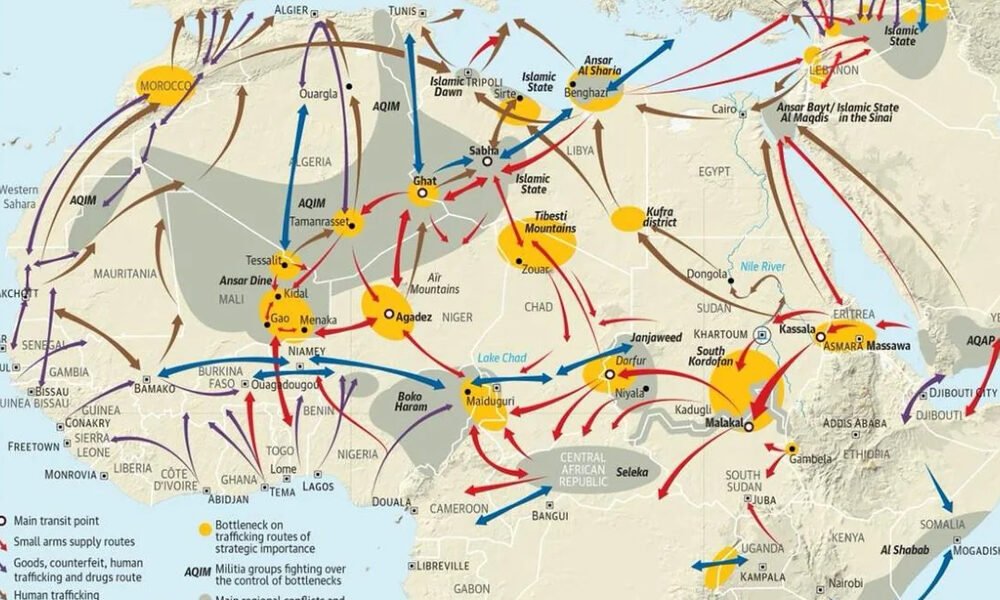
But freedom of movement cuts both ways. The same porous borders that allow traders to move groundnuts and textiles also allow jihadists to move weapons and cash.
Reports on terror financing, arms trafficking, and other transnational crimes consistently identify compromised entry points and understaffed border crossings as primary vulnerabilities. In a region where security services are chronically underfunded and sometimes complicit, the infrastructure for detecting illicit flows simply does not exist at scale.
An Unequal Partnership, Made More Unequal by Conflict
The economic relationship between landlocked and littoral states in West Africa has never been a partnership of equals. Trade data from 2021 renders this imbalance in stark relief.
Ghana’s exports to Burkina Faso were valued at US$276 million that year; Burkina’s exports to Ghana amounted to just US$50 million. Côte d’Ivoire (Ivory Coast) sent US$398 million worth of goods to Burkina Faso, receiving US$182 million in return.
Most striking of all, Senegal earned more than US$1 billion from exports to landlocked Mali, while Mali’s reciprocal exports were a fraction of that figure.
These numbers reflect structural disadvantages that predate the current security crisis. Landlocked countries lack direct access to international shipping lanes, driving up costs for both imports and exports.
Their export bases tend to be narrower, their infrastructure weaker, and their negotiating leverage with coastal partners limited. The AfCFTA was supposed to begin correcting these distortions. Instead, the securitization of West Africa’s borders risks cementing them.
The Hard Border Trap
The logic of tighter border controls is intuitive. If arms and terror financing are flowing freely across frontiers, the remedy appears obvious: reinforce those frontiers.
Yet this approach carries a ruinous side effect for precisely the countries most afflicted by insecurity. A hardened border regime between, say, Burkina Faso and its littoral neighbors would not merely slow the movement of weapons – it would also throttle the commerce upon which Burkina’s economy depends.
For states already weakened by displacement, capital flight, and the collapse of agricultural activity in conflict zones, further economic contraction could prove catastrophic.
Herein lies the trap: the security measures most likely to impede terrorist logistics are also the measures most likely to deepen the poverty and state fragility that terrorism exploits. A government that cannot pay its civil servants or deliver basic services to remote communities creates precisely the conditions in which jihadist recruiters thrive.
Technology, Not Just Troops
The false choice between open borders and secure ones must be rejected. Regional governments, in partnership with international donors and development institutions, must invest urgently in the technologies and institutional mechanisms that can separate legitimate trade flows from illicit ones.
Advanced cargo scanning equipment, biometric traveler tracking, shared intelligence databases, and coordinated customs protocols are not luxuries – they are prerequisites for a West Africa that can simultaneously honor its free trade commitments and deny terrorists the freedom of movement they currently enjoy.
ECOWAS has shown, through its handling of the Mali and Burkina Faso sanctions, that it is capable of pragmatic recalibration when doctrine collides with reality. It must demonstrate that same pragmatism now, before the continent’s most consequential trade agreement becomes a casualty of the very insecurity it was designed, in part, to help overcome.
The stakes are not merely economic. They are existential.
Fidel Amakye Owusu is an International Relations and Security Analyst. He is an Associate at the Conflict Research Consortium for Africa and has previously hosted an International Affairs program with the Ghana Broadcasting Corporation (GBC). He is passionate about Diplomacy and realizing Africa’s global potential and how the continent should be viewed as part of the global collective.