A Diaspora View of Africa
France Trying to Reengage Africa, Part 2


By Gregory Simpkins
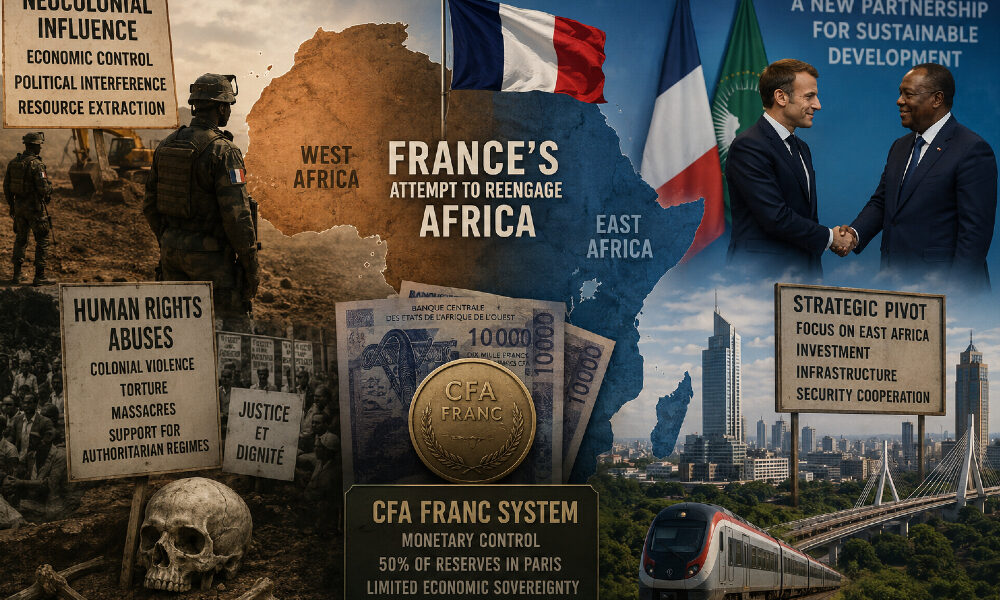
In Part 1 of this two-part presentation on France in Africa, I discussed how France’s problems in West Africa and the Sahel had propelled them to attempt engagement in East Africa. At the outset, I want to say I bear no ill will toward the French people, but over time, French governments have exerted undue control over Africa nations and engaged in human rights atrocities that have alienated many on the continent, especially in West Africa.
During my work in Africa, I witnessed French neocolonial control first hand. In Guinea, officials for that government told me that when France promised a new phone system, they just repainted phones and maintained international service routed through France no matter the ultimate destination of the calls.
In Mali, during discussions with the Bank of Africa concerning Mali’s full participation in the African Growth and Opportunity Act (AGOA), the bank manager excused himself to go consult with someone not in the room. My delegation found out later that he went to receive input on the matter with a French representative.
Perhaps the most significant sore point for African nations vis-à-vis France is the CFA franc operating account system, part of the Franc Zone monetary cooperation between France and 14 African countries. It was created in 1945 and reformed in 2019 for West Africa.
There are two currencies, both called the CFA franc:
- West African CFA franc (XOF): Used by Benin, Burkina Faso, Côte d’Ivoire (Ivory Coast), Guinea-Bissau, Mali, Niger, Senegal and Togo. Issued by the Central Bank of West African States (BCEAO).
- Central African CFA franc (XAF): Used by Cameroon, Central African Republic (CAR), Chad, Republic of Congo, Equatorial Guinea and Gabon. Issued by the Bank of Central African States (BEAC).
Both are pegged to the euro at 1 euro = 655.957 CFA francs.
How France Leveraged the CFA System to Control African Monetary Policy
Under the rules prior to 2019, the BCEAO and BEAC were required to deposit 50 percent of their foreign exchange reserves into a special operating account held at the French Treasury in Paris. From 1973-2005 it was 65 percent; immediately after independence it was 100 percent. France held de facto veto on monetary policy.
In exchange for the deposit, the French Treasury promised unlimited convertibility of CFA francs into euros. If a central bank ran out of foreign reserves, France would lend euros to it so the fixed peg could be maintained and capital transfers wouldn’t be blocked. Thus, France acted like a “private International Monetary Fund” for the African central banks.
France wielded its veto power over disbursements through French officials sitting on the boards of both central banks. Since BCEAO’s 2010 reform, the French representative is a voting member of the monetary policy committee.
Foreign exchange reserves had to exceed money in circulation by at least 20 percent. An individual state or economic agent cannot directly ask the French Treasury to convert CFA to euros – only the central banks can.
Critics say depositing reserves in Paris has deprived Francophone countries of much-needed capital that could be used for development projects.
France has now abolished the obligation to centralize 50 percent of reserves at the French Treasury. BCEAO can now hold reserves where it chooses. France withdrew from the governance bodies of the BCEAO. There is no more French governance voting member.
BEAC countries have not adopted these reforms yet. The 50 percent deposit rule and French board participation still apply there as of 2026.
As of 2026, the UEMOA operating account has been closed, and the 50 percent reserve deposit rule has been abolished. France is no longer involved in BCEAO governance, but the euro peg and convertibility guarantee remain in place.
In contrast, the Economic and Monetary Community of Central Africa (CEMAC) still operates under the old system, with 50 percent of reserves held at the French Treasury and a French representative on the board.
The name change from CFA to ECO is considered a cosmetic change since the peg to the Euro and the guarantee from Paris remain.
While these financial reforms are at least a good start in reversing decades of French economic domination of Francophone countries, they seem to be too little, too late to salvage the French reputation in West Africa. Their best hope is that governments in East Africa ignore French history in Africa because there aren’t the connections between African officials and French government leaders in the East as there were in the West.
France’s Cozy Relations with West African Leaders
The greatest benefits France has derived in Africa come from Niger’s uranium, the CFA franc’s monetary influence, oil in Gabon and the Republic of the Congo (Brazzaville), and military bases in Djibouti and Senegal. These gains were built on long-standing relationships between French presidents and ministers and African heads of state who supported French economic and security interests.
The relationship between French leaders and successive Nigerien presidents – Hamani Diori, Seyni Kountché, Ali Saïbou, and Mamadou Tandja – resulted in France’s nuclear power program obtaining approximately one-third of its uranium from Niger. The state company Orano (formerly COGEMA) has mined uranium at Arlit and Akokan since the 1970s under concession deals.
Because Niger used the CFA franc and maintained defense pacts with France, these contracts remained in French hands even after independence. This arrangement provided France with energy security at Niger’s expense.
French presidents from Charles De Gaulle to Jacques Chirac and Gabon’s Omar Bongo (1967-2009) and Congo’s Denis Sassou-Nguesso have allowed French companies Elf, Total and Bolloré to get privileged access to oil, manganese and timber. During the 42 years that Bongo was a key French ally, France provided military security and political backing. Elf became a major oil player globally thanks to African concessions.
Successive French presidents, along with the leaders of Senegal, Ivory Coast, Djibouti, Gabon, and Chad, permitted France to maintain military bases in Dakar, Abidjan, Djibouti, Libreville, and N’Djamena. This arrangement enabled France to project power quickly across Africa and the Middle East, secure shipping lanes – especially through Djibouti near Bab al-Mandrab – and intervene militarily without UN approval.
Between 1960 and 2010, France conducted more than 50 interventions, including Opération Manta in Chad in 1983.
Djibouti is still France’s largest base in Africa. It’s rented by France for approximately the equivalent of US$30 million a year and gives France a permanent foothold at a global chokepoint. Unfortunately for France, they have no such cozy relationships in Africa’s eastern region.
French Human Rights Abuses in Africa
In addition to the economic domination issue and the absent relationships in East Africa, to establish viable relations in that region, France must overcome a horrid human rights record built over centuries. France’s record in Africa includes several episodes widely documented as human rights violations.
These span the colonial period, post-independence interventions, and more recent counterterrorism operations.
Algeria 1830-1962
- “Pacification” campaigns: The French military used collective punishment, mass displacement and destruction of villages during conquest.
- Algerian War 1954-1962: An estimated 300,000-1.5 million Algerians were killed. Documented abuses include torture at centers like Villa Sésini, summary executions, “disappearances” and internment of as many as two million Algerians in resettlement camps. The Paris massacre of October 17, 1961 saw French police kill dozens of Algerian protesters; bodies were dumped in the Seine River.
- Nuclear tests in the Sahara 1960-1966: There were four atmospheric and 13 underground nuclear tests at Reggane and at In Ekker. Local populations and French conscripts were exposed to radiation without adequate protection or warning.
Madagascar 1947-1948 Uprising
Due to the French military suppression of the Malagasy uprising, estimates range from 11,000 to 100,000 Malagasy killed. Mass executions, aerial bombardment of villages and the use of napalm were documented.
Cameroon 1950s-1960s
French and French-backed Cameroonian government forces fought the Cameroonian Peoples Union independence movement. Tactics included concentration camps, collective punishment of villages suspected of supporting rebels and mass killings. Estimates of deaths range from 10,000 to 200,000.
West Africa conscription and forced labor
Colonial “indigénat” code allowed forced labor, arbitrary arrests and corporal punishment. Conscription for WWI/WWII led to high death rates.
“Françafrique” support for authoritarian regimes
France maintained defense agreements with post-colonial leaders and intervened militarily more than 50 times between 1960-2010 under Opération Manta, Épervier, etc. Critics argue this propped up autocratic governments in Gabon, Togo, Chad and the Central African Republic that committed abuses against political opponents.
Rwanda 1994 Genocide
France’s role remains contested. France backed the regime of Juvénal Habyarimana and intervened via Opération Turquoise in 1994. A French parliamentary commission in 1998 and Mucyo Commission in Rwanda accused France of training and arming Hutu extremist forces before the genocide.
French courts have investigated French officers for complicity. France denies direct responsibility for the genocide but acknowledged “grave errors of judgment” by President Emmanuel Macron in 2021.
If France is to succeed in its East African engagement, they must hope that West African experiences will be put aside when considering relationships with France. However, the more immediate complication would be France’s inability to follow through on economic promises.
France’s finances are under pressure from a 115 percent of GDP debt and greater than 5 percent deficits. Ending the 50 percent deposit rule for West Africa in 2019 didn’t worsen that – the deposits weren’t French money to begin with. The bigger fiscal risks for France now are interest payments and weak growth, not African reserve deposits.
Can France reposition itself in Africa? The odds seem against that succeeding, but it depends on whether East African governments think what happened to their West African counterparts over the years won’t be replicated and that France can indeed provide the promised financial help needed for their further development.
Gregory Simpkins, a longtime specialist in African policy development, is the Principal of 21st Century Solutions. He consults with organizations on African policy issues generally, especially in relating to the U.S. Government. He further acts as a consultant to the African Merchants Association, where he advises the Association in its efforts to stimulate an increase in trade between several hundred African Diaspora small and medium enterprises and their African partners.