News
Former Liberia president Charles Taylor guilty of war crimes
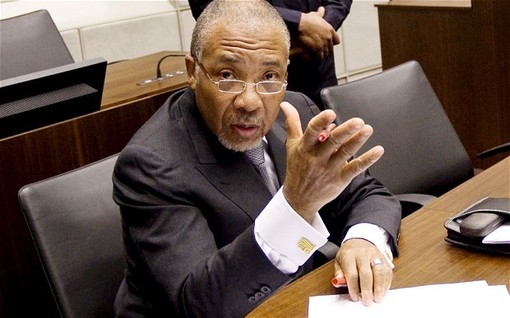

Former Liberia President Charles Taylor. PHOTO/AFP
In a historic ruling, an international court convicted former Liberian President Charles Taylor on Thursday of aiding and abetting war crimes and crimes against humanity for supporting notoriously brutal rebels in neighboring Sierra Leone in return for blood diamonds.
Mr. Taylor is the first head of state convicted by an international court since the post-World War II Nuremberg military tribunal.
Presiding Judge Richard Lussick said the 64-year-old warlord-turned-president provided arms, ammunition, communications equipment and planning to rebels responsible for countless atrocities in the 1991-2002 Sierra Leone civil war. Judge Lussick called the support “sustained and significant.”
“Mr. Taylor, the trial chamber unanimously finds you guilty” of 11 charges including terror, murder, rape and conscripting child soldiers, Judge Lussick told Mr. Taylor.
Mr. Taylor stood and showed no emotion as Judge Lussick delivered the guilty verdicts at the Special Court for Sierra Leone. Judge Lussick scheduled a sentencing hearing for May 16 and said sentence would be passed two weeks later. Mr. Taylor will serve his sentence in Britain.
Human rights activists hailed the convictions as a watershed moment in the fight against impunity for national leaders responsible for atrocities.
“Taylor’s conviction sends a powerful message that even those in the highest level positions can be held to account for grave crimes,” said Elise Keppler of Human Rights Watch. “Not since Nuremberg has an international or hybrid war crimes court issued a judgment against a current or former head of state. This is a victory for Sierra Leonean victims, and all those seeking justice when the worst abuses are committed.”
“Sierra Leone and other countries in West Africa have been devastated by horrific human rights abuses. Justice for the worst crimes is a way to bring a new era in Sierra Leone and West Africa and promote a human rights-respecting order,” she said.
Mr. Taylor had pleaded not guilty to all counts, claiming in seven months of testimony in his own defense that he was a statesman and peacemaker in West Africa.
While judges convicted him of aiding and abetting atrocities by rebels, they cleared him of direct command responsibility, saying he had no direct control over the rebels he supported.
Former Ivory Coast President Laurent Gbagbo is also jailed in The Hague awaiting trial at the International Criminal Court on charges of war crimes and crimes against humanity allegedly committed as he attempted to cling to power last year after losing a presidential election.
The same court also has indicted Sudan’s President Omar al-Bashir on charges including genocide for his regime’s brutal crackdown on rebels in Darfur. Mr. al-Bashir remains at large in his country, which does not recognize the ICC.
The verdicts – whatever they are – will be a watershed moment for international justice. The only other head of state convicted by an international tribunal was Karl Doenitz, a naval officer who briefly led Germany after Adolf Hitler’s suicide, and who faced justice at Nuremberg.
Ex-Yugoslav President Slobodan Milosevic was tried at the Yugoslav war crimes tribunal for fomenting the Balkan wars of the 1990s, but he suffered a fatal heart attack in his cell before the case reached a conclusion. Prosecutors at the same court are close to wrapping up their case against former Bosnian Serb leader Radovan Karadzic, accused of masterminding atrocities including genocide during Bosnia’s 1992-95 war.
The ICC last year indicted Libyan dictator Muammar Gadhafi with crimes against humanity as he resorted to murdering and persecuting civilians to put down protests against his regime, but he was captured and killed by rebel fighters before he could face a court of law.
Mr. Taylor – who once received military training from Gadhafi’s regime – was indicted in 2003 on charges including murder, terrorizing civilians, rape, sexual slavery, and recruiting and using child soldiers during the Sierra Leone war that ended in 2002 after costing more than 50,000 lives. He was arrested in 2006 and flown to The Hague for trial.
Mr. Taylor’s is the final major trial at the Special Court for Sierra Leone, which has already convicted eight other rebel leaders.
The court’s headquarters and courtroom are in the capital, Freetown, but Mr. Taylor’s case was moved to The Hague after the UN Security Council voiced fears trying him in Sierra Leone could destabilize the West Africa region.
Jabati Mambu, whose right hand was hacked off by rebels more than 13 years ago attended the start of the trial and can’t wait for its conclusion.
“The trial is very important to all victims because it will help to heal our wounds,” he told The Associated Press in Freetown, the Sierra Leone capital where he lost his hand.
Copyright 2012 The Associated Press