Opinion
Foreword: The Habari Journal
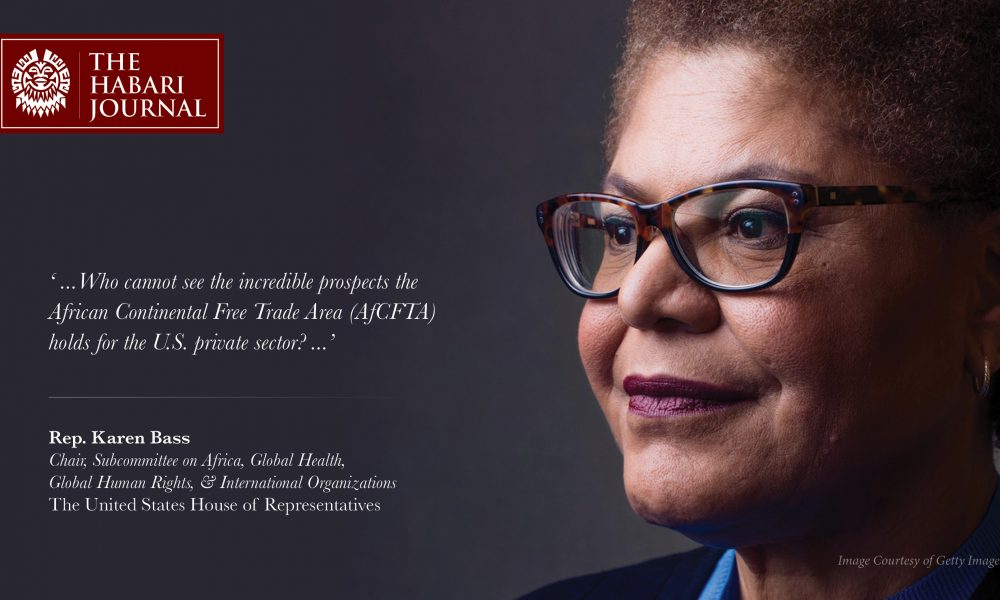
By Representative Karen Bass
Chair, Subcommittee on Africa, Global Health, Global Human Rights & International Organizations The United States House of Representatives
Over the past decade, several synergies in Africa and in the United States have set the stage for a genuinely transformational partnership between two natural allies. First, while challenges still exist, no one can deny the impact of rapid technological adoption, even faster rural-urbanization, and growing consumer class in Africa. Evidenced by improvements in the global Doing Business indices, institutional quality and liberal democracy seem to have taken a stronghold in parts of Africa. In the United States, incremental changes have led to positive results from Millennium Challenge Corporation (MCC), Feed the Future, Power Africa, and even the public and private partnerships that advocated for a more effective African Growth and Opportunity Act (AGOA).
But what gives me this strong sense of optimism is the effective amalgamation of the Overseas Private Investment Corporation (OPIC) and USAID’s Development Credit Authority (DCA) into the United States International Development Finance Corporation (DFC).
In the DFC, the U.S. took on a more proactive role in development finance, further levelling a playing field where the U.S. private sector can extend the benefits of liberal democracy. With double the resources OPIC had, DFC can do so much good in, transforming the way America does business on the continent. One of the things I will be looking to see is the impact of DFC’s equity in certain critical African sectors & institutions. Research shows that taking selective equity positions or stakes could unleash U.S. financial muscle on multi-generational challenges like the cost of borrowing in Africa.
To return to synergies, who cannot see the incredible prospects the African Continental Free Trade Area (AfCFTA) holds for the U.S. private sector? Aside from being the world’s largest free trade area by participating countries since the WTO was established, the AfCFTA is also a chance to resolve debilitating cross-border trade issues over 54 African countries. With centuries of expertise & experience at designing trade facilitation infrastructure, we should know that investments such as these are lucrative. Similarly, by infusing resources into African infrastructure, we should help reduce a significant gap in infrastructure funding. Most of all, if we help resolve these technical barriers to trade, we shall have bolstered intra-African trade. On its own, intra-African trade holds numerous prospects for U.S. firms that can take advantage of the AfCFTA origin rules.
Over the next four years, I pledge to work tirelessly on championing various Africa causes in the United States and beyond. The United States and Africa are natural allies, and positive trends on the continent are too bright to ignore. My colleagues in the House and Senate are ready to do their part. The Biden Administration has already sent the right sort of signals. All that remains is for the U.S. private sector to make their move. And mark you, their move on many of their Africa initiatives and ventures should be much smoother if undertaken side-by-side with the African diaspora.
_____________________________
About Representative Bass
Congressmember Karen Bass was re-elected to her sixth term representing the 37th Congressional District in November 2020. Congressmember Bass serves on the House Committee on Foreign Affairs where she is the Chair of the Subcommittee on Africa, Global Health, and Global Human Rights. She also serves on the House Judiciary Subcommittee on Crime and Terrorism, where she is active in working to craft sound criminal justice reform policies.
Congressmember Bass served as the Chair of the Congressional Black Caucus in 2019 and 2020. During her tenure, the Congressional Black Caucus worked with the Congressional Hispanic, Asian Pacific Islander, and Native American Caucuses to demand a targeted response to the COVID-19 pandemic and initiate a national needs assessment for communities of color. She also introduced the George Floyd Justice in Policing Act – the most transformative piece of policing legislation to ever pass in a chamber of Congress. (You can read more about what the Congressional Black Caucus accomplished under her chairship here.)
To download this feature, click here
To download The Habari Journal – Vol. 5, Issue 1, click here