Opinion
Feeding Africa: The Continent’s Culinary Paradox and Agricultural Opportunity
Africa doesn’t have a farming problem. It has a value-chain problem – and that distinction is worth a fortune to whoever solves it first.


By Ashish Muley
Ask most people why Africa imports so much food, and they will point to bad harvests, drought, or a lack of arable land. They would be wrong. The continent holds roughly 60 percent of the world’s uncultivated arable land, yet many of its fastest-growing economies remain structurally dependent on imported rice, wheat, sugar, and cooking oil. The story isn’t one of scarcity. It’s one of broken supply chains – and for governments, investors, and agribusinesses willing to look closely, that gap is not a crisis. It’s an opportunity hiding in plain sight.
A close look at two regions – East Africa and West Africa – makes the pattern impossible to miss.
East Africa: A Region Divided Against Itself
East Africa isn’t a single food market; it’s a patchwork of surplus and shortage sitting side by side. Ethiopia and the Horn of Africa, Kenya, Tanzania, Uganda, Rwanda, Burundi, and South Sudan each consume, produce, and import food at wildly different rates – and that unevenness is precisely why the region’s biggest opportunity is trade within itself, not just imports from outside.
Take maize. The region as a whole can produce a surplus, yet individual countries swing between glut and shortfall. In the first quarter of 2024 alone, roughly 252,000 metric tons of maize changed hands across East Africa. Uganda supplied 89 percent of it. Kenya absorbed 87 percent, according to data from FEWS NET. That’s not a production failure – it’s a logistics and trade failure, and it’s fixable.
Rice tells a starker story. Eastern Africa imports about 2.7 million metric tons a year, roughly 58 percent of everything the region eats, according to the Alliance for a Green Revolution in Africa (AGRA). Wheat is worse still: the region imports 70 to 80 percent of its needs, a dependence so entrenched that the East African Community’s most recent food-security assessment singles out wheat and edible oils as commodities facing chronic, structural production deficits. Sugar sits in the same category – a staple the region consumes far more of than it grows, creating a standing invitation for anyone willing to invest in processing and production closer to home.
Who fills these gaps? International heavyweights – India, Pakistan, Thailand, Russia, Ukraine, Indonesia, and Malaysia – compete for market share. But the more interesting trend is quieter: African countries increasingly selling to each other, moving surplus maize, sugar, and produce from where it’s grown to where it’s needed. That intra-African trade, still underdeveloped, may end up mattering more than any import contract.
India, notably, has positioned itself across nearly every link in this chain – rice and pulses, sugar and spices, wheat and processed foods, edible oils and oilseeds, and increasingly the machinery, irrigation systems, storage infrastructure, and logistics that African economies need to close these gaps themselves.
Governments have taken note. In July 2026, the East African Community adopted its Regional Agri-Food Systems Investment Plan for 2026 to 2035, pairing it with new initiatives on rice development, farm mechanization, improved seed systems, private-sector participation, and – critically – the reduction of non-tariff barriers that have long made regional trade harder than it should be.
The takeaway for East Africa is simple, and it applies well beyond the region: this isn’t a food-import problem. It’s a food value-chain problem. And every value-chain problem is, by definition, a value-chain opportunity.
West Africa: Scale, Urbanization, and an Enormous Appetite
If East Africa’s story is fragmentation, West Africa’s is scale. It’s one of the continent’s most diverse food systems and one of its largest markets, built on a foundation of cassava, yam, rice, maize, millet, sorghum, and wheat that varies dramatically from country to country. Layer rapid urbanization on top of that diversity, and demand for processed foods, bread, rice, cooking oil, sugar, and animal protein is climbing fast – arguably faster than domestic supply chains can keep pace with.
Rice is the headline number. Nigeria alone is forecast to import 2.8 million metric tons in the 2025/26 marketing year, according to the U.S. Department of Agriculture. Guinea, Mali, and Burkina Faso will import a combined 2.52 million metric tons on top of that. This is arguably West Africa’s single biggest food-import opportunity – and, seen from the other direction, its biggest incentive to build domestic milling and processing capacity.
Wheat is even more lopsided. West Africa has essentially no meaningful commercial wheat production, which makes its import dependence structural rather than cyclical. Ghana is forecast to import a million metric tons in 2025/26; Nigeria, roughly 6.4 million metric tons, per USDA figures. No policy tweak changes that math in the short term – the climate simply isn’t built for large-scale wheat farming. What can change is how much value is captured locally once that wheat arrives, through milling, baking, and packaged-food industries.
Locally grown staples – maize, cassava, yam, millet, and sorghum – remain vital, but supply and demand balances differ so sharply from country to country that regional trade, not just domestic production, is where much of the near-term opportunity lies. Meanwhile, rising urban demand for edible oils and sugar is opening fresh doors for both imports and local investment.
The current suppliers read like a map of global agricultural trade: India, Thailand, Pakistan, and Vietnam dominate rice exports to the region, while Russia and the European Union control the wheat trade. At the same time, Mali, Burkina Faso, and Nigeria are becoming meaningful contributors to regional food flows in their own right – evidence that West Africa’s internal trade architecture, while still developing, is not standing still.
India’s footprint here mirrors its presence in East Africa: rice and pulses, wheat and processed foods, sugar and spices, edible oils and oilseeds, and a growing role in the machinery, irrigation, storage, and logistics infrastructure the region needs to reduce its reliance on imports over time.
Policymakers are responding at scale. The Economic Community of West African States (ECOWAS) is pursuing food sovereignty through regional trade integration, climate-smart agriculture, improved seed systems, and its Regional Food Security Reserve. In 2026, ECOWAS and its partners went further, launching a major initiative specifically designed to scale up regional rice production and chip away at the region’s heavy import dependence.
The Bigger Lesson
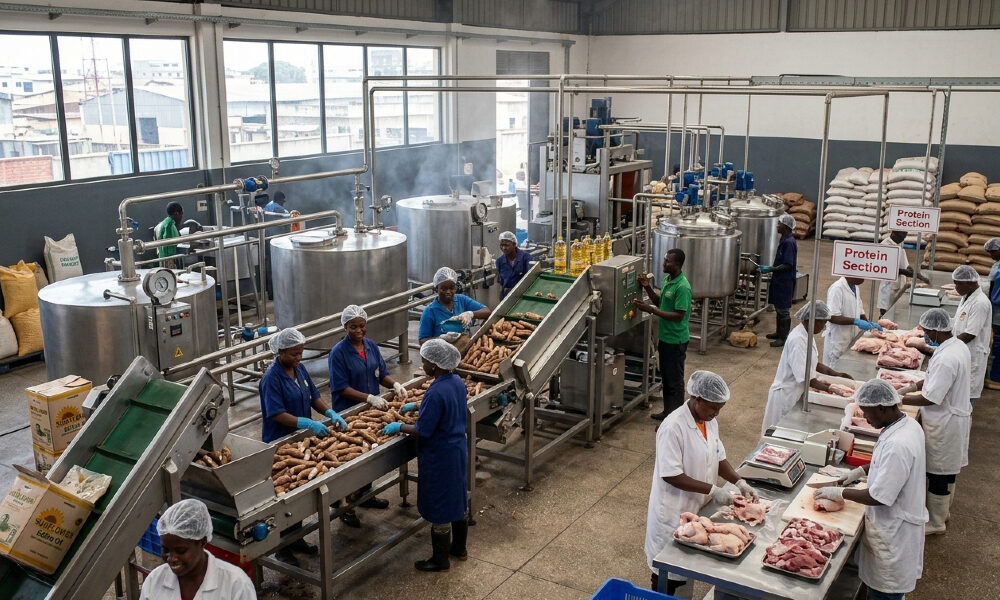
Strip away the country-by-country detail, and both regions are telling the same story from different angles. Africa’s food-security challenge was never primarily about whether the continent can grow enough. It’s about whether it can move, store, process, and trade what it already grows – and increasingly, whether it can build the infrastructure to do all of that domestically rather than relying on someone else to do it from abroad.
For investors and governments, that reframing changes the calculus entirely. A food-import bill isn’t just a liability to be minimized. It’s a map of exactly where the next generation of agricultural investment – in milling, storage, irrigation, seed systems, and logistics – needs to go.
The countries and companies that recognize this first won’t just be feeding Africa. They will be building the value chains that define its economic future.
Which commodity – East or West African – do you believe holds the strongest growth opportunity over the next five years?
Ashish Muley is an independent consultant with Stalwart Management Consulting, with 27+ years in agricultural commodity value chains, export markets, and international trade. He has led projects on business development and capacity building across African countries in partnership with international organizations. Formerly, he spent 15 years in financial services leadership, focusing on sales, marketing, and business development. Based in Pune, India, Ashish advises on agricultural trade, commodity markets, Warehouse Receipt System (WRS) and Asia–Africa economic opportunities, and regularly writes on international trade and logistics.