Opinion
Family Money and Failing Grids Reshape Development
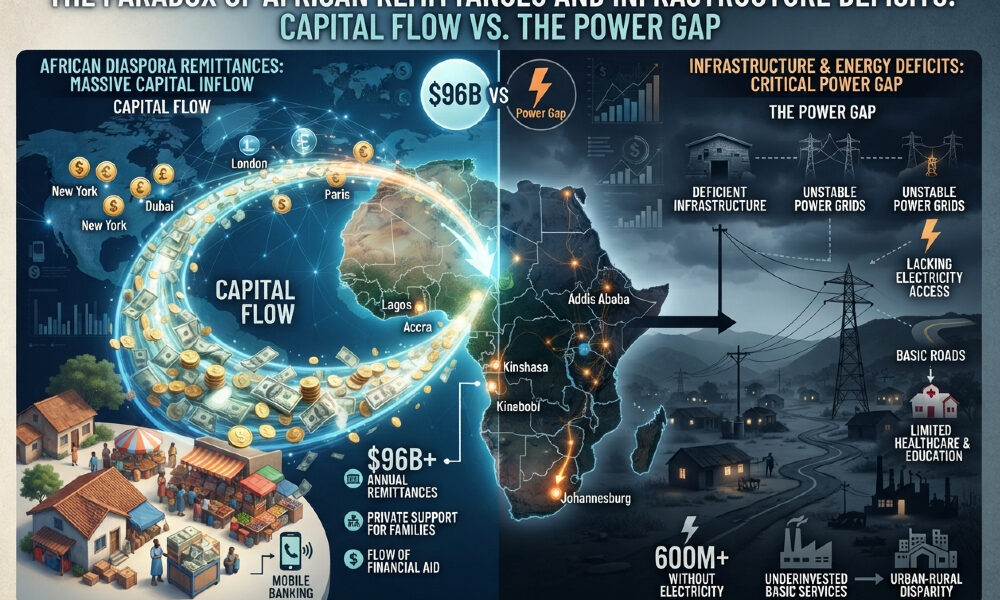
Africa’s diaspora sent home more than $124 billion in 2025, yet 563 million Africans still lack electricity. Could family money finally help power the continent?

By Gregory September
Ask a finance minister in Lagos, Kinshasa or Addis Ababa what holds up the economy, and the answer will involve big things: loans, mining concessions, a pipeline of aid. Ask a family in any of those cities, and the answer is likely to be a phone buzzing with a message from a relative abroad.
That buzz adds up. Africans living overseas sent home more than US$124 billion in 2025. The money goes straight to households, where it pays for food, school fees and rent. It is also dependable. The African Development Bank (AfDB) calls remittances a stable source of foreign money, and the data bear that out. In 2024 they became the continent’s largest source of external non-debt financing, ahead of foreign portfolio investment, the capital that flees at the first sign of global jitters. Roughly one-fifth of the total even originates inside Africa, a quiet rebuttal to the idea that the continent’s economic ties run only outward.
Now place that against a second number. In sub-Saharan Africa, 563 million people still have no electricity. In 2010 the figure was 565 million. In fourteen years, the region has shaved two million off its power gap. Grids grew, but populations grew faster. Africa has been running up a down escalator.
These two facts rarely appear in the same sentence. They should.
The Overlooked Backbone
Policy conversations about African development tend to favor the spectacular: the billion-dollar deal, the donor conference, the ribbon-cutting. Remittances are the opposite of spectacular. They move in small amounts, over millions of transactions, with no press release. Yet they are arguably the continent’s most reliable form of capital, and the least strategically managed.
The AfDB estimates that as much as 30 percent of formal remittances could be left over once households have covered their needs and could be put to work financing local projects. The bank’s figure for the potential pool is almost US$30 billion a year. (Applied to the 2025 total, 30 percent would be higher, which suggests the estimate rests on formal channels only, or on an earlier base.) Whichever way it is calculated, the sum is large. One route is the diaspora bond, a debt instrument that lets emigrants lend to their home countries, often out of loyalty as much as for the return. Few countries have used them at scale. Fewer still have asked what the money should buy.
Why Power Is the Obvious Answer
Electricity is the base layer of every African industrial ambition. Refineries need it. So do smelters, cold chains and the fast-growing cities that are meant to absorb the continent’s young. Jobs follow reliable power, not the other way around, which is why SDG 7, access to energy, is the goal on which nearly every other goal depends. SDG 9, on industry and infrastructure, cannot be met by factories and cold storage that go dark. SDG 8, on decent work, depends on both.
The geography of the shortfall is stark. The number of rural Africans without power rose from 376 million to 447 million, a measure of how much of the deficit is concentrated in places that grids and markets have been slowest to reach. The region now accounts for 86 percent of the global electricity access gap. Three countries tell much of the story: Nigeria has about 87 million people without power, the Democratic Republic of Congo about 85 million, and Ethiopia about 57 million. Together that is some 229 million people, more than the population of most of the world’s countries.
Against this backdrop, Mission 300, the initiative to connect 300 million people to electricity by 2030, is admirable and daunting in equal measure. Reaching the target means reversing a trend that has defied policy for over a decade. The arithmetic is unforgiving: it demands a pace of connection that Africa has never come close to achieving.
Three Goals, One Question
The case for linking remittances to power rests on how the Sustainable Development Goals interlock.
SDG 17 (partnerships). Remittances are still too expensive to send. The average cost of an African transfer was about 7.9 percent in 2023, more than double the UN target of 3 percent by 2030. Closing that gap demands something governments find hard: shared rules across countries. On flows of this size, every percentage point trimmed is worth well over a billion dollars, money that would otherwise go to intermediaries.
SDG 1 (no poverty). Family money is, in effect, the continent’s largest informal safety net. It helps households stay above the poverty line when harvests fail, jobs vanish or prices spike.
SDG 10 (reduced inequalities). Cheaper transfers leave more money with families. In a literal sense, lower fees are a form of redistribution that costs taxpayers nothing.
The Uncomfortable Trade-Off
Here is the tension. If governments treat remittances as investment capital, steering them into bonds and infrastructure, they risk turning private generosity into a quasi-tax and eroding the very trust that makes the flows reliable. If they treat remittances as sacrosanct household income, to be protected from official meddling, they leave billions of dollars idle at a time when 563 million people sit in the dark.
The sensible path lies between. Cut the cost of sending money first; that helps families and requires no persuasion. Then make saving and investing at home an attractive, voluntary option, through well-designed diaspora bonds with transparent terms and credible projects. Nobody should be compelled. But governments that want emigrants to invest in grids must first show that grids get built.
There is a second, quieter question about what to build. Should Africa put its scarce capital into more power plants, or into better grids? Generation without distribution leaves electrons stranded; distribution without generation leaves wires empty. The answer will differ from country to country, but the debate deserves more honesty than it gets. Too often, announcements celebrate capacity added while ignoring the households still unconnected.
A Stabilizer Worth Steering
Africa does not lack resources. It lacks a way to connect the money that works to the places that need it. Families abroad have already shown they will send billions home through every kind of shock. The harder test is whether African governments can offer them, and the families they support, something worth backing: a grid that stays on.
Gregory September is a South African academic, author, and geopolitical analyst with extensive experience in government and Parliament. He is the founder and CEO of SAUP (Sustainability Awareness and Upliftment Projects NPC), which focuses on sustainability education and community development. He previously served as Head of Research and Development for the Parliament of South Africa. His work centers on sustainability, African geopolitics, and economic development, and he regularly contributes to analysis of global political and economic affairs.