Business
EU Manufacturers Turn to Kenya as a Strategic Growth Frontier


By Naomi Mutuku
Mature European manufacturers face a familiar paradox: operational excellence at home yields shrinking margins in saturated markets. Scaling within the European Union has become prohibitively expensive, pushing industrial capital toward frontier economies.
The challenge is identifying jurisdictions where institutional reliability matches growth potential.
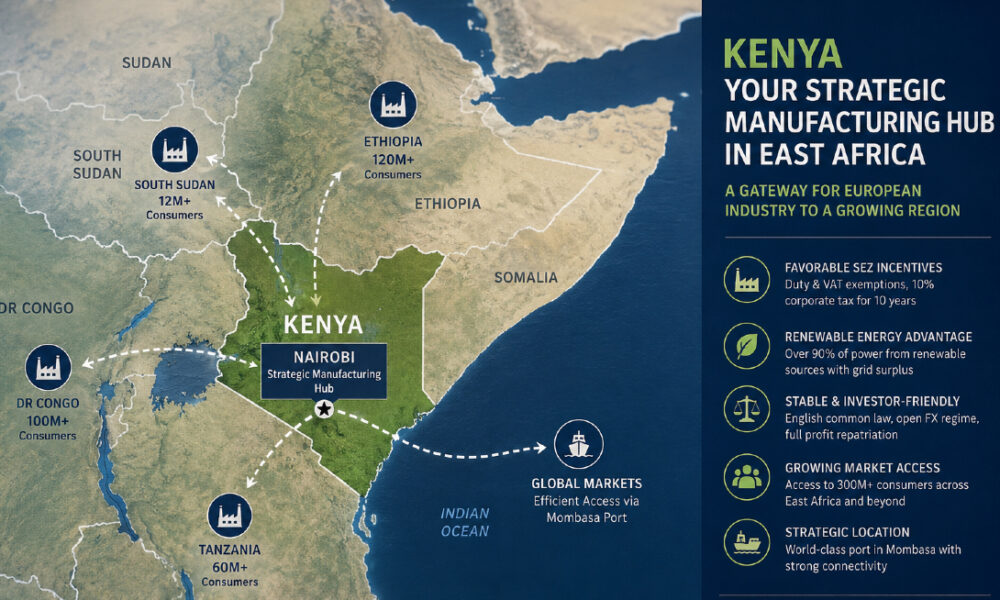
East Africa, and Kenya in particular, is emerging as a viable operational anchor for EU industrial investors – not because of continental hype, but due to specific structural and fiscal conditions that reduce expansion risk.
Legal and Financial Predictability
Kenya’s commercial legal framework derives from English common law, offering EU boards institutional familiarity in contract enforcement and property rights. The foreign exchange regime is fully liberalized: multi-currency accounts are permitted, and capital and profits can be repatriated without exchange controls or administrative delays.
Energy and Market Positioning
While European manufacturers grapple with volatile energy costs, Kenya generates over 90 percent of its electricity from renewable sources, primarily geothermal and hydroelectric. The national grid produces a structural surplus, providing energy-intensive operations with both price stability and a low-carbon production profile.
Demand dynamics also favor imported industrial capacity. East Africa’s infrastructure and real estate expansion has created a deficit in high-specification building technologies, specialized machinery, and modular systems.
European engineering standards command premium pricing in a market where local supply cannot yet meet rigorous quality requirements.
SEZ Fiscal Framework
Kenya’s Special Economic Zones (SEZ) Act provides the most direct fiscal incentive structure for manufacturing entrants. Raw materials, plant machinery, and equipment imported into an SEZ are exempt from import duty, VAT, excise duty, and import declaration fees.
Manufacturing enterprises within an SEZ pay a 10 percent corporate income tax rate for the first ten years, rising to 15 percent for the subsequent decade. Withholding tax on dividends, royalties, interest, and management fees paid to non-residents is eliminated during the same initial period.
Capital expenditure on industrial buildings and machinery qualifies for a 100 percent investment deduction allowance.
Regulatory friction is further reduced through the SEZ Authority’s one-stop-shop mechanism, which consolidates corporate registration, environmental approvals, tax compliance, and immigration processing under a single administrative desk.
Execution and Local Partnership
Government frameworks provide the architecture, but private operators must manage the execution. Establishing a physical presence through a local corporate promoter – ideally one with simultaneous operational capacity in Europe and Nairobi – mitigates customs, logistics, and compliance risks.
Experienced local partners provide ecosystem access and can structure the appropriate vehicle, whether an agency, special-purpose vehicle, or joint venture, aligned with the parent company’s risk and liquidity constraints.
Assessment
For EU manufacturers with dominant home-market positions and constrained domestic growth vectors, Kenya offers a calculable expansion case. The fiscal incentives and demand trajectory are structurally sound, but profitability depends on converting institutional frameworks into operational reality through experienced ground-level management.
The next step is not additional market research, but a product-specific feasibility audit against verified East African demand and SEZ financing structures.
Naomi Mutuku is a trade and investment expert specializing in helping global companies enter Kenya and broader African markets. She focuses on reducing risk, accelerating market entry, and fostering sustainable growth. Based in Nairobi, Naomi is a regular commentator on Africa’s dynamic business landscape and is passionate about the continent’s growth potential. She can be reached via email at: mukuinaomi@gmail.com