Opinion
Ethiopia: The Market Everyone Is Watching, But Few Truly Understand


By Jacqueléne Coetzer
Ethiopia is one of the most compelling – and most persistently misread – markets in Africa. It is not a market you figure out as you go. Most who try, fail before they gain traction.
On paper, the fundamentals are arresting. A population exceeding 138 million, one of the fastest-growing economies on the continent over the past decade, and a government aggressively pursuing industrialization all point to a market of extraordinary opportunity. And yet, despite those headline numbers, companies continue to stumble. The reason is not a lack of opportunity. It is a fundamental failure to understand how this market actually operates.
Ethiopia is difficult not because it is broken, but because it does not work the way most companies expect. Its economy was never shaped by colonial forces – Ethiopia is one of the very few African nations that was never formally colonized – and that singular historical fact still defines how business is done today.
A Market That Was Never Designed for You
Ethiopia stands apart from much of the African continent in one critical respect: it developed on its own terms. While most of Africa’s commercial and administrative architecture was built on European frameworks, Ethiopia grew its own institutions, its own systems, and its own logic. That difference is not merely historical. It is operational.
This is not a market built for external convenience. It does not naturally align with the English-, French-, Arabic-, or Portuguese-speaking business environments that dominate cross-border trade across Africa. Amharic remains the primary working language within government and domestic business structures, though English is widely used in corporate and international trade settings.
For businesses, the implication is immediate and practical: Ethiopia is not a plug-and-play market. It demands localization, patience, and a genuine willingness to operate within a system that was not designed with foreign operators in mind. Those who recognize this early position themselves far more effectively than those who arrive expecting the market to adapt to them.
That resistance to external imposition is, paradoxically, precisely what makes Ethiopia one of the most strategically important markets in the BRICS+ framework today. Ethiopia is not simply growing – it is evolving on its own terms, at scale.
The Ethiopian Paradox: Growth vs. Constraint
Ethiopia operates within a structural paradox that any serious market entrant must reckon with.
On one hand, it is a high-growth economy with clear national ambition. Industrialization, infrastructure development, and export expansion are central to its strategy. The government has been exceptionally proactive in directing economic development, investing heavily in long-term structural transformation.
On the other hand, the operating environment is tightly controlled. Foreign exchange availability remains one of the most significant practical constraints in the market. Importers routinely face delays and limitations in accessing hard currency, directly affecting trade flows. Regulatory processes can be labyrinthine, and market access is rarely as open as it appears from the outside.
This creates a dual reality: Ethiopia offers scale and long-term growth, but access is structured, regulated, and constrained. Success depends on understanding – and navigating – both sides of that equation simultaneously.
Despite conflict and structural challenges, Ethiopia has maintained growth consistently in the 6–8 percent range, with projections above 7 percent in coming years and some estimates pushing toward 10 percent growth in 2025–2026 under continued reform momentum. That trajectory is not accidental.
The Development Model: State-Led, Infrastructure-First
Ethiopia’s growth has been built on three deliberate pillars.
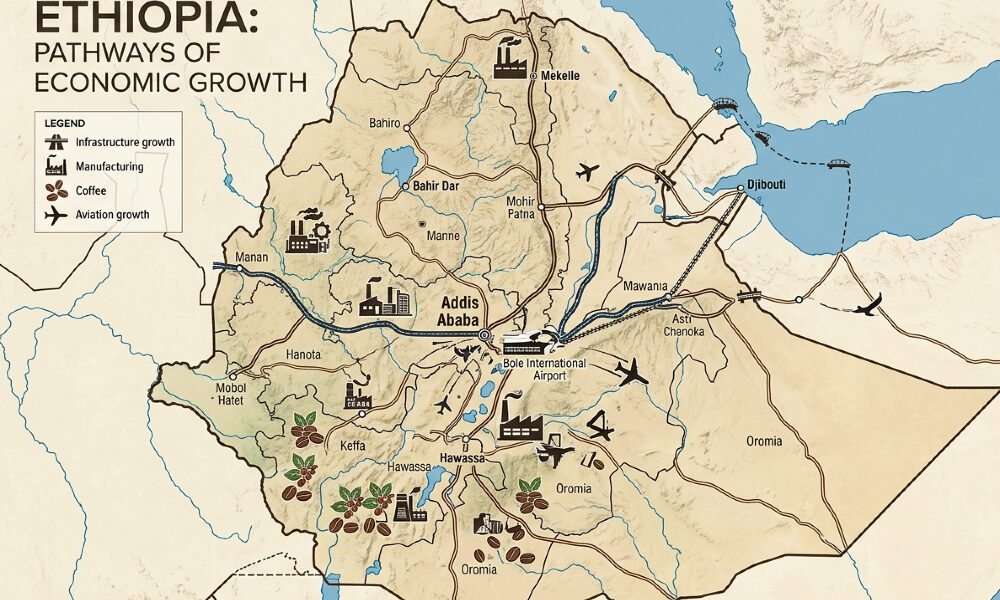
The first is infrastructure as a growth engine. Massive public investment in roads, logistics corridors, rail – most notably the Addis Ababa–Djibouti railway – and energy infrastructure, including the Grand Ethiopian Renaissance Dam (GERD), has created the physical backbone for industrialization and trade.
The second is industrialization by design. The government actively built industrial parks, textile and manufacturing hubs, and export-oriented production zones. Manufacturing was not left to market forces – it was engineered.
The third is an agricultural base with an export focus. Agriculture still employs more than 60 percent of the population and remains foundational to the economy, particularly in coffee, oilseeds, and cereals. The strategy: stabilize food supply, generate foreign exchange, and support industrial expansion.
Ethiopia built a strong foundation first – and is now optimizing from a position of relative structural strength.
Addis Ababa: Strategic Signal, Not Urban Beautification
The rapid transformation of Addis Ababa into a modern, world-class capital is widely misread as organic urban development or civic beautification. It is neither. It is state-directed capital concentration – part of a much larger national economic strategy.
The government recognized early that the optics of a modern capital would function as a proxy signal for the country’s broader economic trajectory. The result: the Addis Ababa City Corridor Project is upgrading major routes and infrastructure; high-rises, parks, and 24-hour urban spaces are proliferating; smart street lighting and urban surveillance systems are being installed; and the city is being positioned as a key node in both the Djibouti–Addis Southern Corridor and the East African City Corridor.
As the seat of the African Union, Addis Ababa is leveraging these developments to attract international business, diplomatic presence, and conference tourism. The city is becoming a continental nerve center – not merely Ethiopia’s capital, but Africa’s political and economic focal point.
The result is a capital that deliberately appears more advanced than the broader economy. That gap is intentional. Addis Ababa is being constructed as a continental reference point for what coordinated, state-directed growth can achieve.
Aviation as Strategy – Not Infrastructure
The rise of Ethiopian Airlines and the planned expansion of the country’s airport infrastructure are not isolated developments – they are central to Ethiopia’s economic strategy. Through aggressive network expansion, Ethiopian Airlines has built the largest aviation network on the continent, turning Addis Ababa into a critical junction connecting Africa, Europe, the Middle East, and Asia.
This connectivity serves three simultaneous purposes: it unlocks trade flows by reducing logistical friction; it drives investment and business travel, supporting sectors far beyond aviation itself; and it positions Ethiopia as a continental transit and redistribution hub.
The planned multi-billion-dollar Bishoftu mega-airport takes this ambition further. It is not merely an infrastructure upgrade – it is a capacity play at scale, designed to handle tens of millions of passengers and significantly expand cargo throughput, effectively future-proofing Ethiopia’s role in global and intra-African connectivity.
In practical terms, Ethiopia is doing what few African economies have managed: using aviation not as support infrastructure, but as a primary driver of economic positioning and growth.
Market Structure: A State-Influenced Economy in Transition
Ethiopia’s economic model is distinct from virtually any other market its size. The state plays a central role in directing development, prioritizing key sectors, and shaping the conditions for market participation. While reforms have been introduced to encourage private sector growth and foreign investment, the system remains guided rather than fully liberalized.
The implication for external operators is significant: Ethiopia is not a market-driven environment – it is a policy-influenced system. Certain sectors are actively promoted, particularly those linked to industrialization and export generation. Market entry requires alignment with national priorities, not just sound commercial logic.
Ethiopia is now transitioning from state-led growth toward market-enabled expansion, with key priorities in manufacturing, energy exports, mining, agricultural modernization, and foreign investment attraction. The next phase is about efficiency, foreign capital, and scaling exports.
Key Sectors: Where the Opportunity Exists
Manufacturing sits at the center of Ethiopia’s industrial strategy. Through industrial parks and export-oriented production zones, Ethiopia is positioning itself as a competitive base for textiles, garments, and light manufacturing – with the objective of integrating into global supply chains, not merely substituting imports.
Agriculture and agro-processing remain foundational, but the strategic focus is shifting decisively from raw commodity export toward processed, value-added products. This transition is critical for improving export revenues and reducing vulnerability to commodity price volatility. Coffee, oilseeds, livestock, and processed foods are the priority areas.
Energy is emerging as a structural advantage. With large-scale hydropower projects – led by the GERD – Ethiopia is positioning itself not just to meet domestic demand, but to become a regional energy exporter with significant implications for industrial growth, particularly in energy-intensive sectors.
Mining remains underdeveloped but holds considerable potential, particularly in gold and potash. As regulatory frameworks evolve and investment increases, this sector is expected to play a far more prominent role. Much of the country remains unexplored, meaning the potential for significant new mineral discoveries is high.
Healthcare and diagnostics represent a growing opportunity driven by a large, still-urbanizing population and persistent infrastructure gaps. Demand for imported medical technologies and diagnostic systems remains high and is not being adequately met.
Geographic Considerations: Turning Weakness into Strategy
Following decades of war with Eritrea, Ethiopia became landlocked – a structural disadvantage that became one of its most defining strategic challenges. Ethiopia’s response has been to turn that weakness into leverage.
Djibouti handles the overwhelming majority of Ethiopia’s imports and exports and serves as the country’s economic lifeline, further strengthened by the Djibouti–Addis Regional Economic Corridor. In 2024, the World Bank approved an additional US$90 million to support transit facilitation along this corridor, including climate-friendly storage and market facilities with dedicated sections for women traders – a notable inclusivity measure in regional trade infrastructure.
Emerging alternative corridors – via Berbera (Somaliland), Port Sudan, and Kenya’s Lamu Corridor – are being developed to reduce dependency risk and diversify access. Logistics into Ethiopia remain documentation-intensive, with foreign exchange constraints and longer clearance timelines as standard operating conditions.
The Blue Nile adds another dimension. The GERD, once fully operational, is expected to be the largest hydroelectric power plant in Africa, fundamentally transforming Ethiopia’s energy capacity and its regional geopolitical position. Control over a major upstream water source has elevated the dam from an infrastructure project to a central point of regional negotiation – particularly with downstream countries Egypt and Sudan. At the same time, it opens pathways for regional energy integration and lower operating costs for energy-intensive industries.
Coffee: A Strategic Asset, Not a Commodity
Ethiopia is widely recognized as the birthplace of coffee, and its importance extends far beyond historical origin. Coffee is among the country’s most significant export sectors and a critical source of foreign exchange, supporting millions of livelihoods across the agricultural value chain.
Ethiopian coffee represents one of the most diverse and complex flavor profiles in the world, shaped by altitude, microclimates, and traditional processing methods that vary significantly across regions such as Yirgacheffe, Sidamo, and Harrar. From a trade perspective, it functions as a strategic asset – combining heritage, identity, and sustained global demand. For buyers focused on provenance and exceptional flavor, Ethiopia remains one of the most important sourcing origins on earth.
The Ethiopian coffee ceremony – a cherished, hours-long cultural ritual performed three times daily, involving the roasting of green beans, grinding, and brewing in a traditional clay jebena pot, with guests sharing three rounds across a single sitting – is not merely a cultural curiosity. It is a networking institution, and any businessperson operating in Ethiopia would be well advised to embrace it.
Ethiopia’s Quiet Digital Shift
Ethiopia is not yet a technology powerhouse – the sector currently contributes only 2–4 percent to GDP – but it is laying deliberate groundwork. The gradual liberalization of the telecoms sector, including the entry of Safaricom, signals a shift toward a more connected and digitally enabled economy. The government’s Digital Ethiopia 2025 strategy aims to expand digital infrastructure, improve service delivery, and support economic modernization.
Ethiopia’s digital trajectory is being shaped by a young workforce, expanding infrastructure, and deliberate government strategy. Current priorities include digital payments, e-government platforms, data infrastructure, and – over the longer term – AI integration and cloud computing. Notably, Ethiopia has announced plans to launch the world’s second dedicated AI university by 2027.
Ethiopia’s leapfrog potential here is real. Having bypassed many legacy digital frameworks, the country has space for direct adoption of newer technologies in logistics, trade facilitation, and public administration. Early African tech adopters like South Africa, Kenya, and Nigeria built highly innovative systems – Kenya’s M-Pesa being the canonical example – but at significant cost and with steep learning curves. Ethiopia can enter an already well-established ecosystem at lower cost and with a far shorter adoption curve.
The Consumer Landscape
Ethiopia is one of Africa’s largest and youngest populations, but it is emphatically not a typical consumer market. Ethiopian consumers are price-sensitive and value-driven, but not yet meaningfully brand-conscious. The dominant preference is for functionality over luxury, though a small niche market for premium goods exists at the top of the income distribution.
There is a deep cultural and traditional identity in Ethiopia, making product localization essential. Addis Ababa, with its large diplomatic community and rapidly urbanizing population, displays distinctly different consumption patterns from the rest of the country.
The mass market is oriented around basic food staples, cooking oil, grains, and affordable fast-moving consumer goods. The emerging middle class is developing demand for packaged foods, entry-level electronics, beauty and personal care products, and practical fashion.
E-commerce remains in its early rapid-growth stage, capturing less than 5 percent of market share and relying heavily on Telegram – the dominant social commerce platform due to its low data requirements – and cash-on-delivery. Despite persistent challenges in logistics, digital payment adoption, and regulation, the sector is growing, and the government’s intense focus on digitization suggests explosive expansion over the coming years.
In marketing, what most foreign companies get wrong is severe. The market rejects Western-style branding and abstract campaigns. Messaging must be rooted in local reality, delivered in Amharic where possible, and built on credibility and tangible value – not aspiration and polish. The most effective channels remain television, radio (particularly outside urban centers), outdoor advertising, and in-person activation. Distribution networks matter more than advertising spend.
The Regulatory Environment: Structured, Not Arbitrary
Ethiopia’s regulatory environment is state-led, structured, and tightly managed. Key sectors – including finance, telecoms, logistics, and parts of manufacturing – have historically been either state-controlled or heavily regulated, and while gradual liberalization is underway, the transition remains controlled and phased.
For businesses, this means full compliance from day one is not optional. Licensing requirements must be thoroughly understood, documentation-heavy import processes must be anticipated, and regulatory timelines will be longer than in more liberalized markets. Foreign currency availability can impose significant practical constraints, particularly for import-dependent operations.
Critically, however, Ethiopia’s regulatory framework is not arbitrary. It is structured around national development objectives – particularly industrialization, import substitution, and export growth. Businesses that understand this and position their operations accordingly will find the system navigable. Those that treat it as bureaucratic noise will not.
What Works, What Fails: A Pattern, Not a Mystery
Ethiopia does not produce random outcomes. Success and failure in this market follow consistent, identifiable structural patterns.
Diageo’s acquisition of Meta Abo Brewery is often cited as a long-term investment success – but the early years were far from smooth. Supply chain instability, agricultural input constraints, infrastructure limitations, and regulatory complexity all compounded. The problem was not the market; it was a systemic underestimation of how much localization and alignment was required.
Heineken faced similar realities in its Ethiopian brewery investments: input supply challenges, foreign exchange constraints, and regulatory navigation that proved more demanding than anticipated. Scale, in Ethiopia, does not solve complexity.
Safaricom’s entry into the Ethiopian telecoms market illustrates a third dimension: the process was highly regulated, structurally complex, and fundamentally dependent on state-led frameworks. This was not a conventional private-sector expansion – it was a negotiated, policy-driven market entry. That distinction matters enormously.
What these cases collectively demonstrate is that Ethiopia does not reward assumption. Companies that treated Ethiopia as a standard emerging market, underestimated state involvement, failed to localize their supply chains, or expected rapid scalability all encountered the same result: stalled entry, delayed execution, and lost momentum.
The success cases tell the opposite story. Huajian Group, the Chinese footwear manufacturer, succeeded by aligning explicitly with Ethiopia’s industrialization strategy, establishing local manufacturing within the industrial park ecosystem, and orienting production toward export. They did not enter Ethiopia as a consumer market – they entered it as a production base.
The Dutch-led floriculture industry tells a similar story: strong government support, infrastructure alignment through Ethiopian Airlines’ air freight capacity, clear export orientation, and favorable climate conditions combined to produce one of Ethiopia’s most successful export sectors. The formula – policy plus infrastructure plus private sector alignment – is replicable across sectors.
The real lesson is this: the difference between success and failure in Ethiopia is not capital, brand strength, or experience. It is alignment versus assumption.
BRICS+ and Ethiopia: Strategic Positioning
Ethiopia’s inclusion in BRICS+ surprised many observers who assumed larger or more externally integrated economies – Nigeria or Algeria, for instance – were more obvious candidates. But BRICS expansion is not driven by GDP size or short-term economic performance. It is driven by strategic positioning, long-term potential, and geopolitical alignment.
Ethiopia meets those criteria in ways that are consistently underestimated.
It brings scale – a population exceeding 138 million, offering both labor capacity and long-term consumer market growth. It brings sustained growth trajectory – high levels of economic expansion over the past decade, driven by infrastructure investment and deliberate industrialization. And – most importantly – it provides strategic geographic positioning. Located in the Horn of Africa, Ethiopia sits at the intersection of African, Middle Eastern, and Red Sea trade corridors, deeply embedded in regional logistics flows despite being landlocked.
Finally, Ethiopia aligns with BRICS’ broader objective of reshaping global economic structures. It represents a large-scale market that is not fully integrated into Western-led systems, but is actively constructing its own development path. In that sense, Ethiopia is not simply a participant in BRICS+ – it is a future platform.
For BRICS members, Ethiopia functions simultaneously as a market and a strategic build-out zone, offering access to East Africa, a manufacturing and industrialization base, significant energy potential, and a demand-heavy economy hungry for industrial inputs, machinery, pharmaceuticals, and infrastructure solutions.
How to Enter: The Principles That Work
Entering Ethiopia successfully requires a structured, aligned approach built on five core principles.
Align with national priorities from the outset. Ethiopia’s economic model is directed, not neutral. Businesses that position themselves within the country’s industrialization, import substitution, and export development agenda move faster and face fewer structural obstacles than those pursuing purely commercial logic.
Think in terms of local integration, not pure export. Forex limitations, import controls, and logistics complexity mean that pure export models face significant structural headwinds. Local assembly, joint ventures, and genuine in-market presence are consistently more effective.
Structure for compliance from day one. Regulatory complexity is real and unavoidable. Understanding licensing requirements, planning for documentation-heavy processes, and building compliance into the business model from the start are non-negotiable prerequisites, not afterthoughts.
Build relationships, not just transactions. Ethiopia is a relationship-driven market where government engagement and local partners matter as much as product quality or pricing. Deals do not move purely on commercial merit. Trust, built over time and through consistent engagement, is the currency of commerce.
Take a long-term position. Ethiopia does not reward short-term entry. Timelines are longer, systems require navigation, and returns build over time. But once properly positioned, the upside compounds in ways that are difficult to replicate in more competitive, more saturated markets.
Why Ethiopia Matters Now
Ethiopia is not a short-term opportunity. It is a long-term structural position.
With a population exceeding 138 million, sustained high-growth momentum, and a deliberate shift toward industrialization, it represents one of the most significant growth markets on the continent. But it is not universally accessible – and it is not forgiving of half-measures.
Ethiopia does not accommodate passive entry. It does not respond to generic strategies. And it does not adjust itself to external expectations. What it offers instead is scale, direction, and intent.
The question is not whether Ethiopia will continue to grow. That trajectory is established. The question is who will position themselves early enough – and correctly enough – to grow with it.
Jacqueléne Coetzer is a strategic trade and market analyst specialising in African and emerging markets. Her work focuses on structuring cross-border commercial relationships, connecting buyers and sellers, and facilitating trade across key sectors including commodities, diagnostics, and premium agricultural products. Her writing explores the realities behind global trade architecture, BRICS, and African economic development – not from a theoretical lens, but from active market engagement and transaction-level insight.