Opinion
Ethiopia: A BRICS Market That Demands a Different Approach


By Jacqueléne Coetzer
Ethiopia’s entry into BRICS is strategically significant for more than one reason. With a population exceeding 130 million, a substantial agricultural base, expanding industrial capacity and a central position in East Africa, Ethiopia is one of the continent’s most consequential emerging markets.
But Ethiopia is not a market that rewards a conventional export-first approach – Its commercial environment is shaped by a strong state role, regulatory complexity, foreign-exchange constraints, infrastructure priorities and a preference for developing domestic productive capacity. For businesses entering the market, particularly African SMMEs, understanding this environment is as important as identifying demand.
Ethiopia is building – Industrial parks, transport infrastructure, energy generation, telecommunications and logistics are part of a broader effort to strengthen domestic production and reduce structural dependence on imports. Addis Ababa is also a major diplomatic and aviation hub, while Ethiopia’s geographic position gives it potential access to wider East African markets.
Opportunities Beyond Commodity Exports
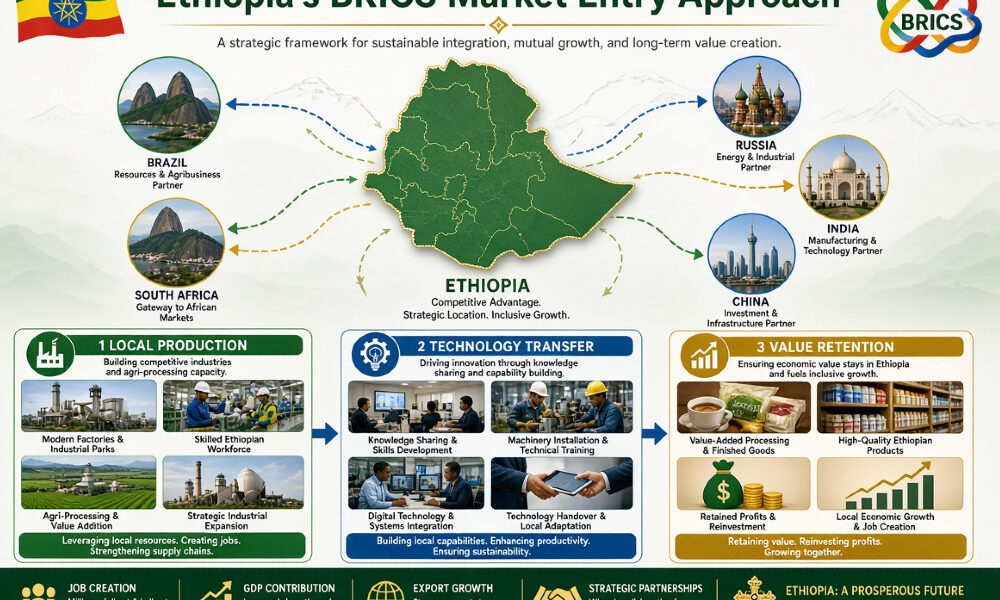
This creates opportunities well beyond traditional commodity exports – Agribusiness and agro-processing, manufacturing, industrial inputs, infrastructure, energy, healthcare, diagnostics, technology and logistics all offer areas of potential engagement. Agriculture is particularly significant – Ethiopia is a major producer of coffee, but the greater opportunity increasingly lies in moving beyond the export of raw products towards processing, branding, packaging and value retention within the country.
The same principle applies across sectors – a company approaching Ethiopia simply as a destination for finished products may encounter constraints around foreign exchange, import controls, regulation and market access. A company able to contribute technology, production capacity, local skills, financing, processing or distribution may find a very different commercial proposition.
This is where Ethiopia’s BRICS position becomes particularly interesting. BRICS should not be viewed simply as another export market or as a guarantee of preferential access. Its value lies in the relationships, networks and alternative channels it can create between economies of the Global South.
For Ethiopia, BRICS strengthens its position within a wider network linking Africa with major economies including China, India, Brazil, Russia, Iran, Indonesia and the Gulf. For African businesses, this creates another layer of opportunity – Ethiopia can potentially serve not only as a domestic market, but as part of a broader East African production, sourcing and distribution strategy.
Rethinking Market Entry
That requires a different mindset – Not simply a “What can I sell in Ethiopia”-mindset, but rather a broader approach that identifies opportunities based on where Ethiopia’s own economic priorities can be accommodated. That may mean a local partner rather than a conventional distributor. It may mean assembly or processing rather than finished-product exports. It may mean technology transfer, joint ventures, local sourcing or participation in infrastructure and industrial development.
There are, of course, challenges. Foreign-exchange availability, regulatory requirements, bureaucracy, logistics and longer decision-making cycles can complicate market entry. Ethiopia is not a market for casual experimentation or an assumption that a successful model elsewhere in Africa can simply be replicated. It rewards preparation, local relationships and patience.
For African SMMEs, Ethiopia’s BRICS membership therefore deserves to be viewed through a commercial rather than purely geopolitical lens. It sits at the intersection of a large domestic market, industrial development, East African connectivity and an expanding South.
Jacqueléne Coetzer is a strategic trade and market analyst specialising in African and emerging markets. Her work focuses on structuring cross-border commercial relationships, connecting buyers and sellers, and facilitating trade across key sectors including commodities, diagnostics, and premium agricultural products. Her writing explores the realities behind global trade architecture, BRICS, and African economic development – not from a theoretical lens, but from active market engagement and transaction-level insight.