Opinion
Egypt and BRICS: The Strategic Value Runs Both Ways


By Jacqueléne Coetzer
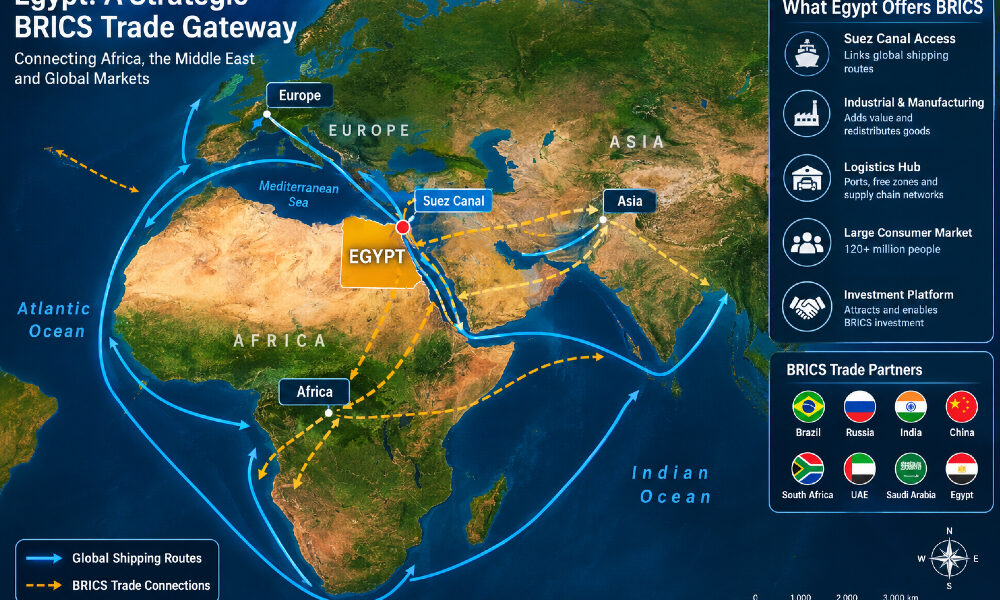
Egypt’s importance within BRICS is often reduced to its geography, population, or control of the Suez Canal. All three matter, but they miss the larger commercial story. Egypt brings something far more valuable to BRICS – a uniquely positioned economy that connects Africa, the Middle East, the Mediterranean, and major global shipping routes, while giving the bloc a strategic platform from which trade, manufacturing, logistics, and investment can be structured across multiple regions.
Egypt joined BRICS in January 2024, and the relationship is already commercially significant. Trade between Egypt and BRICS reached approximately US$50.8 billion in 2024, up 19.5 percent from 2023, with Egyptian exports to BRICS reaching US$9.4 billion. By the first half of 2026, total trade had risen to US$36.7 billion, another 25.5 percent increase year-on-year.
This is not simply a new diplomatic relationship. It is an existing commercial ecosystem being given a larger strategic framework.
What Egypt brings to BRICS
Egypt gives BRICS access to one of the world’s most important trade chokepoints through the Suez Canal, along with Mediterranean and Red Sea ports, industrial zones, and an economy capable of processing, manufacturing, and redistributing goods. Its position allows BRICS trade to move toward Europe, into Africa, toward the Gulf, and across Asian supply chains.
It also brings market scale. With a population exceeding 120 million, Egypt is the largest consumer market in North Africa, but its significance extends beyond consumption. It has substantial manufacturing capacity; food and agricultural production; pharmaceuticals; chemicals; construction materials; textiles; energy; ICT; and logistics infrastructure. The Suez Canal Economic Zone adds another layer by combining logistics, industrial development, manufacturing, and re-export potential.
Egypt therefore gives BRICS something that cannot be replicated by simply adding another large consumer market: a strategic conversion economy – one capable of importing inputs, adding value, and redistributing products into other markets.
What BRICS offers Egypt
The value for Egypt runs in the opposite direction. BRICS gives Egyptian businesses access to a much broader network of major emerging economies, while providing opportunities to diversify trade, investment, financing, technology, and supply chains.
China is already Egypt’s largest BRICS trading partner and its largest source of imports from the bloc. Russia is another deeply established relationship, with bilateral trade reaching a record US$9 billion in 2024. India, Brazil, the UAE, and Saudi Arabia also represent substantial commercial relationships. The opportunity, therefore, is not to ask Egyptian companies to discover BRICS from scratch, but to move existing relationships into higher-value trade and investment.
Egyptian exporters are already selling jewelry and precious stones, fruits and vegetables, electrical machinery, fuels, iron and steel products into BRICS markets. The next opportunity lies in moving further up the value chain, expanding processed food, industrial products, pharmaceuticals, technology, specialized manufacturing, and services, while using BRICS relationships to secure competitive inputs, technology, and investment.
Where the Opportunities are Strongest
For Egyptian business, China remains a major opportunity for manufacturing, technology, machinery, infrastructure, and industrial partnerships. Russia offers opportunities in food, energy, tourism, fertilizers, and industrial cooperation, while India presents opportunities across pharmaceuticals, healthcare, technology, food, chemicals, and manufacturing. Brazil creates scope for agricultural and food trade, industrial inputs, and South–South supply chains.
The UAE and Saudi Arabia are particularly important because they combine BRICS membership with Egypt’s already strong Gulf commercial relationships, investment flows, and regional distribution networks. BRICS investment into Egypt is already substantial, with the UAE particularly prominent in major projects and construction.
Egyptian companies should therefore think beyond exporting finished products. They should be asking where they can manufacture jointly, source competitively, establish distribution partnerships, attract investment, participate in supply chains, and use one BRICS relationship to open another.
The Opportunity for Foreign Business is Equally Significant
Foreign companies should not view Egypt merely as a market of 120 million consumers. They should ask what Egypt can do for their broader market strategy.
The right Egyptian partner can provide access not only to Egypt, but potentially to North Africa, COMESA markets, the Middle East, and Mediterranean supply chains. Egypt can function as a logistics base, a processing and manufacturing location, a distribution platform, and a reexport hub.
That makes Egypt particularly attractive to BRICS companies seeking a bridge into African markets, as well as to African companies seeking access to BRICS supply chains.
But there is an important warning: Egypt is one of the most difficult major markets in Africa to enter successfully. It should be considered alongside South Africa and Nigeria in this respect. Scale does not equal access.
Egypt is not simply an African market, nor should it be approached as a generic Arab or Middle Eastern market. It is distinctly Egyptian – a civilizational state with its own commercial culture, institutional hierarchy, networks, and expectations. Your strategy must therefore be localized to Egypt rather than transplanted from another market.
That lesson has already been demonstrated by international companies that assumed a successful model elsewhere could simply be reproduced in Egypt. The market rewards localization, credible local partners, patience, regulatory preparation, and a clear understanding of how decisions are actually made.
Egypt should not be dismissed as purely a price-sensitive mass market. Alongside its enormous mainstream consumer base is a sophisticated premium segment, particularly in Cairo, Alexandria, New Cairo, the New Administrative Capital, and major tourism and coastal destinations. Luxury retail, premium hospitality, high-end food and beverage, beauty, jewelry, fashion, and lifestyle products all have room for properly positioned international brands. Recent retail and hospitality development confirms the continuing expansion of Egypt’s premium consumption environment.
For Egyptian businesses, BRICS is a platform for diversification, investment, and value-chain expansion. For BRICS businesses, Egypt is a gateway, manufacturing base, logistics platform, and access point to wider regional markets. For both, however, membership itself is not the strategy.
The opportunity lies in understanding how the Egyptian system works, identifying the right partners, localizing the proposition, and structuring the transaction accordingly.
Egypt is not simply a market inside BRICS. It is one of the places from which BRICS trade can be built.
Jacqueléne Coetzer is a strategic trade and market analyst specialising in African and emerging markets. Her work focuses on structuring cross-border commercial relationships, connecting buyers and sellers, and facilitating trade across key sectors including commodities, diagnostics, and premium agricultural products. Her writing explores the realities behind global trade architecture, BRICS, and African economic development – not from a theoretical lens, but from active market engagement and transaction-level insight.