A Diaspora View of Africa
Effective Foreign Policy Requires a Sense of History


By Gregory Simpkins
In executing a nation’s foreign policy, of course language and actions give an indication of intentions, but governments also must consider how these both look to others based on past history. The current Trump administration actions to address drug smuggling seem disconnected from a sense of how these statements and actions look in the context of past US intervention in the Latin America-Caribbean region, and a dangerous and combustible situation has been created.
Foreign Policy magazine speculated in a November 3 article that the real aim of the current military activity surrounding Venezuela is to overthrow Venezuelan President Nicolás Maduro’s government and then, by cutting off the flow of Venezuelan oil to Cuba, fulfill the Republican right’s decades-long dream of collapsing the Cuban government.
Still, the scope of drug transshipments in the Western Hemisphere into the United States is indeed troubling. While the number of deaths from the smuggled synthetic drug fentanyl has decreased since 2023, tens of thousands of Americans are still dying from its use.
Several nations in the region are linked to drug smuggling into the United States. The main countries involved include:
- Mexico: A major source of illicit drugs such as cocaine, heroin, methamphetamine, and marijuana, with cartels like the Sinaloa Cartel and Jalisco Cartel dominating the trade.
- Colombia: A significant producer of cocaine, with many cartels and organizations trafficking it through Mexico and into the United States.
- Venezuela: Has become a key transit country for cocaine and other illicit drugs, with some officials allegedly involved in the trade.
- Ecuador: A major transit country for cocaine, with some traffickers using it as a hub to smuggle drugs into the United States.
- Peru: A significant producer of cocaine, with many cartels and organizations trafficking it through Mexico and into the United States.
- Bolivia: A producer of cocaine, with some traffickers using it as a hub to smuggle drugs into the United States.
- Central American countries: Such as Guatemala, El Salvador, and Honduras, which are used as transit countries for cocaine and other illicit drugs.
Consequently, there is reason for the Trump administration concern for drugs being shipped into the United States. Yet, the country undeniably has a long history of intervening in Latin America and the Caribbean, with actions that have had significant impacts on the region.
Here are some notable examples:
- Guatemala Coup (1954): The CIA orchestrated a coup to remove democratically elected President Jacobo Árbenz, citing concerns about communism. This led to decades of military rule and human rights abuses.
- Cuba (1898-1902, 1906-1909, 1917-1922): The US occupied Cuba and later sponsored the failed Bay of Pigs invasion in 1961 to overthrow Fidel Castro’s government.
- Dominican Republic (1916-1924, 1965): US troops intervened to restore order and later to prevent a leftist government from taking power.
- Nicaragua (1853, 1854, 1909, 1912-1933): Repeated US interventions aimed to protect American interests and influence the government.
- Panama (1989): The US invaded Panama to remove Manuel Noriega, a former CIA asset turned adversary, leading to his capture and imprisonment.
- Grenada (1983): The US invaded Grenada to overthrow the Marxist government, citing concerns about American medical students’ safety.
- Haiti (1915, 1994, 2004): US interventions aimed to restore order, reinstall democratic governments, and address humanitarian crises.
- Chile (1970s): The US supported Augusto Pinochet’s coup, which removed democratically elected President Salvador Allende.
- Colombia, Ecuador, Peru, and other countries: The US backed anti-communist governments, often with human rights violations.
The prior interventions have been widely criticized for undermining sovereignty, promoting instability, and causing human suffering. The current tensions with Venezuela are part of this broader historical context.
The attacks on boats alleged to be transporting drugs without seizures in what many consider violation of international law only hearkens back to past rule of law violations and causes concern among US neighbors.
Moreover, the threats to go after drug cartels on Mexican territory only add to regional concern about the United States returning to its interventionist past in the hemisphere. When asked about US military anti-drug intervention in Mexico, Mexican President Claudia Sheinbaum told reporters: “It’s not going to happen. We cannot permit an intervention.”
An American Military Buildup
What began in early September as a series of American airstrikes on boats in the Caribbean – which U.S. officials alleged were trafficking drugs from Venezuela – now seems to have morphed into a campaign to overthrow Venezuelan leader Nicolás Maduro.
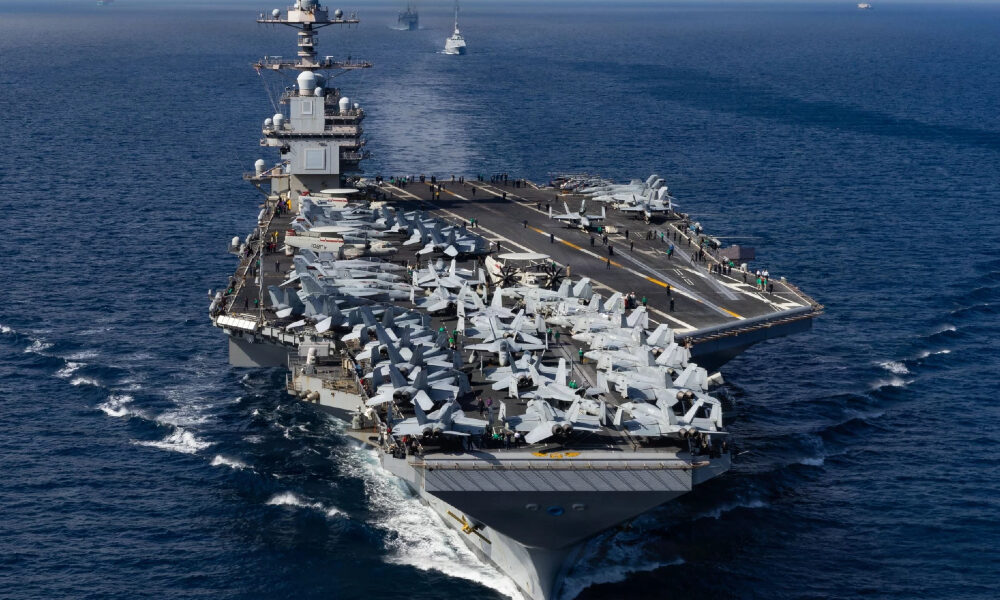
Over the course of two months, the Wall Street Journal reported on November 4 that President Donald Trump’s administration had deployed 10,000 U.S. troops to the region, amassed at least eight U.S. Navy surface vessels and a submarine around South America’s northern coast, directed B-52 and B-1 bombers to fly near the Venezuelan coastline and ordered the Gerald R. Ford Carrier Strike Group.
No leader in the Caribbean has embraced the Trump administration’s forceful new military presence in the region like the prime minister of Trinidad & Tobago.
Kamla Persad-Bissessar, who took office in May, has been unwavering in her support for President Trump, cheering airstrikes against alleged drug boats, allowing U.S. military operations in her country’s waters and permitting an American warship to dock at the capital’s main port. On drug smugglers, she has said the U.S. should “kill them all violently.”
That view is not widely shared in the region nor elsewhere in the international community.
According to the Wall Street Journal, this pro-U.S. posture has thrust Persad-Bissessar, often called by her initials KPB, into conflict with Maduro. Many in this former British colony of 1.5 million people – just seven miles from the Venezuelan coast – fear being dragged into a war.
Maduro accused Persad-Bissessar of “converting Trinidad into an aircraft carrier for the U.S. Empire against Venezuela, against South America.” He suspended all talks with Persad-Bissessar’s administration to develop offshore gas fields, jeopardizing revenue that could secure the future of Trinidad’s large but increasingly depleted oil-and-gas industry.
Venezuela’s foreign minister recently warned that Trinidad “will suffer the most tragic consequences of any intervention” by the U.S. into Venezuela.
Conflict Imperils the Caribbean
The Caribbean region’s maritime-based economies as a whole are fragile and vulnerable to various challenges. Climate disruptions, geopolitical crises, and trade imbalances have significantly impacted the region, with disruptions in the Panama Canal serving as a stark example of the wider issues.
Key Challenges:
- Climate Change: Rising sea surface temperatures, ocean acidification, and increased frequency of natural disasters threaten the region’s marine ecosystems and economies.
- Maritime Connectivity: Small island developing states (SIDS) face a 9 percent decline in maritime connectivity, resulting in higher costs and reduced competitiveness.
- Port Infrastructure: Inefficient processes, poor management, and infrastructure shortages lead to high port handling charges, two to three times higher than in similar ports globally.
- Trade Imbalances: Inbound vessels arrive fully loaded, while outbound vessels leave empty, exacerbating costs and reducing maritime services viability.
Resilience Efforts:
- Blue Economy Initiatives: Projects like the Unleashing the Blue Economy of the Caribbean (UBEC) aim to promote sustainable ocean resource use, economic growth, and improved livelihoods.
- Climate Resilience: The Caribbean Climate Justice and Resilience Agenda 2023-2030 outlines priority needs and actions to address climate change impacts.
- Sustainable Ports: The World Bank’s Blue Ports initiative supports sustainable port development, enhancing economic growth and healthy ocean ecosystems.
Overall, the Caribbean region’s maritime-based economies require urgent attention and investment to help to address these challenges and build resilience, and a conflict in the region would only add to their current challenges.
Fortunately, aside from the military maneuvers and Trump’s refusal to rule out ground forces or CIA activity in Venezuela, he has signaled his willingness to begin discussions with Maduro, who has repeatedly called for such talks. Perhaps this will turn out to be another case of Trump belligerence creating a situation he feels is favorable to the outcome he seeks.
Gregory Simpkins, a longtime specialist in African policy development, is the Principal of 21st Century Solutions. He consults with organizations on African policy issues generally, especially in relating to the U.S. Government. He further acts as a consultant to the African Merchants Association, where he advises the Association in its efforts to stimulate an increase in trade between several hundred African Diaspora small and medium enterprises and their African partners.