Opinion
ECOWAS Bets on the ECO: West Africa’s 2027 Currency Test
ECOWAS reaffirms 2027 target for the ECO, a common currency meant to bind together economies from Nigeria’s oil wealth to Sierra Leone’s leone


By Des H Rikhotso
For nearly two decades, the “eco” has existed mainly as an idea: a single currency that would someday unite the fifteen-member Economic Community of West African States (ECOWAS) the way the euro unites much of Europe. Heads of state have floated the target date so many times – 2003, 2005, 2015, 2020, 2027 – that skepticism has become the default response.
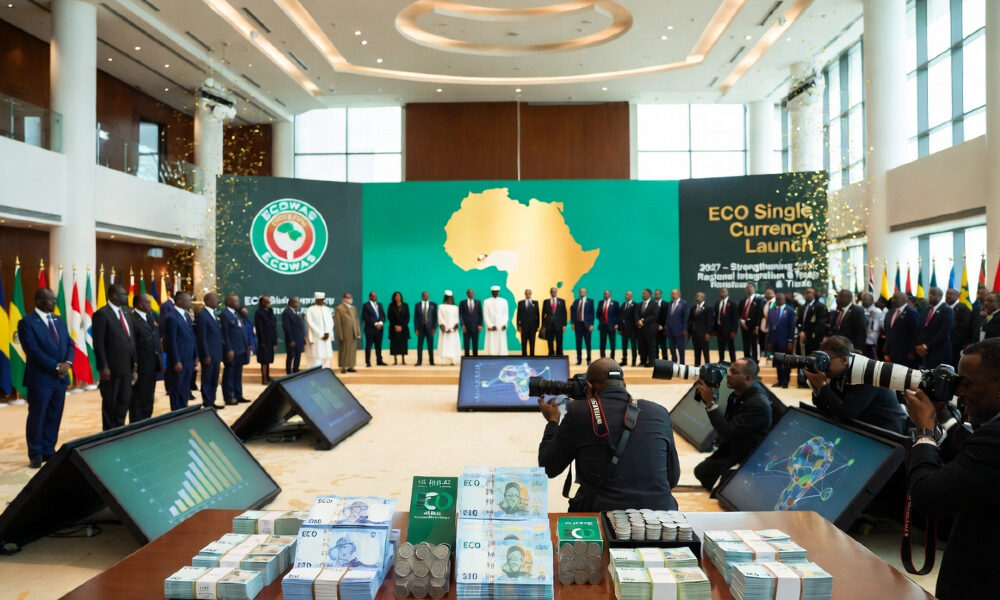
Yet the bloc’s leaders, meeting this month for the 69th Ordinary Session of the ECOWAS Authority of Heads of State and Government in Lungi, Sierra Leone, insist this attempt is different. They emerged from the summit with a formal communiqué reaffirming 2027 as the launch year, a shortlist of countries positioned to go first, and – perhaps most tellingly – a trademark.
A Currency Union, Phased and Conditional
Chairing his final summit before handing the ECOWAS Authority’s rotating leadership to Senegal’s Bassirou Diomaye Faye, Sierra Leonean President Julius Maada Bio presided over a communiqué that reads less like a triumphant declaration and more like a carefully hedged compromise. Rather than a single “big bang” conversion, the eco will roll out in stages. Member states that satisfy agreed macroeconomic convergence criteria will adopt the currency first; the rest will receive support to catch up later.
Those criteria are exacting by regional standards: a budget deficit no larger than 3 percent of GDP, annual inflation held below 10 percent, and foreign-currency reserves sufficient to cover at least three months of imports. According to reporting from the summit, the first wave of adopters is expected to include Sierra Leone, Liberia, Nigeria, Ghana, Guinea, and the Gambia – though final participation will hinge on compliance and further technical work.
This graduated approach is, in effect, an admission of past failure. Earlier eco timelines collapsed largely because member economies were too divergent – oil exporters like Nigeria have little in common, macroeconomically, with agrarian, currency-board-adjacent economies elsewhere in the bloc – to plausibly submit to one monetary policy simultaneously. A phased launch tries to sidestep that problem by letting the readiest economies move first and treating the rest as a work in progress rather than a precondition.
Why West Africa Keeps Trying
The economic logic behind the eco has not changed in twenty years, and it remains compelling. West Africa’s currency landscape today is a patchwork: eight countries share the CFA franc, pegged to the euro and issued by the Central Bank of West African States, while Nigeria’s naira, Ghana’s cedi, the Gambian dalasi, the Liberian dollar, the Guinean franc, and Sierra Leone’s leone all float or manage independently. That fragmentation raises transaction costs, discourages cross-border investment, and forces businesses trading across borders to absorb currency risk that a shared unit would largely eliminate. ECOWAS officials frame the eco, explicitly, as a tool for deepening trade integration and insulating the region’s economies from external shocks – the same argument Europe made for the euro a generation ago.
There are reasons for cautious optimism this time. The Authority’s communiqué points to an improving regional backdrop heading into 2026: declining inflation, falling public debt-to-GDP ratios, and a widening current-account surplus, even as fiscal deficits persist as a source of concern. Officials also flagged progress on less glamorous but telling groundwork – consultations between the ECOWAS Commission and the region’s central bank governors on outstanding technical questions, and the registration of the “ECO” trademark with the African Intellectual Property Organization, a small bureaucratic step that nonetheless signals the project has moved from concept to execution.
The Politics the Communiqué Didn’t Resolve
What the summit did not settle may matter more than what it did. Burkina Faso, Mali, and Niger formally exited ECOWAS after their military governments broke with the bloc, yet all three remain part of the West African Economic and Monetary Union and continue using the CFA franc. Their eventual relationship to a common ECOWAS currency – inside the tent, outside it, or negotiating some hybrid arrangement – went unaddressed in the final communiqué. Given that these three countries were meant to be integral to the bloc’s westward economic reach, that omission is not a footnote; it is a fault line that future summits will have to confront.
The bloc’s own credibility problem looms larger still. A currency union asks sovereign governments to cede meaningful control over monetary policy, fiscal discipline, and – ultimately – a piece of national identity. Nigeria, whose economy dwarfs most of its neighbors combined, would need to accept convergence criteria that could constrain its famously volatile naira management. Smaller economies, meanwhile, must weigh the benefits of monetary stability against the loss of an independent policy lever during local shocks. Reconciling those competing interests is precisely the work that has doomed the eco’s timeline before.
What to Watch Before 2027
ECOWAS has set itself a near-term test: the Commission, along with an expanded Presidential Task Force on the Single Currency Program that Guinea has just joined, is expected to report back ahead of the bloc’s next ordinary summit in December 2026. That gathering should reveal whether the convergence criteria are being met in practice, not just endorsed on paper, and whether the currency’s institutional architecture – a regional central bank, rules for fiscal oversight, mechanisms for enforcing discipline among sovereign members – is taking real shape or remaining aspirational.
History counsels patience bordering on doubt. But something has shifted in the tenor of this year’s commitments: a defined first cohort of countries, published macroeconomic thresholds, and a trademark filing suggest a bureaucracy preparing for implementation rather than merely rehearsing ambition. Whether that translates into a functioning currency circulating from Freetown to Lagos by 2027 will depend on whether West Africa’s governments can do something they have struggled to do for twenty years: agree, and then actually follow through.
Des H Rikhotso is a seasoned C-Suite Multi-Industry (Automotive – OEM + Retail, Logistics, Oil & Gas, etc) business executive with 25+ years of Business Leadership Experience across the South, East and Western Sub-Sahara Africa Region. Based in Kampala, Uganda he serves as East Africa Region Country Director and Business Executive, driving Business Strategic Growth and Operational Excellence – contributing his Business Leadership Experience to the Region. Des has held Business Leadership roles at BMW Group Africa, Volkswagen Group Africa, Peugeot Motors South Africa, Toyota/Lexus South Africa, Lexus East Rand (Unitrans/CFAO), Nissan Group of Africa, G.U.D Holdings (Africa Exports Operations Division),The HDR Group of Companies and The Ezra Group of Companies (a Leading Uganda & East Africa Conglomerate). He holds Under-Graduate and Post-Graduate business degrees from the University of the Western Cape, Wits University (Wits Business School) and the University of South Africa.