Opinion
East Africa’s Oil and Gas Boom: A Golden Opportunity – If Managed Wisely


By Des H Rikhotso
In recent years, East Africa has emerged as one of the world’s most promising frontiers for oil and natural gas development. With vast reserves stretching from the shores of Lake Albert to the deep water basins off the Indian Ocean, countries such as Tanzania, Mozambique, Uganda, and Kenya are poised to transform their economies – if they can navigate the complex web of investment, infrastructure, governance, and sustainability challenges that accompany such wealth.
A Region Rich in Potential
East Africa’s hydrocarbon potential is no longer speculative – it’s measurable and increasingly undeniable. In Uganda’s Lake Albert Basin alone, proven oil reserves are estimated between 3.5 and 4 billion barrels, positioning the country as a significant new player in global oil markets.
Meanwhile, Tanzania has identified approximately 1.4 trillion cubic meters (50 trillion cubic feet) of recoverable natural gas, primarily offshore in the prolific Mafia Basin.
But the real game-changer lies in the Rovuma Delta, shared by Mozambique and Tanzania. According to the U.S. Geological Survey, this region may hold up to 250 trillion cubic feet of natural gas and 14.5 billion barrels of oil, making it one of the largest offshore gas discoveries in the past two decades.
These figures have drawn the attention of global energy giants – from ExxonMobil and TotalEnergies to smaller independent operators – eager to tap into a region that could soon become a major exporter of Liquefied Natural Gas (LNG).
Infrastructure: The Bridge Between Potential and Prosperity
Yet, reserves alone do not guarantee prosperity. Transforming subterranean wealth into sustainable economic growth requires substantial investment in infrastructure.
Key projects such as the Uganda-Kenya Crude Oil Pipeline (UKCOP) – a proposed 1,500-kilometer (932-mile) pipeline designed to transport oil from Uganda’s western fields to the Kenyan port of Lamu – are critical to unlocking export capacity. Similarly, Mozambique is advancing plans for liquefied natural gas (LNG) terminals in the Cabo Delgado province, while Tanzania continues negotiations on a long-delayed national gas pipeline.
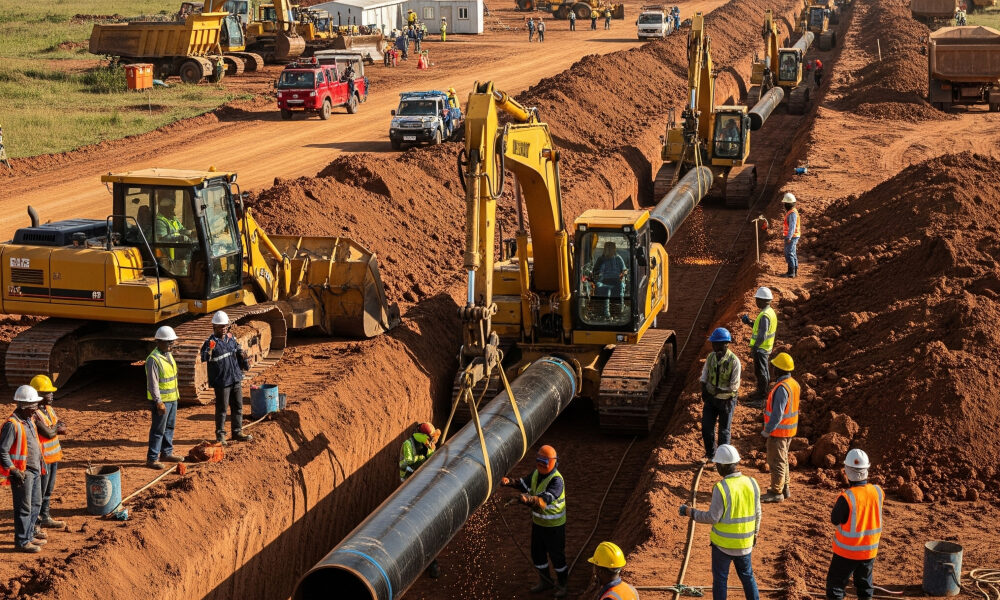
One of the most significant infrastructure initiatives in the region is the East African Crude Oil Pipeline (EACOP). This major development project aims to facilitate the export of Uganda’s crude oil to international markets by establishing a direct transportation link to the coast.
Overview of the EACOP Route:
The EACOP will span 1,443 kilometers (897 miles), transporting crude oil from Kabaale in Uganda’s Hoima District to the Chongoleani Peninsula near the port of Tanga in Tanzania. The pipeline will traverse both countries, passing through multiple districts and regions.
- Origin: Kabaale, Hoima District, Uganda
- Termination: Chongoleani Peninsula, Tanga, Tanzania
- Total Length: 1,443 kilometers (897 miles)
- Ugandan Section: 296 kilometers (184 miles) across 10 districts and 25 sub-counties
- Tanzanian Section: 1,147 kilometers (713 miles) through 8 regions and 25 districts
Key Features of the Pipeline:
- The pipeline will be buried and thermally insulated to maintain crude oil at a consistent temperature of 50°C (122°F).
- It will incorporate fiber-optic cables for real-time monitoring and leak detection.
- Above-ground installations – including pumping stations, block valves, and maintenance facilities – will support safe and efficient operations.
- The design adheres to international best practices and technical standards, incorporating resilience measures to withstand seismic activity and extreme temperature variations.

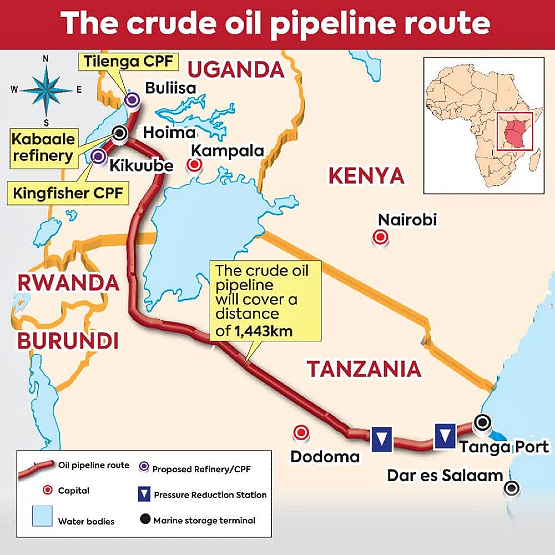
Map of the EACOP route from Hoima, Uganda to Tanga, Tanzania, showing major towns and cross-border infrastructure.
Without reliable pipelines, refineries, storage facilities, and upgraded port infrastructure, East Africa risks leaving billions of dollars in potential revenue untapped underground. The challenge is not merely technical – it is financial.
These infrastructure projects require multi-billion-dollar investments and sustained commitments from both public institutions and private sector partners. Strategic collaboration and long-term planning will be essential to turning natural resource wealth into inclusive, sustainable development.
Governance and the Shadow of the “Resource Curse”
History offers cautionary tales. From Nigeria to Venezuela, nations rich in oil and gas have too often fallen victim to the “resource curse” – where resource wealth fuels corruption, inequality, and economic instability rather than broad-based development.
East African governments must act now to establish transparent revenue management frameworks, enforce strong environmental regulations, and ensure local communities benefit from exploration and production. Initiatives like the Extractive Industries Transparency Initiative (EITI) offer a roadmap for accountability, but political will remains the decisive factor.
In Uganda, for instance, the government has begun publishing oil contracts and revenue projections – an encouraging step. But in Mozambique, where insurgency in Cabo Delgado has disrupted LNG projects and raised security concerns, the stakes are higher.
As World Oil recently noted, security and regulatory instability could delay first LNG production by years, undermining investor confidence and regional ambitions.
Regional Cooperation: Power in Unity
The East African Community (EAC) – a regional bloc comprising six nations – has an opportunity to turn individual national projects into a collective energy strategy. Coordinated infrastructure development, harmonized regulations, and cross-border energy trade could enhance energy security and reduce costs.
Imagine a future where gas from Tanzania powers industries in Kenya, or where Uganda’s oil revenues fund regional transportation networks. This vision hinges on deeper integration, political cooperation, and shared standards – a tall order, but not impossible.
Environmental and Climate Imperatives
As the world transitions toward cleaner energy, East Africa’s oil and gas ambitions face growing scrutiny. While natural gas emits less carbon than coal, it remains a fossil fuel, and large-scale development risks locking the region into carbon-intensive infrastructure.
At the same time, many East African nations still grapple with energy poverty. Over 60 percent of the population in some countries lacks access to electricity.
Responsible gas development – used domestically for power generation and industrial growth – could be a bridge to a more sustainable future, provided it is paired with investments in renewables and strict emissions controls.
The Road Ahead: Opportunity Meets Responsibility
East Africa stands at a pivotal crossroads. The discovery of oil and gas presents a once-in-a-generation opportunity to reduce poverty, create jobs, and build modern economies.
But this potential can only be realized through strategic investment, strong governance, regional collaboration, and environmental stewardship.
The world is watching. As global demand for LNG remains strong – especially in Asia and Europe – East Africa has a chance to become a key energy supplier.
But to succeed, it must do more than extract resources. It must build institutions, protect communities, and invest in the future.
The oil and gas may lie beneath the surface – but the real test lies above ground.
Des H Rikhotso (PgDip-BA, MBL) is a seasoned C-suite Multi-Industry business executive with 25+ years of Business Leadership Experience across the South, East and Western Sub-Sahara Africa Region. Based in Kampala, Uganda he serves as East Africa Region Business Executive, driving Business Strategic Growth and Operational Excellence – contributing his Leadership Voice and Clarity to the Region. Des has held Business Leadership roles at BMW Group Africa, Volkswagen Group Africa, Peugeot Motors South Africa, Toyota/Lexus South Africa, Nissan Group of Africa, G.U.D Holdings (Africa Exports Operations Division) and The HDR Group of Companies. He holds Under-Graduate and Post-Graduate business degrees from the University of the Western Cape, Wits University, and the University of South Africa.