Opinion
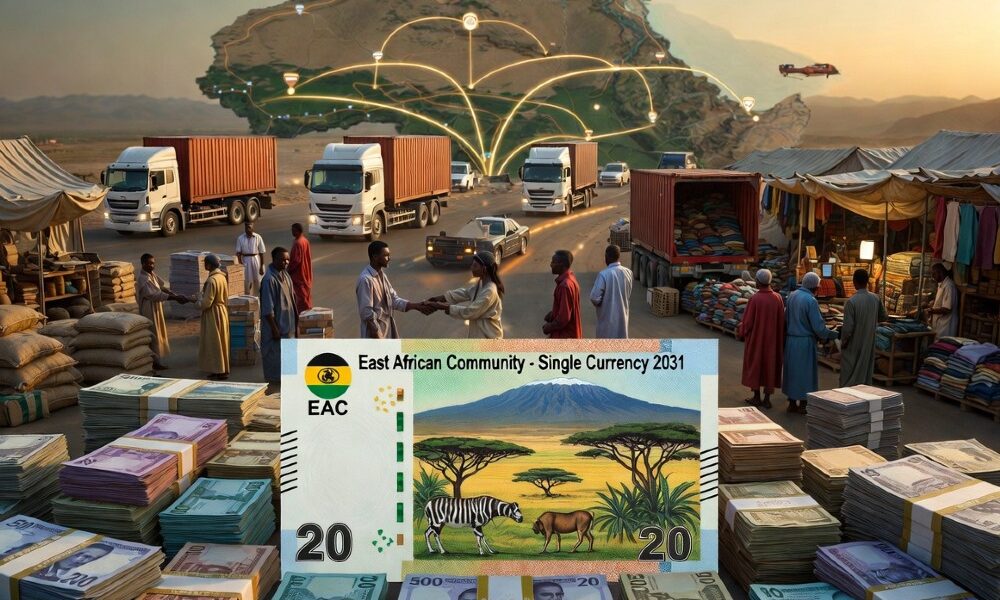
East Africa’s Common Currency: A 2031 Test of Monetary Union Viability
The East African Community has pushed its single-currency target to 2031. Here’s why the plan matters, why it keeps slipping, and what it would take to finally work.


By Des H Rikhotso
Seven years is a long time in monetary policy. It is also, as it happens, exactly how much extra time the East African Community (EAC) has just given itself to pull off one of the most ambitious economic experiments on the continent: a single currency shared by eight nations, from the Indian Ocean coast of Tanzania to the interior of the Democratic Republic of Congo (DR Congo).
The bloc originally promised its citizens a common currency by 2024. That date has come and gone, another casualty of the COVID-19 pandemic, currency volatility, and the kind of fiscal strain that makes coordinated monetary policy look like a luxury rather than a plan. The new target is 2031. Whether that deadline proves any sturdier than the last one is the question hanging over the entire project.
A Bloc Bigger Than It Looks
The EAC is not the sleepy customs union outsiders might picture. It now counts eight members: Kenya, Uganda, Tanzania, Rwanda, Burundi, South Sudan, the DR Congo, and Somalia, the newest addition. Together they represent a market of roughly 300 million people and a combined economy worth well over US$300 billion – numbers that would make the EAC one of the more consequential regional blocs on the continent, if it can hold together.
That is a considerable “if.” Somalia and Ethiopia have been at odds over a port deal with Somaliland, a reminder that the EAC’s members do not always agree on much beyond the ambition of integration itself. Building a shared currency on top of that kind of friction is a bit like renovating a house while the foundation is still settling.
Why Bother With a Single Currency at All?
The economic logic is not hard to follow. A shared currency would, in principle:
- Eliminate currency-conversion costs for businesses and travelers moving across borders that currently require juggling shillings, francs, and pounds.
- Boost trade and investment by removing exchange-rate risk, the kind of uncertainty that makes investors nervous and lenders cautious.
- Simplify cross-border commerce for the small traders and manufacturers who make up the backbone of East African economies.
- Deepen regional integration, following on from the EAC’s customs union and common market, and building toward genuine political and economic cohesion.
The trouble is that intra-regional trade within the EAC remains stubbornly low – only around 15 percent of the bloc’s total trade happens between member states. A common currency will not, on its own, fix that. Infrastructure gaps, non-tariff barriers, and political mistrust have proven just as stubborn as exchange-rate friction. A single currency addresses one obstacle among many, not the whole obstacle course.
The Fine Print: Convergence or Bust
Here is where the EAC’s plan gets serious, and where past attempts have foundered. Before any shared banknote is printed, all eight member states must hit and sustain a set of macroeconomic convergence criteria: caps on inflation, limits on public debt, ceilings on fiscal deficits, and adequate foreign-currency reserves. These are not bureaucratic formalities. They are the same kind of criteria the eurozone imposed on its own members, with mixed results.
Europe’s experience is instructive, and not entirely reassuring. The euro survived its early years, but the 2010s sovereign-debt crisis exposed what happens when countries share a currency without sharing fiscal discipline or political will. East Africa’s economies are more varied still, spanning oil-rich, aid-dependent, and resource-driven models, each with its own inflation dynamics and debt burdens. Locking them into one currency without first narrowing those gaps risks importing Europe’s mistakes without inheriting its institutional depth.
In March 2026, EAC heads of state took a real step forward, signing legislation to establish the East African Statistics Commission and the Surveillance Compliance and Enforcement Commission, along with a formal framework for the East African Monetary Institute. These are the unglamorous plumbing of monetary union: the bodies that will monitor whether member states are actually meeting their targets, rather than simply promising to. Their creation suggests the EAC has learned something from its first missed deadline. Institutions, not just political declarations, are what make convergence enforceable.
Africa’s Next Big Economic Bet?
It is tempting to compare the EAC’s currency ambitions to the African Continental Free Trade Area (AfCFTA), the continent-wide effort to create a single market for goods and services. But the comparison only goes so far. AfCFTA asks countries to lower trade barriers; a monetary union asks them to surrender one of the most potent tools of national economic policy – their own currency – and with it, a measure of control over inflation, exchange rates, and crisis response. That is a far bigger ask, and a far bigger risk, than tariff reform.
If the EAC pulls it off, the payoff could be substantial: a more attractive investment destination, cheaper cross-border commerce, and a genuine rival to other regional currency zones on the continent. If it does not, 2031 risks becoming just another way station on a road that has already run twelve years past its first exit.
The EAC’s leaders are betting that institution-building now will prevent a repeat of 2024’s disappointment. Whether that bet pays off will depend less on the currency itself than on the harder, slower work of getting eight very different economies to actually converge – not just agree, on paper, that they should.
Des H Rikhotso is a seasoned C-Suite Multi-Industry (Automotive – OEM + Retail, Logistics, Oil & Gas, etc) business executive with 25+ years of Business Leadership Experience across the South, East and Western Sub-Sahara Africa Region. Based in Kampala, Uganda he serves as East Africa Region Country Director and Business Executive, driving Business Strategic Growth and Operational Excellence – contributing his Business Leadership Experience to the Region. Des has held Business Leadership roles at BMW Group Africa, Volkswagen Group Africa, Peugeot Motors South Africa, Toyota/Lexus South Africa, Lexus East Rand (Unitrans/CFAO), Nissan Group of Africa, G.U.D Holdings (Africa Exports Operations Division),The HDR Group of Companies and The Ezra Group of Companies (a Leading Uganda & East Africa Conglomerate). He holds Under-Graduate and Post-Graduate business degrees from the University of the Western Cape, Wits University (Wits Business School) and the University of South Africa.