Opinion
Songwe: During this pandemic period, Africa needs additional fiscal space to achieve its short and long term goals.
The Global Pandemic has had significant economic, monetary and fiscal ramifications for Africa
By Dr. Vera Songwe | UN Under Secretary-General & Executive Secretary, UN Economic Commission from Africa
Supply chains shrunk to a trickle at the height of the COVID global pandemic. By July 2020—a mere six months into coronavirus—foreign direct investment to Africa had contracted at alarming proportions. But unlike the GFC where more advanced nations marshalled resources to get out of recession, Africa’s 55 sovereign nations stand to bear the brunt of this economic, fiscal and monetary crisis. To a large extent, the continent does not have an adequately-sized tool shed or the tools necessary to dig out of the fiscal hole the region’s frontier markets are mired in now. With surging public debt crises, African presidents and ministers have had to make difficult decisions: to pay down their debt, or to keep COVID infections and death at bay while continuing to build infrastructure.
In this regard, African Finance Ministers and Economic Commission for Africa proposed the Debt Service Suspension Initiative (DSSI), a fast-acting measure such as a time bound suspension that saw the world’s richest and most advanced economies allow less developed ones to suspend official bilateral credit repayments. Under this welcome development, the G20 committed policy tools to ‘support the global economy, boost confidence to maintain financial stability’ and avoid prolonged economic negativity. Essentially, this is neither the time to preach austerity, nor the period to experiment on perfect economic policy.

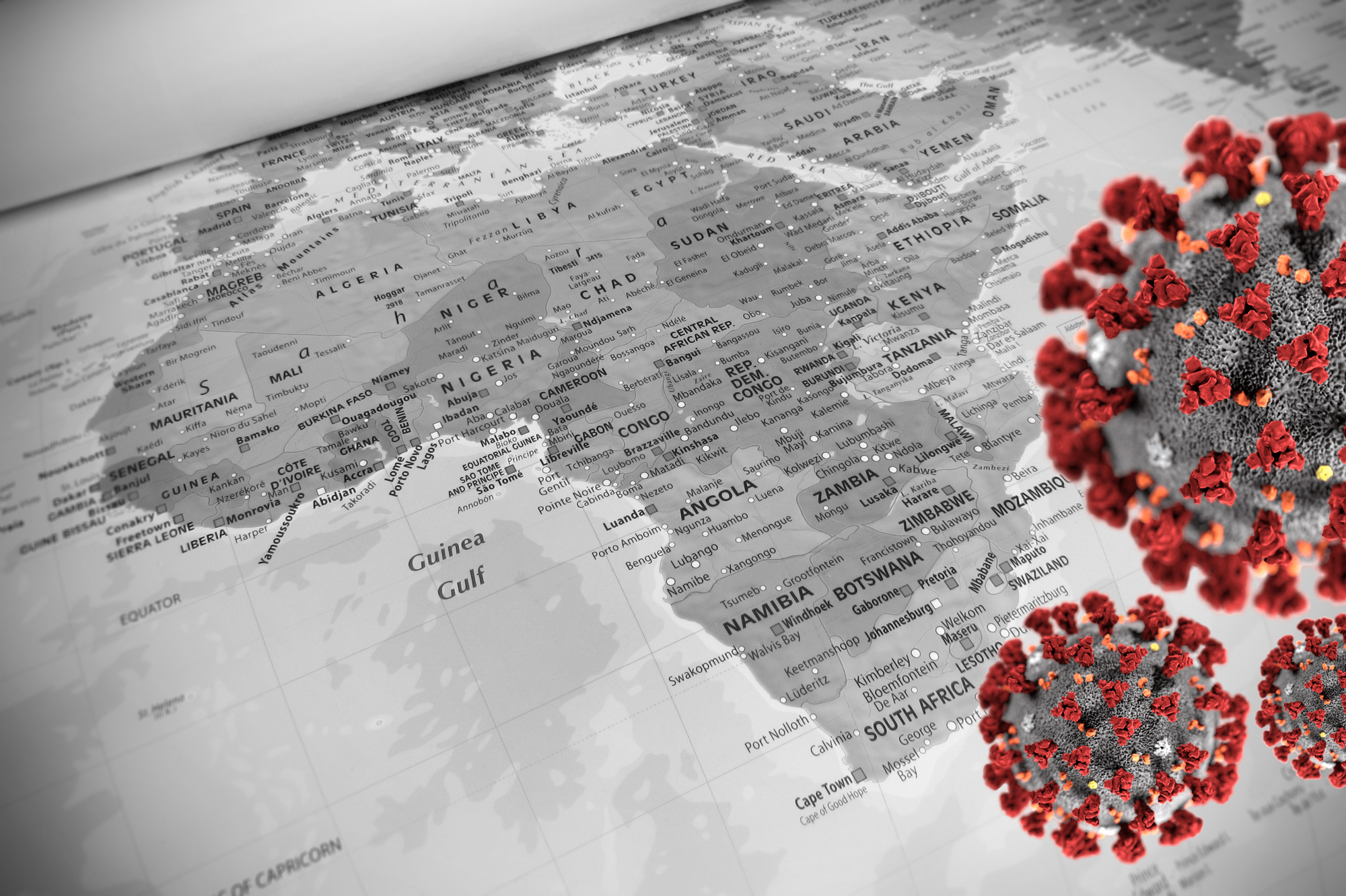
The Global Pandemic has had significant economic, monetary and fiscal ramifications for Africa/Image Courtesy of Deposit Photos
A Little More Would Go A Long Way
However, let us remember where we are now. Whereas developed country citizens are or have received the COVID-19 vaccine, projections are that some Africans will wait until end of 2022. Secondly, if you go back to pre-COVID days, many African countries had fiscal deficits that were above 3 percent of respective annual GDPs, and debt-to-GDP ratios above 50 percent in 2019. In line with current challenges, there is a major opportunity for Africa to close her current funding deficit and even achieve targets under the SDGs. In the United States and in various African capital cities across the Atlantic, there’s the usual start-of-an-administration buzz. U.S. President Joe Biden has assembled an administration that is knowledgeable about Africa. American representative to the UN, Ambassador Linda Thomas-Greenfield will, without a doubt, oversee a world of change, and she can help shape it.
Treasury Secretary Janet Yellen’s support for a new issuance of 650 billion in Special Drawing Rights (SDR) is a strong show of unity in the face of the global pandemic, and we now advocate for support to on-lending some new and unused SDRs to help increase liquidity in African countries.
Rejoining the Paris Agreement is a welcome move on America’s part. We are also seeing more movement on the multilateral agenda, one of those being President Biden’s decision to rejoin international organizations and support the World Trade Organization (WTO). On the economic front, the African Growth and Opportunity Act (AGOA) expires in less than four years. A call for the U.S. to find a more permanent preference program for the world’s fastest growing region is appropriate. After all, despite its post-NAFTA challenges and loss of competitive advantage, the Caribbean Basin Economic Recovery Expansion Act of 1990 (CBI II) – a program that emanated from the Caribbean Basin Initiative (CBI) – is a permanent preference program that remains in existence many years later.
On the other hand, the U.S. and Africa stand to gain from an even stronger relationship. The African Continental Free Trade Area (AfCFTA) provides a blue print for doubling investment. Africa continues to reform its economies; amongst other indices, evidence is laid out in the World Bank Doing Business (DB) rankings, and in Heritage Foundation’s Index of Economic Freedom. Each year, more than five African nations are recognized for improving their business environment.
Thus, the United States’ new development outlook for Africa, and push for institutional quality should work to increase foreign direct investment to the continent.
The U.S. International Development Finance Corporation could be a bridge for African and U.S. business. Combining the tools of the Overseas Private Investment Corporation (OPIC) and financial muscle of over US$ 60 billion could be transformational for Africa, creating jobs, increasing productivity and delivering prosperity for both Africa and the U.S. Africa is ready to partner, recover, and reset together.
About Vera Songwe
Vera Songwe is UN Under Secretary General & Executive Secretary of the UN Economic Commission for Africa, and a non-resident senior fellow in the Africa Growth Initiative at the Brookings Institution. Previously, she was Regional Director Africa covering West and Central Africa for the International Finance Corporation, and Country Director for Senegal, Cape Verde, The Gambia, Guinea Bissau, and Mauritania at the World Bank.