Opinion
DR Congo is the world’s largest producer of cobalt – how control by local elites can shape the global battery industry
By Raphaël Deberdt and Jessica DiCarlo
The mineral-rich Democratic Republic of the Congo (DR Congo) is often portrayed as a victim of exploitation by China, the US and Europe in their competition for its minerals, which are critical for the energy transition.
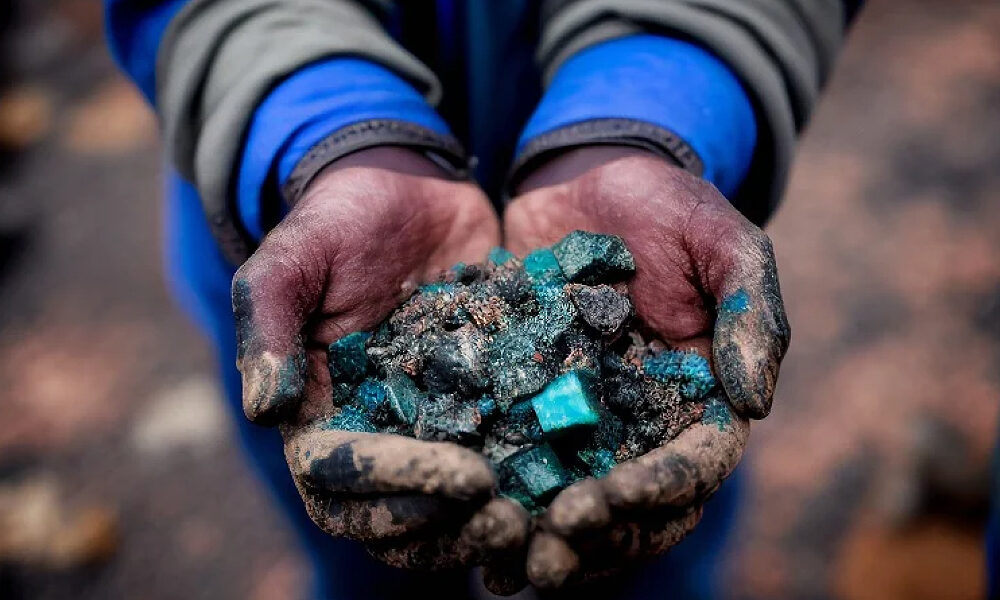
But our research has found that the DR Congo can influence the shape of the cobalt market, in which it is the single largest producer. Cobalt is a very important metal. It reduces overheating in batteries and is essential in the manufacture of electric vehicles.
Our research, conducted in both China and the DR Congo, reveals how governments that are often viewed as peripheral, such as the DR Congo, can influence and sometimes define global industries.
Our findings were based on months of fieldwork in the artisanal and industrial cobalt mines of the DR Congo and on China’s infrastructure developments. We also examined local media and government documents to review legal and administrative decisions.
We found that there’s a high level of control by the DR Congo government, both national and regional. Mining policy decisions made by politicians in the DR Congo’s capital Kinshasa or mining regions like Kolwezi are felt throughout global battery supply chains. For instance, as the producer of 70 percent of the world’s cobalt, the DR Congo has influence over the global electric vehicle battery supply chain.
Despite this, the DR Congo isn’t using this influence for the benefit of the DR Congo people. An estimated 74 percent of people in the DR Congo continue to live in poverty. Some mining revenues flow to the government but communities living near mines see little improvement in their daily lives. Many continue to face poverty, pollution, and dangerous working conditions in and around the mines.
China’s cobalt processing
Cobalt was first mined in the DR Congo in 1914 during the long period of Belgian colonization, from 1885 to 1960, when many of the country’s precious resources were pillaged by Belgium.
Today, DR Congo cobalt is shipped to China, which accounts for 65 percent of all global cobalt processing into cathodes for lithium ion batteries (rechargeable batteries). China is also the world’s biggest producer of these batteries and dominates the electric vehicle industry. In 2023, one in five cars sold worldwide was an electric vehicle.
In China, the cobalt refining and battery manufacturing industry has grown rapidly over the past two decades. Chinese companies have invested heavily in developing advanced processing technologies and large-scale production facilities.
These factories transform raw cobalt from the DR Congo into high-purity cobalt compounds and integrate them into battery cathodes. Chinese companies like Huayou Cobalt, CATL and BYD have become global leaders in cobalt refining and battery production, supplying the global electric vehicle market.
DR Congo influence over the cobalt industry
Though Chinese mining companies, both private and state-owned, control vast cobalt deposits in the DR Congo, our research concluded that the DR Congo can exert significant influence over the wider industry.
For instance, when the DR Congo government suspended exports from the largest Chinese-owned cobalt mine in 2022 over financial disputes, it temporarily halted about 10 percent of global cobalt production.
More locally, when governor Fifi Masuka Saini was appointed in DR Congo’s cobalt-rich Lualaba province, she seized trucks that were transporting cobalt to pressure Chinese companies that received the largesse of the former governor and close ally of President Kabila. The result was a realignment of Chinese operators with the new government.
Local politics can also cause a standstill in production. For instance, China’s cobalt industry sources some cobalt from artisanal miners and in 2021, the DR Congo’s national government canceled contracts from artisanal sites even though they had been approved by the provincial government. While Kinshasa pushed for the establishment of a centralized purchasing company for the artisanal cobalt produced in the province, provincial interests clashed with this approach. Chinese operators found themselves in the middle. Lengthy negotiations between the Chinese and Congolese ensued which placed the company in a slippery situation depending on the political wills of both Kinshasa and Kolwezi.
The government has also been able to use its influence over minerals by pushing for better terms in mining contracts and more domestic processing of minerals. In 2018, for instance, it declared cobalt a “strategic” resource and tripled export taxes.
Locals haven’t benefited
However, despite the influence the DR Congo can exert over the sector, those that should be benefiting from the lucrative cobalt industry, like the miners, aren’t.
Today, there are at least 67 artisanal cobalt mines in the south east of DR Congo. About 150,000 artisanal miners work in the industry, and face hazardous conditions.
These include being buried in collapsing mine pits and exposed to radioactive gas.
Miners are also exploited, with up to 50 percent of their revenue seized by cooperatives – associations of miners that are often controlled by powerful politicians. An estimated 40,000 children labor in the DR Congo’s artisanal cobalt mines under dangerous circumstances.
Local realities matter
Our research shows that the shift to clean energy technologies is not simply a matter of scientific innovation or great power politics. Global supply chains can even be shaped by local elections in African mining towns.
The transition to renewable energy is global. Countries like the US and China need to treat producer nations like the DR Congo as partners in the global energy transition rather than just suppliers of raw materials whose local populations could be harmed by the transition. This could be done by supporting the set up of localized supply chains, more local added-value, including further transformation of the cobalt in the DR Congo, fairer contracts, and more.
Especially as the electric vehicle revolution accelerates, the often-overlooked voices and interests of mineral-producing regions like the DR Congo must be heard. By revealing these less visible power dynamics, this research provides insights for policymakers, companies and concerned citizens working towards a cleaner energy future.
Raphaël Deberdt, is a Postdoctoral Fellow, Mining Engineering Department, at the Colorado School of Mines. He specializes in critical minerals extraction, production and trade, and his interest in Central Africa motivated his research on the artisanal cobalt sector. He receives funding from the National Science Foundation and the Alfred P. Sloan Foundation.
Jessica DiCarlo is an Assistant Professor of Geography at the University of Utah. Her research broadly focuses on development, issues at the environment-society nexus, and China’s global engagements. She received funding from The Wilson Center. This article is republished from The Conversation under a Creative Commons license. Read the original article.