A Diaspora View of Africa
Diaspora Trade Now Can Become More Business-to-Business


By Gregory Simpkins
The destruction of the U.S. Agency for International Development (USAID) is just about complete. Even Prosper Africa, administered by the agency and created by the first Trump administration has been shrunk and is to be folded into the State Department.
So too is Power Africa and Feed the Future, both also managed by USAID.
There are many observers and analysts who speculate this this could force African governments to do more to promote business in their countries, including intra-Africa trade. Perhaps that will happen but not overnight.
In conducting training on the African Growth and Opportunity Act (AGOA) together as we do here in the United States, although our collaboration is not perfect either.
Chike Ayodele Igwegbe, an occasional contributor to The Habari Network and founder of Eco Trinity Homes, a company dedicated to developing sustainable communities, stated on our site that even though foreign aid has provided needed assistance to African countries, it also has contributed to a cycle of dependency that has, at times, hindered local innovation and self-determination.
“The reduction in U.S. funding presents an opportunity for Africa to shift its focus from external assistance to harnessing its own resources and capabilities, Igwegbe wrote. “Africa is endowed with abundant natural resources, a rich cultural heritage, and a wealth of knowledge.
“By investing in homegrown solutions and policies tailored to its unique economic and social realities, the continent can pave the way for sustainable growth and development.” We shall see relatively soon how all this aid rearrangement works beyond theories, but one US initiative regarding trade has not been mentioned in the effort to make program cuts: AGOA.
That is because AGOA is monitored and administered by several agencies and has no specifically dedicated staff. While I was with USAID, I worked on AGOA, but not that program exclusively, so cutting my position – as with so many others in similar circumstances – would gain little to nothing budgetarily.
The Shifting Landscape of US-Africa Trade Relations
Just as Igwegbe and other believe the aid cutoff provides an opportunity for African governments to do something different on their own behalf, it also provides an opportunity for business-people, including those in the Diaspora, to experience trade under different circumstances. Anyone like myself who worked on AGOA from the beginning will tell you that the original intent was for the program to involve businesses interacting with other businesses.
Unfortunately, it has turned out to be a government-to-government enterprise. The United States has suspended countries from AGOA for non-trade reasons – seven in the last administration alone – while allowing others to remain despite genuine trade-related concerns.
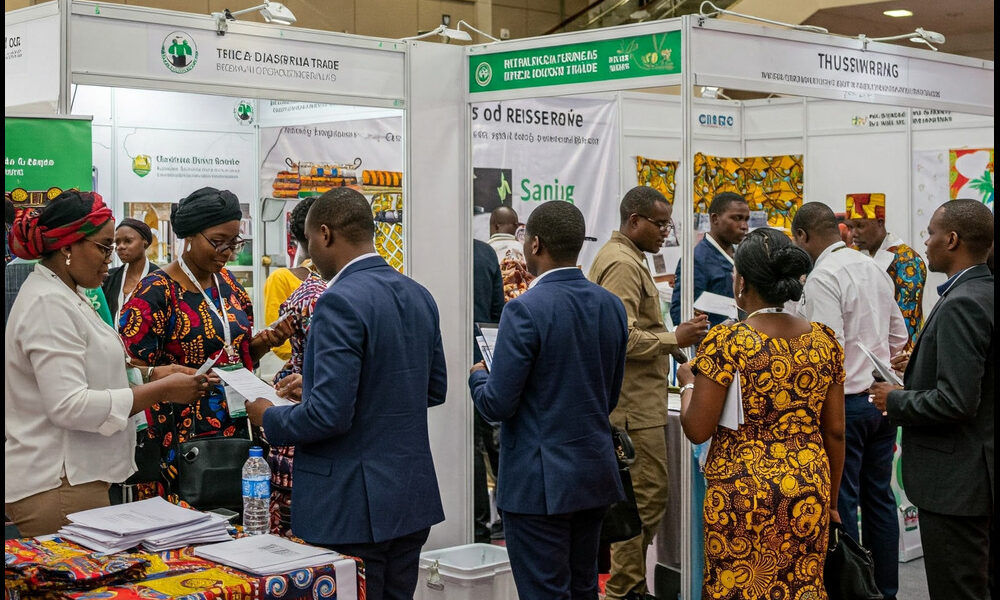
Without robust US government involvement in international trade processes due to budget and personnel cuts, American and African business-people will be freer to interact with one another on a business-to-business basis. Moreover, they will not be bound merely to US-Africa trade but can look far afield to Diaspora businesspeople worldwide.
Currently, some business-people are concerned that the situation in which we find ourselves means no government assistance to facilitate trade. Yet government has more often presented impediments to Diaspora trade rather than real assistance as business-people have told me over the years.
AGOA did not provide funding so nothing would be lost on that score. While I am not sure how the country commercial information gathering will work between the State Department, Commerce Department and other agencies, there is little they provide that cannot be replicated through the private sector.
In a February 24 article on Semafor news platform, Africa policy watchers in Washington, DC, were increasingly skeptical about the future of AGOA, a trade deal that offers sub-Saharan African countries duty-free access to the US market. The 25-year-old free-trade program, set to expire in September, is unlikely to survive in its current form, Capitol Hill staffers and analysts told Semafor, as US President Donald Trump pursues a policy of introducing tariffs with longstanding free trade partner nations.
One congressional staffer, who spoke to Semafor on condition of anonymity, said they viewed AGOA as “80 percent dead.” News that four Republican Congressmen this month called for South Africa to be ruled ineligible for AGOA over geopolitical concerns has only added to the uncertainty.
The Future of AGOA and the Rise of Intra-African Trade
Having been associated with AGOA for the entirety of its existence as a program, I can attest that it is too valuable for too many American interests for Congress to let it disappear.
There are, of course, trade benefits that the Department of Government Efficiency might consider targeting, but that agency will find it might be too toxic to cut with legislators looking out for their constituents. Ironically, those of us who fought for Senate support for AGOA in the beginning appealed to the development benefits; to appeal to the Trump administration, we must promote the mutual economic benefits of trade.
So, as long as AGOA brings trade benefits to Africans, and ultimately to American buyers and suppliers, it will be more difficult to justify its disappearance.
In the meantime, Diaspora businesses should be able to take a new track and conduct business without significantly depending on direct government support. I say this with confidence because I know Diaspora business-people who have been successful with minimal government assistance in the best of times.
To be successful, Diaspora business-people will have to become more acquainted with international trade processes and the offers of international financial institutions such as the African Development Bank and the African Export-Import Bank. For example, the African Continental Free Trade Area (AfCFTA) offers the potential of a continent-wide process to reach 54 countries without having to establish offices in each one.
With a combined GDP of approximately US$3.4 trillion, AfCFTA connects 1.3 billion people across diverse regions of the continent. It is the largest free trade agreement by membership in the world, aiming to position Africa as a unified, industrialized, and competitive global economic player.
Unfortunately, like the AGOA process has become, AfCFTA is government-to-government, as evidenced by the fact that the dispute resolution mechanism in place is primarily designed for governments.
Navigating a New Era of Diaspora Business and Regional Trade Agreements
After more than a decade of negotiations, the Tripartite Free Trade Area (TFTA) officially came into force in 2024, marking a historic milestone in Africa’s economic landscape. This groundbreaking agreement unites 29 African nations from the Common Market for Eastern and Southern Africa (COMESA), the East African Community (EAC), and the Southern African Development Community (SADC), creating one of the largest free trade zones on the continent.
Africa has long engaged in trade agreements, but the TFTA stands out due to its scale and impact. Covering a market of 800 million people and representing over 60 percent of Africa’s GDP (approximately US$1.88 trillion), it offers significant economic potential. TFTA member states also account for 53 percent of the African Union’s total membership.
Hopefully TFTA will be more accommodating toward business-people in the Diaspora.
After counting on government assistance for so long to facilitate international trade, it will take some getting accustomed to a road with no familiar guardrails. Furthermore, working in concert with unfamiliar businesses will pose a difficulty in the beginning, but it should be possible to move toward collaboration in the long run since it is in the mutual interest of so many in North America, Africa, the Caribbean, Europe and South America.
Gregory Simpkins, a longtime specialist in African policy development, is the Principal of 21st Century Solutions. He consults with organizations on African policy issues generally, especially in relating to the U.S. Government. He further acts as a consultant to the African Merchants Association, where he advises the Association in its efforts to stimulate an increase in trade between several hundred African Diaspora small and medium enterprises and their African partners.