Owusu on Africa
Democracy Isn’t ‘Western’ – It’s African Too


By Fidel Amakye Owusu
In recent years, a troubling refrain has gained traction across Africa: “Democracy is not good for Africa.” I heard it echoed last year at an international conference, where foreign ministers from Mali and Burkina Faso repeated the line – sometimes with conviction, sometimes with rhetorical flourish.
But the sentiment lingers, amplified online and in political discourse, especially among younger generations.
At first glance, it sounds like a bold critique of Western interference. But dig deeper, and the phrase reveals a dangerous misconception – one that risks undermining Africa’s own democratic heritage and future.
The Myth of “Western Democracy”
Critics often dismiss democracy as a foreign import, lumping it under the vague and misleading label of “Western democracy.” Yet this term itself is a mirage.
There is no monolithic Western model. The United States operates under a federal-presidential system shaped by an electoral college; Germany follows a federal parliamentary republic; France blends a strong presidency with semi-parliamentary features; and the United Kingdom maintains a unitary parliamentary monarchy.
These systems differ profoundly in structure, culture, and practice.
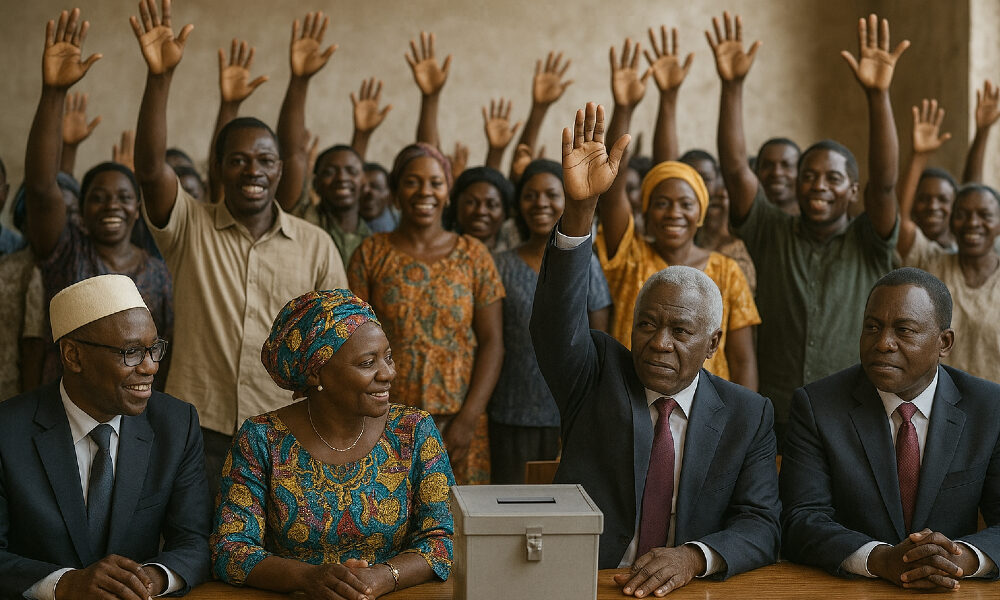
More importantly, the core principles of democracy – human rights, consensus-building, accountability, and limits on power – are not Western inventions. They are universal values with deep roots in African political traditions.
Africa’s Indigenous Democratic Traditions
Long before colonial borders carved up the continent, many African societies practiced forms of governance grounded in consultation, balance, and collective decision-making. Take the Akan people of present-day Ghana: their kings were never absolute rulers.
Unlike Louis XIV’s infamous declaration, “L’État, c’est moi” (“I am the state”), no Akan chief could claim to embody the state itself. Leadership was conferred through consensus among elders, spiritual leaders, and community representatives.
Checks and balances were built into the system – removal from office was not only possible but practiced when leaders failed their people.
Similar traditions existed across the continent – from the Igbo “republican” village assemblies in Nigeria to the age-grade systems of East Africa and the deliberative councils of the Ashanti Empire. Power was rarely concentrated; legitimacy was earned, not inherited.
Colonialism Disrupted – Not Defined – African Governance
The real rupture came with colonialism. The arbitrary partitioning of Africa at the 1884–85 Berlin Conference forced dozens of distinct ethnic groups, languages, and political systems into artificial nation-states.
In Ghana, the Akan, Ewe, Mole-Dagbani, and others were merged into a single colony. In Kenya, the Kikuyu, Luo, Kalenjin, and more were bound together under British rule.
This legacy poses a genuine challenge: How do diverse communities coexist within modern nation-states without domination by one group? The answer isn’t authoritarianism or hereditary rule—it’s inclusive democracy.
A system where every citizen, regardless of ethnicity or region, can aspire to lead. Where leadership is chosen—not imposed.
Where no single group monopolizes power indefinitely. That is not “Western” democracy. That is African democracy, adapted to contemporary realities.
Reclaiming Democracy as an African Value
To say democracy doesn’t work for Africa is to deny Africa’s own history—and to surrender the future to those who benefit from centralized, unaccountable power. Democracy isn’t flawless, and its implementation in post-colonial states has often been marred by corruption, elite capture, and external interference.
But the solution isn’t to abandon democracy—it’s to deepen and democratize it further, rooted in local values and institutions.
Africa doesn’t need to import democracy. It needs to remember it.
The path forward lies not in rejecting democratic ideals as foreign, but in reclaiming them as homegrown, evolving, and essential to building just, stable, and prosperous societies across the continent.
Fidel Amakye Owusu is an International Relations and Security Analyst. He is an Associate at the Conflict Research Consortium for Africa and has previously hosted an International Affairs program with the Ghana Broadcasting Corporation (GBC). He is passionate about Diplomacy and realizing Africa’s global potential and how the continent should be viewed as part of the global collective.