Opinion
Data Is the New Territory: Why Africa Must Govern Its Digital Sovereignty
Africa’s next sovereignty battle isn’t over land or minerals – it’s over data. Without strong data governance, the continent risks losing control of its digital future.
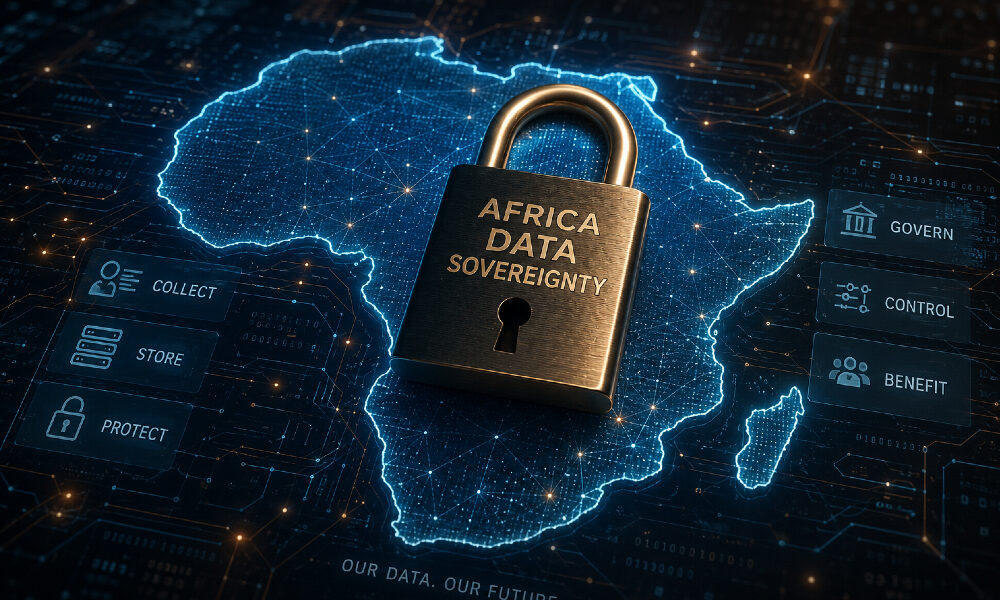


By Daki Nkanyane
For centuries, power in Africa – and everywhere else – was measured in land, minerals, ports, and trade routes. That calculus is changing. In the twenty-first century, a new and less visible form of territory has emerged, and it is just as consequential: data.
This is not a futuristic abstraction. Data is the continuous record of how a society moves, spends, learns, works, communicates, travels, heals, and votes. It spans financial histories, health records, biometric identities, agricultural data, geolocation trails, consumer behavior, and the digital exhaust of everyday public and private life. In a world run on artificial intelligence, cloud computing, and algorithmic decision-making, data isn’t just information – it’s leverage. The African Union’s Data Policy Framework recognizes as much, treating data as a strategic asset and calling for a harmonized, continent-wide approach to governing it.
A New Kind of Sovereignty
Territory has traditionally meant land under a state’s control. That still matters. But today, territory also includes the informational layer through which nations, companies, and societies are tracked, classified, and ultimately governed.
A country can hold its borders secure while quietly losing its grip on the data that defines its people, markets, and institutions. That is a subtler kind of vulnerability, but a real one nonetheless. It’s why the Pan-African Parliament has increasingly linked data sovereignty and ethical AI to the continent’s long-term development, security, and economic prospects.
Africa needs to grasp this early. If the continent doesn’t govern its own data, others will end up governing Africa through it.
That isn’t alarmism – it’s simply how the system works. Whoever stores, analyzes, monetizes, and sets the standards for data gains real influence over the decisions African societies make.
Data increasingly determines credit scores, digital identity, public-service delivery, agricultural planning, health policy, insurance pricing, and the performance of the AI systems now shaping daily life. If the digital infrastructure underlying African societies is built and run largely from elsewhere, Africa risks becoming digitally visible without becoming digitally sovereign.
Beyond Connectivity: The Real Question Is Control
Africa has rightly spent years pursuing digital inclusion – expanding internet access, digital payments, and e-government services. But connectivity without governance is only half the job. A more connected society can also be a more exposed one. The World Bank’s 2025 research on digital governance in Africa makes this point clearly: technology can strengthen state capacity and public accountability, but only if the governance of the digital economy itself is treated seriously.
That reframes the central question. It is no longer simply who is connected? It is who is in control? Who sets the rules on cross-border data flows? Who owns the cloud infrastructure African data sits on? Who defines consent and data portability? Who profits from behavioral data generated in African markets? Who trains AI models on African languages and transactions? These are not technical footnotes – they are sovereignty questions.
Sovereignty, in this context, doesn’t mean isolation. Sealing Africa off from the global digital economy would be both impossible and self-defeating. What the continent needs instead is the capacity to engage globally while still setting the terms at home. That is precisely the ambition behind the AU’s Data Policy Framework, which aims to harmonize governance standards well enough to support intra-African digital trade under the African Continental Free Trade Area (AfCFTA), rather than leaving the continent fragmented and externally shaped.
Fragmentation Is the Real Vulnerability
Fifty-four countries, fifty-four legal systems, and wildly uneven regulatory capacity make for an easy target. One country underregulates. Another overregulates without the enforcement muscle to back it up. A third outsources its digital backbone entirely. The result isn’t sovereignty – it’s a patchwork of weak bargaining positions. External players don’t even need to dominate by force in that scenario; they dominate simply by being more coherent, arriving with better infrastructure, deeper capital, and more sophisticated legal teams than fragmented African states can match individually.
That is why data governance belongs in the boardroom of continental strategy, not the back office of technical compliance. The United Nations Conference on Trade and Development (UNCTAD) now treats data governance as central to the global digital economy, not a side issue, emphasizing inclusive digital growth and implementation of the Global Digital Compact so developing economies aren’t left permanently behind. For Africa, where AI, fintech, digital public infrastructure, and cross-border trade are all expanding simultaneously, that guidance carries particular weight.
More Than a Privacy Problem
Privacy matters enormously, and citizens deserve real protection from surveillance and exploitative data practices. But the stakes go well beyond privacy in the narrow sense. Health records, land registries, national identity systems, court records, agricultural data, and language archives are not disposable by-products of modernization – they are the informational foundation on which future economic and political power will be built. Treating them carelessly is a bet against the continent’s own future.
This urgency compounds in the age of AI. Machine learning systems are only as good as the data that trains them. If African languages, transactions, and social patterns are underrepresented in global datasets, African realities will be poorly understood by the very systems now shaping credit, healthcare, and public services. UNESCO’s recent work on AI localization in Africa makes the same warning: without deliberate effort, African languages and contexts risk becoming permanently peripheral to the AI era, while the continent supplies raw data for value that is captured elsewhere.
Not Oil – Territory
The comparison of data to oil, once fashionable, is misleading. Oil is depleted by use; data can be endlessly reused, recombined, and multiplied in value. A better metaphor is territory itself: something that must be actively governed, protected without being sealed off, and used productively without being surrendered by default.
That calls for what might be described as a doctrine of informational stewardship. Not all data needs to stay within national borders, and not every cross-border data flow is a threat. But Africa needs clear, shared principles about which data is strategic, which requires local safeguards, and which can move freely under trusted frameworks. As the World Bank’s research on digital public infrastructure argues, standards are never neutral – they determine who participates, who captures value, and who bears the risk.
A Market Question, Too
Poorly governed data ecosystems create uncertainty for African banks, startups, health-tech firms, and logistics companies, while leaking economic value outward. Well-governed ones make African markets more trustworthy, interoperable, and investable – exactly the conditions needed to scale intra-African digital trade under AfCFTA. Beyond commerce, there is a subtler stake: narrative power.
Whoever holds the data effectively gets to define the story – assessing creditworthiness, market potential, and social behavior through systems that outsiders build and Africans often cannot fully inspect. Left unchecked, this is not just an economic risk; it’s an epistemic one, in which the continent becomes better known to others than to itself.
The Window Is Closing
None of this can be solved with connectivity alone. Africa needs data institutions: regulatory capacity, trusted legal frameworks, interoperable standards, cybersecurity expertise, and public officials who understand that digital sovereignty is administrative and technical work, not a slogan for conference panels.
Time is not on the continent’s side. Digital platforms are scaling, AI models are improving, and global standards are hardening – often faster than African institutions can respond. The risk isn’t only that Africa moves too slowly; it’s that the architecture of the digital economy will solidify around the continent before it has meaningfully shaped the rules.
Africa still has a window to treat data as a foundation of sovereignty, trade, and public trust rather than an afterthought for technical specialists. But that window will not stay open indefinitely.
Territory, in the end, is not only what lies beneath a people’s feet. It is also what lies inside the systems through which they are counted, understood, and governed. A continent that wants genuine sovereignty in this century must govern not just its land, its minerals, and its markets, but its data too – because data is the new territory, and a people that fails to defend its territory will eventually find that someone else has drawn the map.
Daki Nkanyane is a South African – born Pan-African thought leader, entrepreneur, keynote speaker, and strategist with over 25 years of experience driving innovation, identity, and development across Africa. He is the Founder & CEO of Interflex Capital, AfrisoftLive, QonnectedAfrica, and iThinkAfrica, where he focuses on youth empowerment, entrepreneurial ecosystems, and Africa’s economic and ideological renewal. His work spans technology, digital transformation, major international events, and strategic advisory for future-ready African institutions. As a contributing writer for The Habari Network, Daki covers African innovation, leadership, human capital, economics, entrepreneurship, and Africa–Caribbean relations through cultural, philosophical, and developmental perspectives. His mission is to help shape a new African consciousness rooted in pride, possibility, and self-determination for Africans on the continent and in the diaspora. He can also be reached on Facebook and X.