Business
Dangote’s Namibia Pipeline: The Private Path to African Energy Power
Aliko Dangote is building the infrastructure that governments never could – and quietly rewriting the rules of regional trade.


By Mark-Anthony Johnson
For decades, the energy story of Southern Africa has been a story of distance. Fuel arrives by sea at a handful of ports, then crawls inland by tanker truck over worn roads, through slow border posts, to the landlocked economies that need it most. Every kilometer adds cost, delay and risk. Every disruption, whether a global price spike or a clogged border crossing, lands on the consumer.
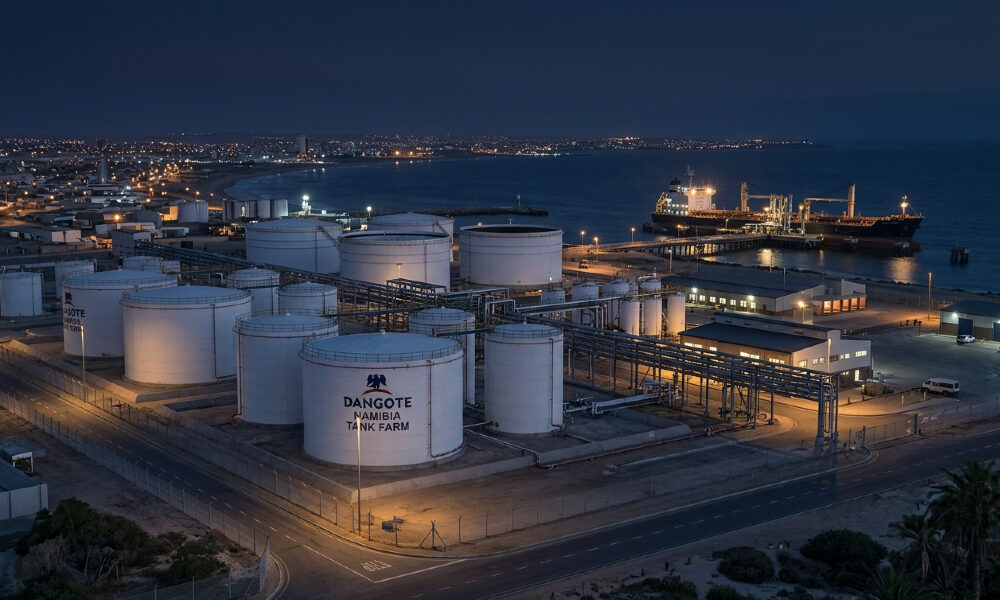
On Wednesday, Aliko Dangote set out to rewrite that equation. The Nigerian industrialist broke ground on the US$2.5 billion Dangote Namibia Tank Farm and Regional Pipeline Project at Farm 58 in Walvis Bay, in a ceremony co-officiated by Namibia’s president, Netumbo Nandi-Ndaitwah. If it delivers on its promise, the project will turn a modest coastal port into the logistical heart of a regional fuel network. The question is whether the promise survives contact with reality.
The Scale Is the Story
The numbers are deliberately outsized. The terminal is designed to hold roughly 600 million liters of fuel, about 4 million barrels, split between 360 million liters of diesel and 240 million liters of petrol. That is eight times the capacity of Namibia’s current National Oil Storage Facility. For a country that has long lived close to the edge on fuel reserves, the difference is not incremental. It is a change in kind.
The tank farm is only half the plan. A proposed 1,700-kilometer (1,056-mile) pipeline would run inland from Walvis Bay through domestic hubs such as Otjiwarongo and Rundu before crossing borders to serve Botswana, Zimbabwe, Zambia, Malawi and the southern regions of the Democratic Republic of Congo, alongside Namibia itself. The supply would come from the 650,000-barrel-per-day Dangote Petroleum Refinery in Lagos, which makes Walvis Bay the western landing point of an intercontinental supply chain that, until recently, would have sounded fanciful.
The tank farm is scheduled for completion in 18 to 20 months. Note the careful wording: that timeline applies to the coastal terminal. The pipeline remains, for now, a proposal.
Why It Matters: Buffer Stocks and Broken Roads
The strategic case rests on three arguments, and each deserves scrutiny.
The first is energy security. A storage buffer of this size gives the region a cushion against the shocks that routinely rattle import-dependent economies. Anyone who lived through the fuel-price turbulence of recent years understands the value of a full tank when markets seize up.
The second is cost. Moving fuel by pipeline is cheaper than moving it by truck, and it removes thousands of heavily loaded tankers from roads that were never built for them. The savings should show up not only in pump prices but in lower road-maintenance bills and fewer of the border queues that sap productivity across the region.
The third is jobs. Heavy construction, specialized engineering, logistics and long-term maintenance should generate thousands of positions. This is the argument most often made for megaprojects, and the one most often oversold. The real test will be how many of those jobs go to local workers and how many skills are left behind once the cranes leave.
The Uncomfortable Questions
Enthusiasm is cheap. Pipelines are not. A cross-border network spanning half a dozen sovereign states is as much a diplomatic undertaking as an engineering one, and the history of regional infrastructure in Africa is littered with ambitious plans undone by mismatched regulations, contested tariffs and shifting political winds.
Consider what the model demands. Six or seven governments must agree on transit fees, safety standards, customs treatment and dispute resolution. Each must accept that a single private company, however capable, will sit at the center of its fuel supply. That raises a legitimate question about market concentration. A system that lowers costs by integrating the supply chain from Lagos refinery to Zambian filling station also concentrates enormous leverage in one set of hands. Regulators in the receiving countries will need to ensure that efficiency does not curdle into dependency.
There is also the matter of the energy transition. Governments across the region have climate commitments, and a pipeline built today will be asked to earn its returns for decades. Investors will want assurance that fuel demand will hold up; policymakers will want assurance that they are not locking in a fossil-fuel corridor just as cleaner alternatives mature. Both can be true at once. Africa’s energy needs are vast, and billions of people still lack reliable power and fuel. But the honest case for this project must acknowledge the tension rather than wave it away.
A Pattern, Not an Exception
Walvis Bay does not stand alone. The project fits a broader expansion by the Dangote Group to build distribution links across the continent, following its recent US$660 million pipeline development connecting Djibouti and Ethiopia. Taken together, these moves suggest a strategy: use a single giant refinery as the anchor, then build the arteries that carry its output to markets that have been poorly served by existing infrastructure.
It is a bold approach, and a rare one. Africa’s private sector has too seldom financed infrastructure at this scale, leaving the job to governments with stretched budgets or foreign lenders with their own agendas. An African industrialist building continental infrastructure with African capital, supplying African markets from an African refinery, is a quietly radical idea. If it works, it will change how the continent thinks about who builds its future.
The Real Test Begins After the Shovels
Groundbreakings are the easy part. Photographs of dignitaries and golden shovels do not move a single liter of fuel. The proof will come in the unglamorous details: whether the tank farm opens on schedule, whether the pipeline secures the cross-border agreements it needs, whether prices at the pump actually fall, and whether the benefits reach ordinary consumers rather than stopping at the balance sheet.
Dangote has made a US$2.5 billion wager that Southern Africa’s energy future can be built on distance conquered rather than distance endured. It is the right kind of ambition. Whether it becomes the right kind of outcome depends on governments willing to cooperate, regulators willing to scrutinize, and a developer willing to be held to its word.
Mark-Anthony Johnson is the founder and CEO of JIC Holdings, a global asset and investment management firm founded in 2009. With over 30 years of experience and strong ties to Africa, his investments span mining, infrastructure, power, shipping, commodities, agriculture, and fisheries. He is currently focused on developing farms across Africa, aiming to position the continent as the world’s breadbasket.