Owusu on Africa
Could recent events in Africa and elsewhere revive the raison d’etre of the Non-Aligned Movement?


By Fidel Amakye Owusu
When the Cold War ended and the Soviet Union collapsed in the early 1990s, many expected international organizations formed during that era to dissolve. The Warsaw Pact, created to counter NATO, was officially disbanded in mid-1991.
More recently, some have argued that NATO itself should have followed suit after the fall of the Berlin Wall. Others, however, point to ongoing Russian aggression as justification for its continued existence.
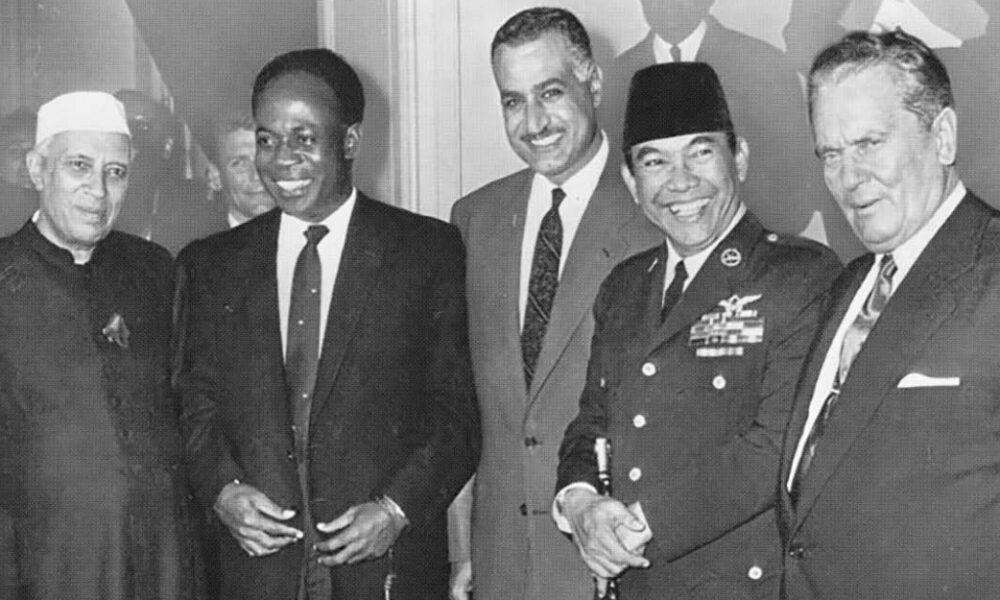
Another significant product of the Cold War was the Non-Aligned Movement (NAM), established in 1961 by a coalition of newly independent and developing nations seeking to remain neutral in the ideological struggle between the United States and the Soviet Union. Its founding leaders – Josip Broz Tito of Yugoslavia, Jawaharlal Nehru of India, Kwame Nkrumah of Ghana, Sukarno of Indonesia, and Gamal Abdel Nasser of Egypt – championed a vision of global non-alignment.
In theory, NAM stood for neutrality, but in practice, this principle often led to contradictions. For instance, Cuba, a staunch Soviet ally, played a prominent role within the movement.
Despite such inconsistencies, NAM wielded considerable influence on global affairs, advocating for causes such as the Nuclear Test Ban Treaty and non-proliferation efforts. However, following the Cold War’s conclusion, the movement shifted its focus to issues of economic development and social justice, leading to a decline in its geopolitical relevance.
A New Era of Geopolitical Competition?
With recent global developments – particularly in Africa – that echo Cold War tensions, could NAM experience a revival? The geopolitical landscape today is even more complex than in the 20th century.
Instead of a bipolar world dominated by the U.S. and the Soviet Union, we now see a multipolar dynamic, with China, Russia, and emerging middle powers playing significant roles.
However, the post-Cold War realities have reshaped the priorities of NAM’s member states. Unlike in the 1960s, when many of these nations were newly independent and seeking a unified stance, decades of governance have led to more distinct national interests and strategic alignments.
For some African states, non-alignment may no longer be a viable strategy. Junta-led governments in the Sahel have explicitly chosen alliances, while others have leaned significantly towards Western partnerships.
While Egypt and Ghana were instrumental in NAM’s founding, today’s geopolitical complexities could render the movement obsolete, even if it seeks to reassert itself in what some are calling a “New Cold War.” The question remains: does NAM still have a role to play, or has the world moved beyond the need for such a movement?
Fidel Amakye Owusu is an International Relations and Security Analyst. He is an Associate at the Conflict Research Consortium for Africa and has previously hosted an International Affairs program with the Ghana Broadcasting Corporation (GBC). He is passionate about Diplomacy and realizing Africa’s global potential and how the continent should be viewed as part of the global collective.