Opinion
Concrete and Code: Africa Is Building Two Futures at Once
From Nairobi’s construction sites to telemedicine apps in rural clinics, the continent’s twin infrastructure booms are reshaping where global capital should be looking next.


By Naomi Mutuku
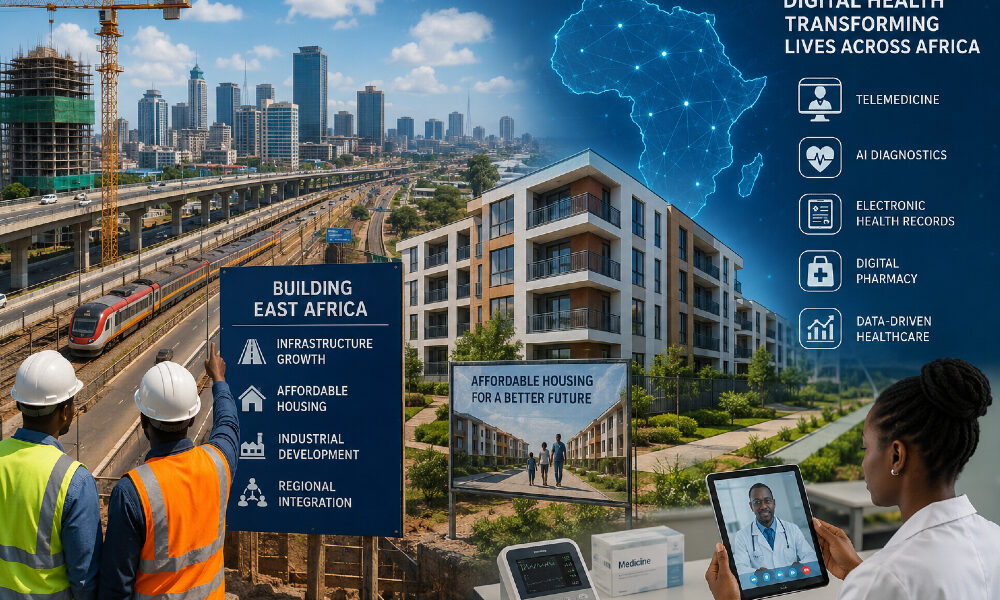
Ask an investor where the smart money is heading in Africa, and you will likely hear about ports, railways, or perhaps the latest fintech unicorn. Few will mention concrete and code in the same breath. That is a mistake. East Africa’s construction boom and the continent-wide surge in digital health investment are not separate stories – they are two expressions of the same underlying force: a young, fast-urbanizing population that needs places to live, work, and get well, often before the institutions meant to serve them have caught up.
Understanding both booms, and the connection between them, is essential for anyone trying to read Africa’s economic future correctly.
The Hard-Hat Boom
East Africa is in the middle of one of the continent’s fastest infrastructure buildouts. Kenya, Tanzania, Uganda, and Rwanda have all made roads, railways, housing, energy, and logistics hubs central planks of their national budgets – a signal that, for these governments, construction is not a side project but a core growth engine and a tool for regional integration.
The forces behind this are familiar to anyone who has watched East Africa’s economy over the past decade: rapid urbanization, a population across the East African Community that now exceeds 300 million, a swelling middle class, and rising demand for housing, healthcare, education, and logistics capacity. Add to that a steady increase in public-private partnerships, and the result is a construction sector that behaves less like a cyclical industry and more like long-term infrastructure for an economy still being assembled.
Kenya leads the pack. Construction contributed roughly 6.7 percent of the country’s GDP in 2024, making it one of the largest productive sectors in the economy. The numbers behind that figure are striking: an estimated US$16 billion in sector output, more than 230,000 people employed directly, and annual housing demand exceeding 200,000 units – a shortfall the market has yet to close. Analysts expect the sector to keep expanding at around 5.5 percent a year through 2029, buoyed by sustained government spending on transport, housing, renewable energy, and industrial infrastructure.
For investors looking for an entry point, five areas stand out:
- Affordable housing. With a deficit north of 200,000 units a year, there is durable demand for developers, financiers, modular construction firms, and building-material manufacturers willing to build at scale and at a price ordinary Kenyans can afford.
- Roads and transport corridors. Billions of dollars continue to flow into road expansion and the strategic corridors linking Kenya to its East African neighbors – infrastructure that pays dividends well beyond the construction phase.
- Green building materials. Demand is rising fast for sustainable construction technologies: modular housing systems, energy-efficient buildings, and lower-carbon materials that reduce both emissions and long-term operating costs.
- Industrial parks and logistics facilities. As Kenya positions itself as East Africa’s manufacturing and trade hub, warehousing and logistics infrastructure is becoming as valuable as the factories it serves.
- Healthcare and education facilities. Hospitals, schools, and training centers remain a significant – and underappreciated – growth category within the broader construction story.
The takeaway is not that Kenya is simply pouring concrete. It is building cities, supply chains, and industrial capacity all at once, and the investors who recognize that distinction now stand to shape East Africa’s next decade of growth.
The Quiet Revolution Inside the Clinic
If construction is the visible half of Africa’s transformation, healthcare’s digital shift is the half hiding in plain sight. For decades, healthcare investment on the continent meant one thing: building more hospitals and clinics. That logic is now being upended. The next wave of opportunity is not about brick and mortar at all – it is about bandwidth.
Africa’s digital health market was valued at roughly US$4.8 billion in 2025 and is forecast to grow at more than 23 percent annually through 2030 – a pace that would make most industries blush. The continent’s broader telehealth market is estimated at US$1.6 billion, with Kenya, South Africa, and Nigeria leading adoption.
The economic impact of digital health technologies across Africa, estimated at US$4.9 billion as of last year, could exceed US$6.5 billion by 2030 if policy environments remain supportive.
Five areas are driving that growth:
- Telemedicine and remote care. Millions of Africans still live far from specialist services. Telemedicine platforms – increasingly paired with remote diagnostics and even early 3D telemedicine tools – close that distance while cutting costs
- AI-powered diagnostics and screening. Early detection remains one of the continent’s most persistent healthcare gaps. AI-driven diagnostic tools, portable testing devices, and community-based screening programs are starting to fill it.
- Medical equipment manufacturing. Africa imports the overwhelming majority of its medical devices. Local production of diagnostic tools, laboratory equipment, and monitoring technology represents an underexploited opportunity hiding behind a long-standing supply chain gap.
- Pharmaceutical manufacturing. The continent holds nearly 18 percent of the world’s population but produces only a small share of its medicines. Expanding local drug manufacturing would strengthen supply security and lower costs simultaneously.
- Health technology infrastructure. Electronic medical records, health data systems, wearable devices, healthcare fintech, and digital pharmacies are quickly becoming the connective tissue of modern African healthcare systems.
The deeper point is that Africa’s healthcare future will not be built through hospital construction alone. It will be built through data, software, and scalable technology that brings quality care closer to people who have historically been left out of the system entirely.
Two Booms, One Logic
What links a Nairobi housing estate to a telemedicine app in rural Tanzania is the same demographic and economic pressure: more people, more demand, and institutions racing to catch up. Africa’s population is young, urbanizing, and increasingly impatient with old models of service delivery – whether that means waiting decades for adequate housing or traveling hours to see a doctor.
Investors who treat construction and health-tech as unrelated sectors are missing the bigger picture. Both are responses to the same structural reality, and both will define how livable – and how healthy – Africa’s fast-growing cities become over the next decade.
The question facing capital allocators is no longer whether these transformations will happen. Population growth and urbanization will keep advancing whether or not investors show up. The real question is who moves early enough to help shape them – and who is left, a decade from now, wondering why they waited.
Naomi Mutuku is a trade and investment expert specializing in helping global companies enter Kenya and broader African markets. She focuses on reducing risk, accelerating market entry, and fostering sustainable growth. Based in Nairobi, Naomi is a regular commentator on Africa’s dynamic business landscape and is passionate about the continent’s growth potential. She can be reached via email at: mukuinaomi@gmail.com