A Diaspora View of Africa
Christian Genocide in Nigeria Is Real


By Gregory Simpkins
Now that there is a peace accord signed in Gaza, attention to charges of genocide there are now giving way to examination of genocide elsewhere – namely Nigeria. Comedian and talk show host Bill Maher recently cited the allegation of genocide on his program Real Time with Bill Maher.
“I’m not a Christian, but they are systematically killing the Christians in Nigeria. They’ve killed over 100,000 since 2009. They have burned 18,000 churches. These are the Islamists, Boko Haram,” he said.
“This is so much more of a genocide attempt than what is going on in Gaza. They are literally attempting to wipe out the Christian population of an entire country,” he said.
The Complexity on the Ground: A Government Rebuttal
Soon thereafter, Gimba Kakanda, Senior Special Assistant to the President of Nigeria on Research and Analytics in the Office of the Vice President, weighed in on Al Jazeera to dispute the charge of Christian genocide in Nigeria, claiming it was more complex than Maher had described.
“This misinformation – aimed at maligning Nigeria as much as undermining the gravity of the situation in Gaza – is linked to Nigeria’s position at the 2025 United Nations General Assembly. By reaffirming support for a two-state solution to the Palestinian conflict, Nigeria challenged powerful interests invested in one-sided narratives,” he stated.
“Delivering the statement on behalf of President Bola Ahmed Tinubu on September 24, Vice President Kashim Shettima stressed Nigeria spoke for peace, not partisanship. He framed Nigeria’s stance through its history as a nation that survived civil war and deep tensions, observing that ‘such bitter experience has taught us that such violence never ends where it begins’.
Christian persecution in Nigeria is quite real, and the government is aiding and abetting it by not acting strongly to end this.
He also drew on Nigeria’s struggle with violent extremism to argue that “military tactics may win battles measured in months or years, but in wars that span generations, it is values and ideas that deliver the ultimate victory.”
Kakanda pointed out that President Bola Ahmed Tinubu inherited a country that has faced brutal Islamist insurgencies led by Boko Haram and its offshoot, Islamic State – West Africa Province (ISWAP), for more than a decade. While Western media often highlight attacks on churches and Christian communities, the reality is that these terrorists are indiscriminate in their violence.
Most of Boko Haram’s victims have been Muslims, despite the group’s hostility to Christians. Operating mainly in the predominantly Muslim northeast, Boko Haram has slaughtered thousands of Muslims, including clerics, village heads and civilians it deems apostates or opponents.
I can attest to the fact that more moderate Muslims have indeed been the target of attacks by Boko Haram and other extremist elements in Nigeria. During a Congressional delegation to Nigeria several years ago, we were told by one Muslim cleric that “if you preach against them on Friday, you are targeted by Saturday.”
On another Congressional visit to Nigeria, our delegation was told of Shiite conflicts with the predominant Sunni Muslims in northern Nigeria.
By the Numbers: Quantifying the Violence
The figures on Christian killings in Nigeria vary depending on the source, but here’s a summary of the most recent and credible estimates:
- At least 5,898 Christians killed in 2021 for their faith, with 80 percent of these deaths occurring in Nigeria, which translates to approximately 16 Christians killed daily.
- Over 7,000 Christians killed in the first 220 days of 2025 alone, averaging 32 deaths per day.
- Since 2009, the death toll has climbed to 185,000, including 125,000 Christians and 60,000 Muslims accused of being “liberal” or insufficiently radical.
- Another estimate suggests 62,000 Nigerian Christians have been murdered since 2000.
- A 2014 African Studies Centre report estimated around 350,000 deaths (direct and indirect) due to the conflict between 2009 and 2020, with projections of 48,000 direct deaths and 674,000 indirect deaths by 2025.
- More than 14 million people have been uprooted, and 8 million have been forced to flee their homes to avoid persecution.
- In the first 100 days of 2023, 1,041 Christians were slaughtered, and 707 were kidnapped.
According to Open Doors, an organization dedicated to monitoring the persecution of Christians worldwide, in Africa’s most populous country, more believers are killed for their faith each year than everywhere else in the world combined. Violence remains the most dangerous and prevalent threat.
Christians in Nigeria, particularly in the Muslim-majority north, continue to live under immense pressure from Islamic militants and armed “bandits.”
The brutal attacks can involve destruction of properties, abductions for ransom, sexual violence and death. Believers are stripped of their livelihoods and driven from their homes, leaving a trail of grief and trauma.
The government’s failure to protect Christians has only strengthened the militants’ influence, Open Doors says, and these attacks have led to large numbers of Christians (and other Nigerians) being forced to live in camps for internally displaced people where women and children are particularly vulnerable to health issues and human trafficking.
Despite these challenges, the church in Nigeria is a resilient church. They understand what it means to rely on their Savior for every breath. And they are asking the worldwide Church to pray with them.
International Attention and Legislative Response
U.S. Senator Ted Cruz (R-Texas) introduced the Nigeria Religious Freedom Accountability Act of 2025. The bill protects Christians and other religious minorities being persecuted in Nigeria by holding accountable Nigerian officials who facilitate Islamist jihadist violence and the imposition of blasphemy laws.
“Nigerian Christians are being targeted and executed for their faith by Islamist terrorist groups and are being forced to submit to sharia law and blasphemy laws across Nigeria,” Cruz stated. “It is long past time to impose real costs on the Nigerian officials who facilitate these activities, and my Nigeria Religious Freedom Accountability Act uses new and existing tools to do exactly that.
I urge my colleagues to advance this critical legislation expeditiously.”
Eyewitness to Persecution: First-Hand Accounts
As I mentioned earlier, I have been to Nigeria several times to investigate religious persecution in a country called the most dangerous place on earth for Christians. On the instruction of then-Africa Subcommittee Chairman Chris Smith, I organized several hearings on this subject, including victims of jihadist terrorists.
I mentioned in an earlier post Habila Adamu, a Christian shot in the head for refusing to abandon his Christian faith. He survived and testified before our subcommittee.
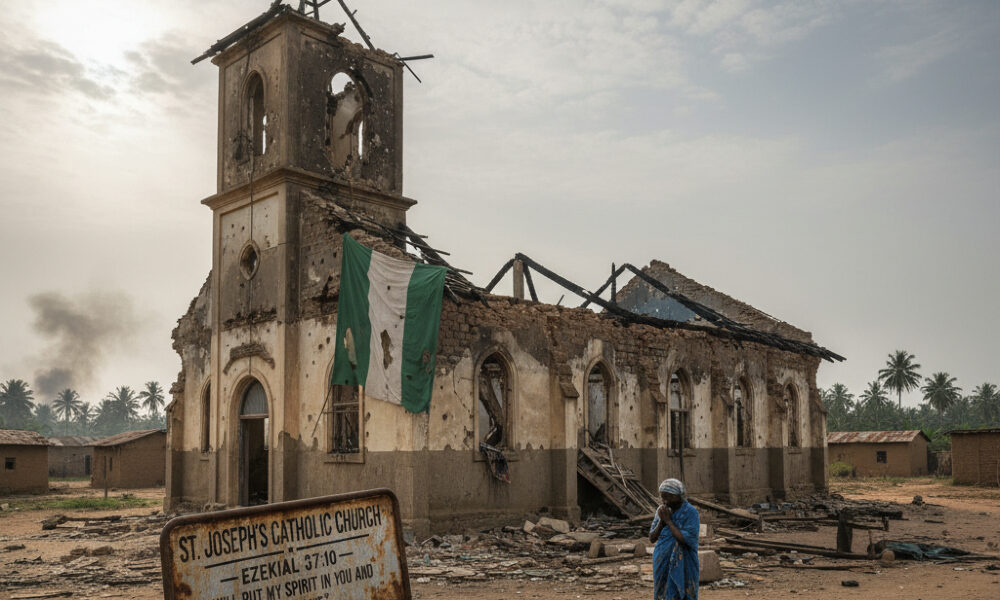
We also heard from Chibok girls, young women kidnaped by jihadists and forced to convert as wives of Boko Haram fighters. Again, I have spoken with refugees of Christian persecution in Nigeria and seen churches that had been the target of attacks.
Christian persecution in Nigeria is quite real, and the government is aiding and abetting it by not acting strongly to end this. No matter how complicated the situation is in Nigeria, and it is indeed quite complex, there is no justification for allowing the slaughter of Christians who choose to hold firm to their religious beliefs.
Gregory Simpkins, a longtime specialist in African policy development, is the Principal of 21st Century Solutions. He consults with organizations on African policy issues generally, especially in relating to the U.S. Government. He further acts as a consultant to the African Merchants Association, where he advises the Association in its efforts to stimulate an increase in trade between several hundred African Diaspora small and medium enterprises and their African partners.