Opinion
Chinese EVs in Africa: Leapfrogging the Grid
Western electric vehicles remain a luxury. But as BYD and GWM flood the continent with budget models and charging infrastructure, a new paradox emerges: cheap cars versus fragile grids.


By Des H. Rikhotso
Africa skipped the landline and went straight to the mobile phone. It skipped the bank branch and embraced mobile money. Now Chinese carmakers want it to skip the petrol pump, too.
The pitch is seductive. Electric vehicles (EVs) from Western brands remain far beyond the reach of most African drivers. BYD, GWM and other Chinese makers of “new energy vehicles” are counting on a different equation: small, cheap battery cars like the BYD Dolphin Mini, priced to tempt buyers who have never considered going electric. Behind them comes a second wave of Chinese firms, many from Shenzhen, that build the chargers to keep those cars moving. Showrooms and plugs are arriving together.
The Paradox at the Heart of the Boom
The trouble is that Chinese manufacturers can supply cheap electric cars far more easily than African utilities can supply reliable electricity. Nigeria’s national grid has collapsed repeatedly. South Africa endured years of rolling blackouts. In much of the continent, tens of millions of people have no dependable connection at all. Selling an electric car into that environment is a bit like selling a refrigerator to a village that has power for four hours a day.
Yet the standard objection, that millions of EVs will overwhelm the grid, is overstated. At today’s tiny levels of adoption, the extra demand is trivial next to total consumption. The real bottlenecks are local: overloaded transformers, unreliable municipal distribution networks and chargers that sit dark when the power fails. A motorist can forgive a slow charge. Nobody forgives a charger that doesn’t work.
Three Ways to Build the Bridge
First, the plug-in hybrid. It is the least glamorous answer and probably the most sensible. A car that runs on electricity when the grid cooperates and on petrol when it doesn’t removes the fear of being stranded, which is the main psychological barrier to going electric. Chinese makers already sell these models in volume. Purists will grumble, but a hybrid on the road today does more for emissions than a pure EV that buyers are too nervous to purchase.
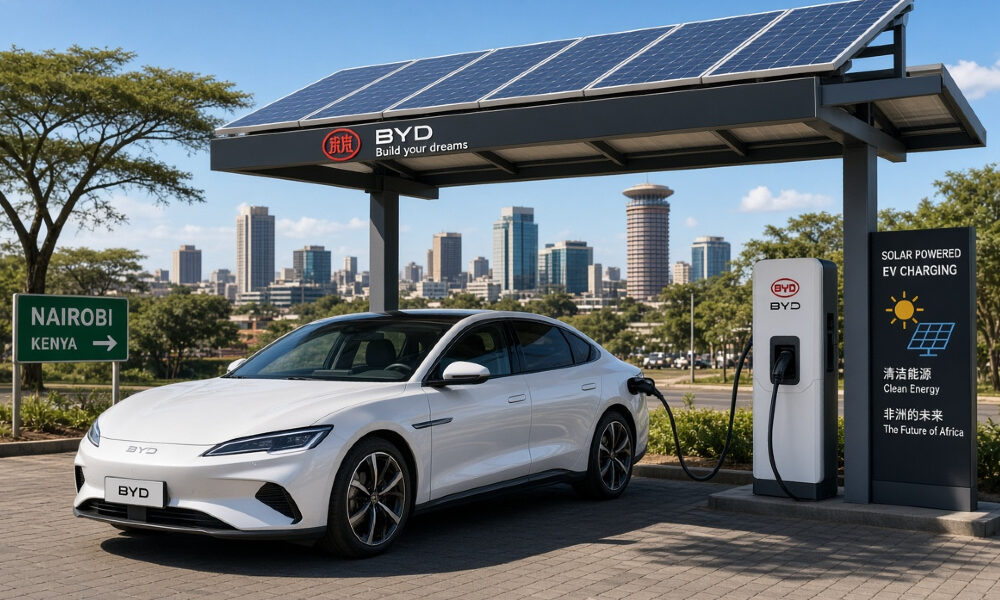
Second, chargers that don’t depend on the grid at all. Chinese firms dominate the global market for solar panels and stationary batteries, and African imports of both have surged. Pairing a charging bay with rooftop solar and a battery pack lets a station work through a blackout. The Shenzhen charging companies now arriving in Africa are well placed to sell exactly this kind of package.
Third, and most neglected, is policy. Africa risks becoming a showroom rather than a factory floor, a market for finished cars with little local benefit. Governments have leverage, since access to a huge and growing consumer base is worth a great deal to Chinese firms. They should use it, tying tariff breaks and other incentives to local assembly, technician training, battery recycling and genuine technology transfer. Morocco, which has courted Chinese battery and vehicle makers, shows what a deliberate industrial strategy can attract. Countries that simply lower import duties and hope for the best will get cars, and little else.
The Verdict
Chinese carmakers have solved the affordability problem that Western rivals could not. What remains is a problem of electrons, not vehicles. If African governments and Chinese firms treat the grid, the charger and the factory as one project, the continent could leapfrog to cleaner transport as it once leapfrogged to mobile phones. If they don’t, Africa will have plenty of cheap electric cars and nowhere reliable to plug them in.
Des H Rikhotso (PgDip-BA, MBL) is a seasoned C-suite Multi-Industry business executive with 25+ years of Business Leadership Experience across the South, East and Western Sub-Sahara Africa Region. Based in Kampala, Uganda he serves as East Africa Region Business Executive, driving Business Strategic Growth and Operational Excellence – contributing his Leadership Voice and Clarity to the Region. Des has held Business Leadership roles at BMW Group Africa, Volkswagen Group Africa, Peugeot Motors South Africa, Toyota/Lexus South Africa, Nissan Group of Africa, G.U.D Holdings (Africa Exports Operations Division) and The HDR Group of Companies. He holds Under-Graduate and Post-Graduate business degrees from the University of the Western Cape, Wits University (Wits Business School) and the University of South Africa.