Opinion
China’s Trillion-Dollar Trade Surplus – and Africa’s Defining Choice


By Gregory September
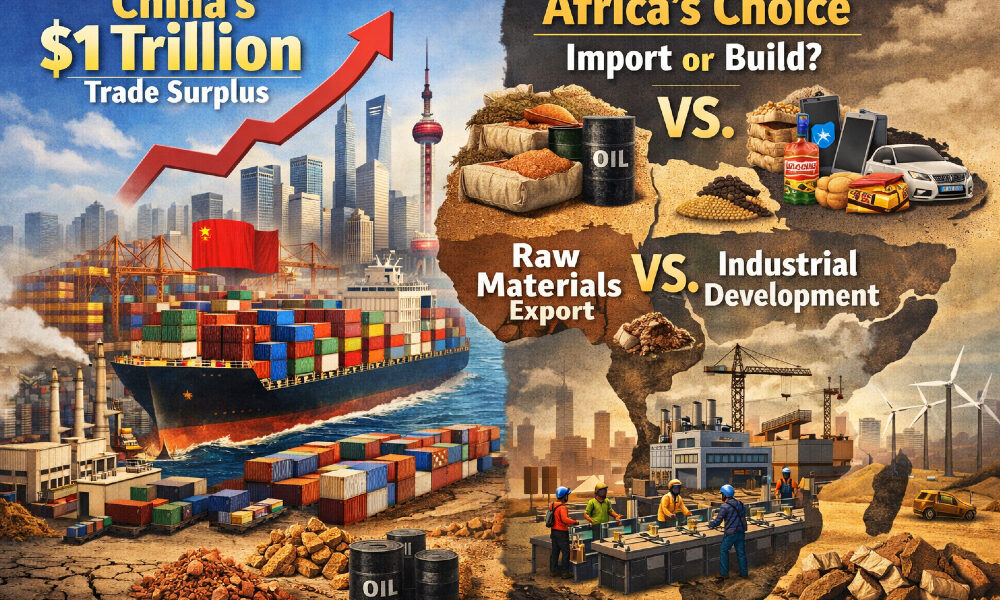
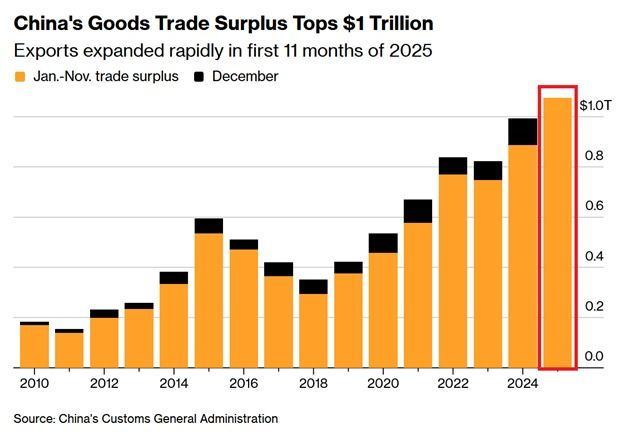
China has crossed a historic threshold: a US$1 trillion trade surplus. Even as exports to the United States decline sharply, the world’s second-largest economy continues to demonstrate that competitiveness, strategic planning, and scale remain decisive advantages in global commerce.
For Africa, this milestone arrives as both warning and opportunity – a stark reminder that while the continent imports the future, it has yet to build one of its own.
The narrative of “slowbalization” has captivated economists and policymakers in recent years, suggesting that the era of hyperglobalization has peaked. Yet China’s achievement tells a different story.
Through deliberate export diversification and systematic market expansion, Beijing has shown that integrated industrial strategy can overcome geopolitical headwinds. The question for Africa is no longer whether global trade dynamics are shifting, but whether the continent will seize this moment to transform from passive consumer to active competitor.
Africa’s Trade Paradox: Exporting Potential, Importing Dependence
The contrast between China’s trajectory and Africa’s current position could not be more pronounced. Where China has leveraged integration to achieve unprecedented efficiency, Africa’s fragmentation across 54 nations with disparate regulatory frameworks creates systemic friction that stifles industrial development.
Consider the value chain asymmetry: Africa exports raw materials and imports finished goods. We ship cobalt ore and purchase smartphones.
We export agricultural commodities and import processed foods. We send raw cotton abroad and buy back garments.
This pattern doesn’t merely represent trade – it represents the systematic export of employment, technological capacity, and economic sovereignty.
When a continent depends on others to add value to its resources, vulnerability becomes embedded in policy. Each imported product represents jobs not created, skills not developed, and industries not built.
This is not growth; it is managed decline dressed in the language of comparative advantage.
Scale as Strategy: What China’s Integration Reveals
China’s US$1 trillion surplus is not simply the result of cheap labor or currency manipulation, as critics have long claimed. It reflects decades of strategic investment in integrated supply chains, infrastructure connectivity, and manufacturing ecosystems that create compounding advantages.
When production networks are deeply interconnected, efficiency gains multiply. Transportation costs fall. Innovation accelerates. Quality improves while prices remain competitive.
Africa’s fragmentation imposes the opposite dynamic. Disconnected markets mean duplicated inefficiencies.
Small production runs prevent economies of scale. Regulatory divergence raises compliance costs.
Infrastructure gaps break supply chains before they can mature. The African Continental Free Trade Area represents recognition of this problem, but recognition alone does not dissolve the structural barriers that have calcified over decades.
Trade and Sustainable Development: The Unspoken Connection
The relationship between trade policy and human development is often discussed in abstract terms, but China’s export success illuminates a concrete truth: trade shapes which nations build prosperity and which merely experience it as consumers.
Africa’s current trade posture directly undermines progress on six critical Sustainable Development Goals (SDGs).
Consider SDG 1 (No Poverty), SDG 8 (Decent Work and Economic Growth), and SDG 9 (Industry, Innovation and Infrastructure) – all depend fundamentally on productive capacity, not merely resource extraction.
Similarly, SDG 10 (Reduced Inequalities), SDG 12 (Responsible Consumption and Production), and SDG 17 (Partnerships for the Goals) all require that Africa participates in global value chains as a creator, not simply as a supplier of inputs and buyer of outputs.
Progress toward these goals cannot be imported. Jobs are not created by purchasing foreign-made goods.
Industrial capability is not developed through consumption. Inequality is not reduced when value addition happens elsewhere.
If Africa is serious about achieving the SDGs, trade policy must become industrial policy.
The Crossroads: Which Foundation Gets Built First?
China’s achievement forces a fundamental question for African policymakers and business leaders: which comes first – addressing poverty, creating jobs, or building industrial capacity? The conventional wisdom suggests these goals must be pursued sequentially, that poverty alleviation creates the foundation for employment, which eventually enables industrialization.
But China’s experience suggests a different sequence. Industrial development creates jobs, which reduces poverty, which generates domestic demand, which attracts further investment in a virtuous cycle.
The first brick matters enormously, because it determines the architecture of everything that follows.
Africa faces a choice. The continent can continue its current trajectory, serving as a market for others’ manufacturing while exporting raw materials at minimal margins.
Or it can make the strategic investments – in infrastructure, regulatory harmonization, skills development, and industrial policy – that transform fragmentation into integration and consumption into production.

Progress Is a Choice, Not a Destination
The world does not wait for those who hesitate. While Africa deliberates, other regions are positioning themselves to capture the manufacturing capacity that geopolitical tensions are redistributing.
Vietnam, India, Mexico, and others are actively competing to absorb supply chains leaving China or seeking to diversify beyond it.
The uncomfortable reality is this: competitiveness still determines outcomes. Strategy still separates winners from bystanders.
Scale still delivers advantages that fragmentation cannot overcome. China proved these principles over four decades.
The question now is whether Africa will apply them over the next four.
Trade is not neutral. It is the mechanism through which nations either build or lose industrial capacity, create or export jobs, develop or remain dependent.
For Africa, China’s US$1 trillion surplus should serve not as a source of envy but as a mirror – reflecting both what is possible when strategy meets scale, and what is at stake when a continent chooses consumption over creation.
The future Africa imports today is the future it will not build tomorrow. That is not pessimism. It is arithmetic. And the world, as always, moves forward regardless of who chooses to compete.
Gregory September is a South African academic, author, and geopolitical analyst with extensive experience in government and Parliament. He is the founder and CEO of SAUP (Sustainability Awareness and Upliftment Projects NPC), which focuses on sustainability education and community development. He previously served as Head of Research and Development for the Parliament of South Africa. His work centers on sustainability, African geopolitics, and economic development, and he regularly contributes to analysis of global political and economic affairs.