Opinion
China’s Latest Coffee Gambit Could Redraw the Map of African Agricultural Trade
Beijing’s decision to widen market access for African producers is far more than a routine trade adjustment – it is a strategic signal that the global commodity order is shifting.


By Ashish Muley
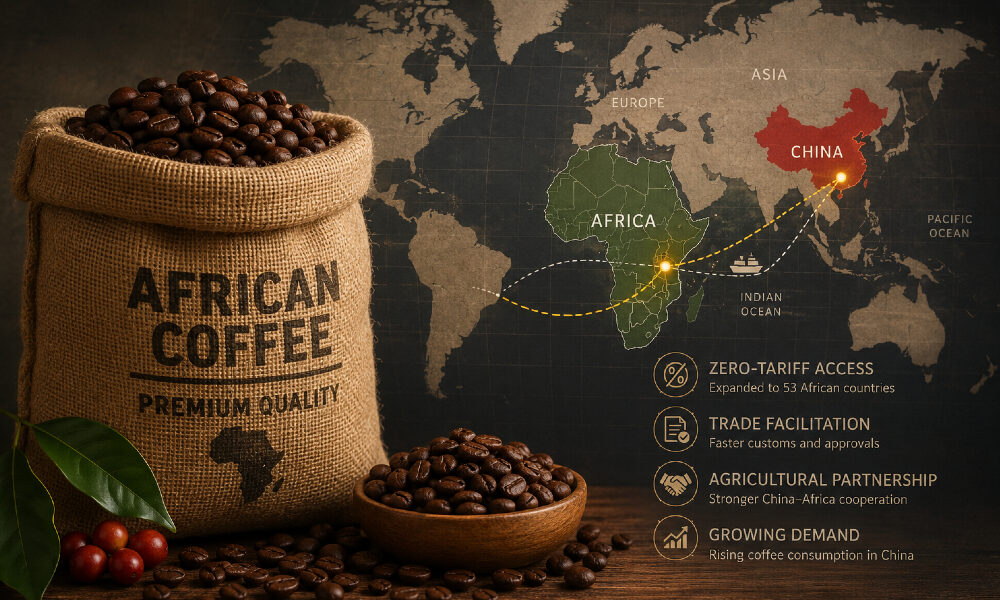
When China announced an expanded zero-tariff and trade facilitation framework covering 53 African nations, most observers filed it under routine diplomatic housekeeping. They should look again. The move represents something considerably more consequential: a deliberate effort by Beijing to embed itself at the heart of African agricultural supply chains – and coffee, the world’s second most-traded commodity, sits squarely at the center of that ambition.
More Than a Tariff Cut
The nuance matters here. China already maintained zero-tariff arrangements with much of Africa.
What has changed is the architecture surrounding those arrangements. The new framework addresses the more stubborn obstacles to trade: streamlined customs procedures, faster quarantine approvals, and rationalized market-access systems for agricultural products.
In the language of trade economics, China is attacking non-tariff barriers – the invisible walls that have long frustrated African exporters far more than headline duty rates ever did.
The timing is not incidental. China’s domestic coffee market is expanding at a pace that would have seemed implausible a generation ago.
A younger, urbanizing consumer class has taken enthusiastically to specialty and premium coffee, creating demand that domestic production in Yunnan province cannot fully satisfy. African origins – Ethiopia’s florals, Uganda’s bold robustas, Kenya’s bright acidity, Burundi’s nuanced complexity – offer precisely the diversity and quality that an increasingly sophisticated Chinese consumer expects.
A Structural Opportunity for Africa
For African producers, the potential is genuine. Access to a fast-growing market of 1.4 billion consumers, improved price competitiveness, and reduced dependence on the handful of European roasters and North American importers who have historically set the terms of trade: these are not trivial gains.
More importantly, the framework creates conditions in which Africa might, at last, begin to escape the commodity trap. For decades, the continent has shipped raw green beans abroad, allowing others to capture the margins from roasting, branding, and retail.
If China’s improved logistics and agro-processing investments materialize, there is a credible pathway toward exporting finished or semi-finished product. Ethiopia’s Yirgacheffe in a branded bag on a Shanghai shelf represents a fundamentally different economic proposition than green coffee auctioned at the New York exchange.
Whether Africa seizes that opportunity is, of course, the critical question – and the answer will depend on decisions made in Addis Ababa, Kampala, and Nairobi as much as in Beijing.
Uncomfortable Arithmetic for Traditional Buyers
Europe and North America have long enjoyed a buyer’s market for African coffee, benefiting from established sourcing relationships, favorable pricing, and relatively limited competition for the finest lots. China’s deeper engagement disrupts that equilibrium in ways that will be felt gradually but persistently.
The practical consequences include stronger competition for premium supply, rising procurement costs, and potential erosion of the exclusive origin relationships that specialty roasters have spent years cultivating. Traditional importers who have relied on incumbency rather than genuine partnership with producing countries may find themselves at a structural disadvantage as African governments and cooperatives develop new options.
The intelligent response – investment at origin, long-term sourcing contracts, robust sustainability and traceability programs, and genuine commitment to farmer productivity – is also the most demanding one. Companies that have deferred that investment will face a reckoning.
India’s Dual Exposure
India occupies a particularly complex position in this evolving landscape. As both a significant coffee producer and an increasingly active player in African agricultural trade, it faces China’s expanded engagement on two fronts simultaneously.
In Asian export markets, Indian coffee will encounter intensified price competition as African origins gain improved access. In Africa itself, Indian traders and processors who have built sourcing partnerships may find themselves competing with better-capitalized Chinese counterparts for supply and influence.
Yet the same dynamics also create openings. India’s established expertise in roasting, blending, and value-added processing represents a genuine comparative advantage that Chinese buyers – focused primarily on securing raw supply – may not quickly replicate. Joint ventures between Indian processors and African producers, positioned to serve both Asian and Western markets with finished product, represent a commercially and strategically coherent response.
The Deeper Question
The arrival of China as a serious agricultural partner for Africa is no longer a matter of speculation; it is a structural feature of the new trade landscape. The more consequential and unresolved question is whether Africa will use this moment of enhanced leverage to fundamentally renegotiate its position in global commodity chains, or whether it will simply exchange one set of extractive arrangements for another.
The difference between those outcomes will not be determined by Beijing’s policy frameworks. It will be determined by the quality of industrial policy, export strategy, and institutional development across African producing nations – and by whether governments and private sectors alike recognize that the window to move up the value chain rarely stays open indefinitely.
China has changed the terms of the game. Africa still has to decide how to play it.
Ashish Muley is an independent consultant with Stalwart Management Consulting, with 27+ years in agricultural commodity value chains, export markets, and international trade. He has led projects on business development and capacity building across African countries in partnership with international organizations. Formerly, he spent 15 years in financial services leadership, focusing on sales, marketing, and business development. Based in Pune, India, Ashish advises on agricultural trade, commodity markets, and Asia–Africa economic opportunities, and regularly writes on international trade and logistics.