Opinion
China, Africa, and the Dollar: Why Trade Power Matters More Than Currency Headlines
A record year for Sino-African commerce reveals more about shifting interests than shifting currencies.


By Gregory September
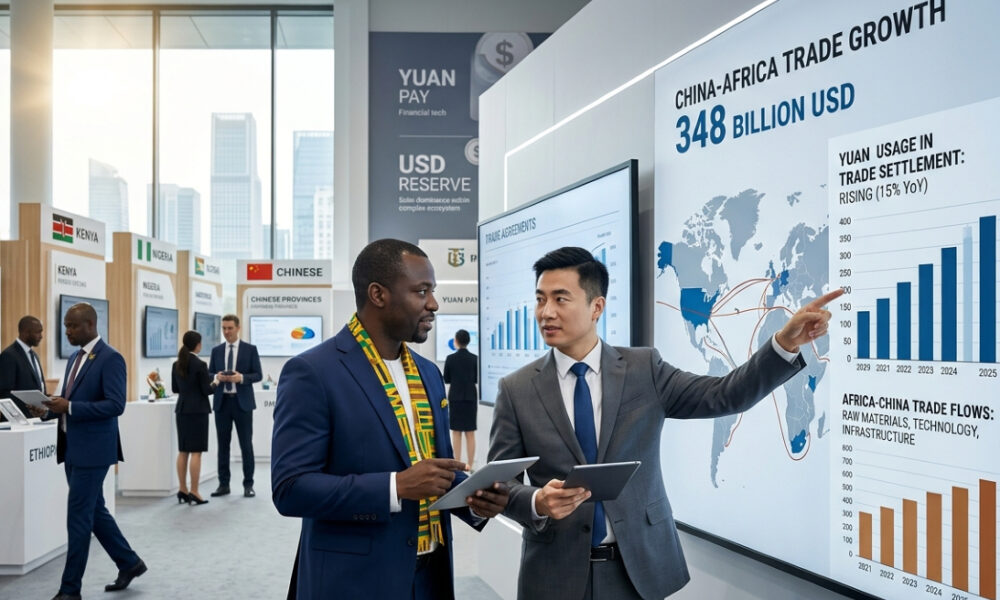
Two numbers rarely appear in the same sentence, yet last year they did. Trade between China and Africa reached US$348 billion in 2025, a record that capped a 17.7 percent jump from the year before. Over that same period, the dollar’s grip on global finance loosened by approximately nothing. Both statements are true. The temptation to wire them together into a single story – booming yuan trade equals a dying dollar – is understandable. It is also wrong, or at least premature.
The case for skepticism starts with the headline figure itself. Chinese exports to Africa surged 25.8 percent, to US$225 billion, while African exports to China crawled ahead by just 5.4 percent, to US$123 billion. The result was not balanced growth but a widening chasm: Africa’s trade deficit with China ballooned 64.5 percent, to US$102 billion. A relationship growing this lopsided is not, on its face, evidence of a new financial order taking shape. It looks more like an old one deepening.
Three Clocks, Three Speeds
Confusion sets in when people assume that trade, geopolitics, and money move in lockstep. They don’t. Trade relationships shift first, often in response to nothing more exotic than price and proximity. Strategic alignment – who courts whom, who needs whom – follows at its own pace, shaped by elections, debt loads, and diplomacy. Monetary infrastructure, the plumbing of settlement systems, reserve holdings, and clearing arrangements, moves slowest of all, because it is the most expensive and riskiest layer of the system to rebuild. A surge in trade volume tells you something happened in the first category. It tells you almost nothing, yet, about the third.
Follow The Incentives, Not The Currency
Beijing’s appetite for African commerce is not mysterious. China needs commodities – the cobalt powering its battery industry, the copper wiring its grid, the oil fueling its factories – and it needs buyers for the manufactured goods, machinery, and green technology increasingly filling its export ledgers as Western markets turn more guarded. Its decision to scrap tariffs on imports from the 53 African countries with which it maintains diplomatic ties, announced at the African Union summit in February and in effect since May 1, is best read in that light: a deliberate move to lock in commercial relationships before rivals do.
African governments have their own, equally rational, calculus. Chinese capital tends to arrive with fewer of the governance conditions that often accompany Western lending, and Chinese infrastructure financing fills gaps domestic budgets cannot. None of this requires any government to hold a settled view on the dollar’s future. It requires only that each side gets something it currently lacks: markets and resources for China, financing and room to maneuver for Africa.
That logic is already nudging a slice of transactions away from dollar invoicing. A handful of African exporters – South African fruit growers, Nigerian processors, Kenyan producers among them – have begun settling shipments to China directly in yuan, cutting out a currency conversion that adds cost and risk to deals where China is already the dominant buyer. That is a real and interesting development. It is not, by itself, a verdict on the dollar’s future.
Reserve Currencies Rarely Die of Natural Causes
History offers a useful corrective here. No reserve currency in the modern era has been toppled overnight. Sterling’s decline after the Second World War took decades, and it happened only once Britain’s underlying economic and military weight had shrunk to match. Reserve status follows deep, structural shifts in trade networks, capital markets, and institutional trust – and those shifts, almost without exception, lag well behind the headline trade numbers that make the news. Rising yuan invoicing on a subset of African trade routes is evidence that alternative settlement networks are forming. It is not evidence that the dollar’s underlying network is unraveling.
A More Crowded Room, Not a Changing of The Guard
What the data more plausibly describes is not a handoff from one dominant currency to another, but a slow thickening of competing networks beneath the world economy – a more multipolar order forming gradually, layer by layer, rather than a single throne changing hands. Africa’s growing importance in this story has less to do with the continent’s command over global finance, which remains limited, and everything to do with its position as contested terrain: a place where China, the United States, the European Union, and Gulf states are all competing to shape the trade relationships that will, eventually, determine where money flows and how it gets settled.
Policy, in other words, tends to follow structure rather than lead it. Currency arrangements are usually the last thing to change, not the first.
The Question That Actually Matters
Commentators will keep asking which currency wins. It is the wrong question to spend a decade answering. The more useful one is this: over the next ten years, will it matter more who settles the transaction, or who controls the underlying economic relationship that the transaction represents? China’s US$348 billion bet on Africa is a clear answer to the second question. On the first, the verdict is still years away.
Gregory September is a South African academic, author, and geopolitical analyst with extensive experience in government and Parliament. He is the founder and CEO of SAUP (Sustainability Awareness and Upliftment Projects NPC), which focuses on sustainability education and community development. He previously served as Head of Research and Development for the Parliament of South Africa. His work centers on sustainability, African geopolitics, and economic development, and he regularly contributes to analysis of global political and economic affairs.