Opinion
Championing for the Two Thirds Gender Principle in Kenya
By Imali Ngusale
The two-thirds gender principle is not progressive, by now Kenya is supposed to have legislated and mandated it. Article 3 of the Kenyan constitution lays the two-thirds principle as a baseline for governance and leadership. However, the Kenyan political sphere seems ambivalent to fully adopting the gender principle as a pinnacle for the democratic process.
“We must ensure that women’s political participation is activated and realized,” said Daisy Amdanya the Executive Director at the Community Advocacy and Awareness (CRAWN) Trust, “We need to continually push for our leaders to do the right thing but we also need to sue them when they don’t.”
Speaking during the consultative forum on the two-thirds gender principle, Amdanya, said that women have a duty and responsibility to engage in the political process to advance social inclusion.

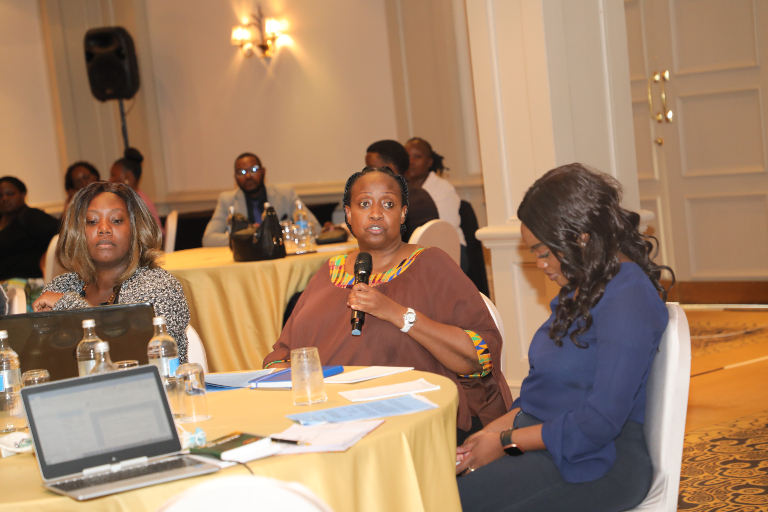
Daisy Amdanya the Executive Director at the Community Advocacy and Awareness speaks at the forum. Image courtesy: Imali Ngusale
Although the August 2022 election ushered in more women leaders (including 7 county governors, 3 senators, and 29 elected Members of Parliament), efforts of attaining the two-thirds principle are yet to be realized.
Superficially the number of women elected in Kenya has increased, however, there are more milestones for women to overcome in the quest for inclusion. Women are still marginalized especially in the political arena. At the County level, the 7 governors only represent 14 percent of the total number of governors elected, while the 3 Senators represent 6 percent and the 29 parliamentarians 8 percent, which implies that they still do not have a voice in influencing policies that affect their communities.
“The two-thirds principle is not a right issue it’s a principle that is constitutional and that is why it requires a deliberate political will,” said Stephen Odendo a consultant at Centre For Fiscal Affairs (Sentao Kenya Limited).
” We can no longer be silent while the mandate of our constitution is diluted,” added Dorothy Otieno from the Africa Women’s Development Network.
For the Kenyan parliament to meet the two-thirds gender requirement, the country needs to have elected at least 97 women to the National Assembly and 16 to join the Senate. The current numbers fall short of the gender principle. Moreover, statistics from the Charter of inclusion note that less than 10 percent of women, youth, and people with disabilities (PWDs) were elected as governors, senators and members of the national assembly.
“Social inclusion literally means that no one is left behind. Women have been left behind for far too long. We, therefore, need to push for more women to be engaged in the realms of politics,” Winnie Gloria from the Institute of Certified Public Accountants of Kenya (ICPAK).
With the same breath Kavi Karuga from Uraia Trust said, “We must continue to advocate for women’s leadership and it is paramount that we do this together in a collective voice.” Affirmative action must be employed to ensure that inclusivity is recognized at all levels. Notably, the Universal Declaration of Human Rights (UDHR) Article 21 underscores the need to recognize that every citizen has a right to participate in the political space. Additionally, Article 27 (8) of the Kenyan constitution requires that not more than two-thirds of members of elective or appointive bodies should be of the same gender.
“As a defender of our constitution, we need to adopt a position that ensures that women are equally presented. Social inclusion should be intentional,” remarked Joshua Munyoki of Transparency International Kenya. In as much as there is no formula to guide the gender ratio in electing women in the national assembly, the constitution warrants political leaders to be deliberate in implanting every Article without any derogation from the law.
Imali Ngusale is a prolific African writer passionate about amplifying Pan-African stories on Socio-Economic Justice, Climate Change, and Politics. You can access more of her publications via her her blog at ngusaleimali.blogspot.co.ke.