Opinion
Chad’s Strategy: Forging Economic Arteries from Desert Corridors


By Princess C. Mutisya
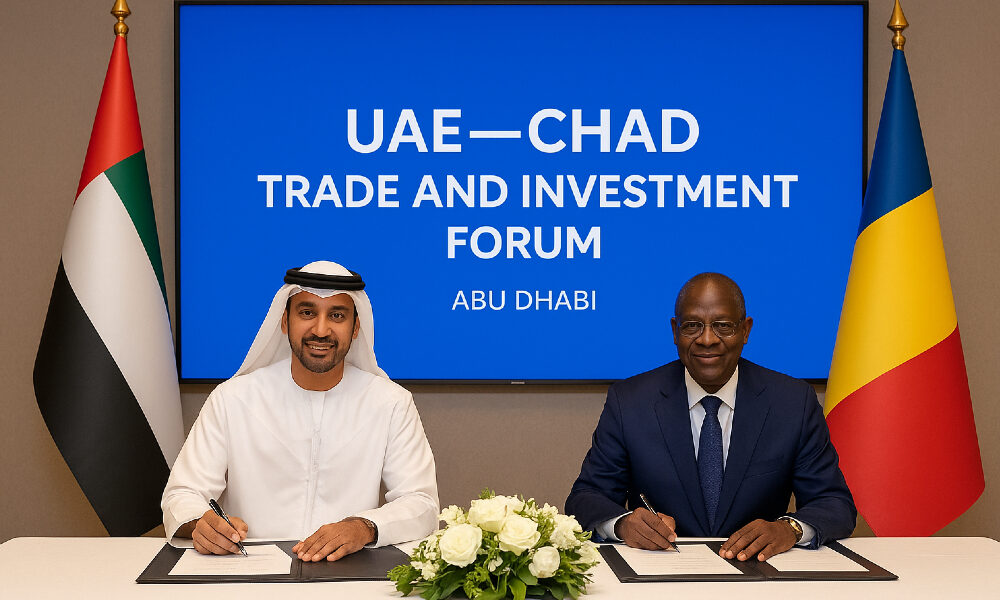
Not every day does a landlocked, fragile state stride into a desert capital and demand not just investment – but a new architecture of roads, power grids, trade rules, and digital corridors. Yet that is precisely what Chad did at the UAE–Chad Trade & Investment Forum in Abu Dhabi.
It didn’t arrive with a slogan or a photo-op. It arrived with a blueprint.
Two strategic moves – announced almost in lockstep – signal a turning point in Chad’s economic trajectory and the UAE’s expanding footprint in Central Africa:
- The UAE committed to finalizing a Comprehensive Economic Partnership Agreement (CEPA) with Chad by the end of 2025.
- Chad unveiled “Chad Connection 2030,” an ambitious US$30 billion mobilisation plan targeting infrastructure, energy, mining, agriculture, logistics, and financial services.
The scale of engagement was immediate and substantial:
- Bilateral trade surged past US$1.9 billion – a 30 percent increase in just one year.
- 39 agreements were signed on the spot, including 18 with UAE entities with a potential collective value exceeding US$6.2 billion.
This was no ceremonial delegation. It was the quiet laying of a transcontinental corridor in real time.
The Real Question: What Kind of CEPA Will This Be?
Beneath the fanfare lies a pivotal design challenge: how will this partnership function once the headlines fade and ground realities set in?
A CEPA is more than a trade acronym – it’s a governance framework that dictates how risk, reward, and responsibility are allocated. It determines:
- Where disputes land when politics or delays derail projects,
- How transparent and stable tariffs, customs procedures, and market access truly are,
- And crucially, how much policy autonomy Chad retains as it executes its own national vision.
The UAE has been methodically weaving a web of CEPAs – from India and Indonesia to Kenya and the Central African Republic – as part of its broader ambition to reach US$1 trillion in non-oil trade. Chad’s inclusion is not incidental; it reflects the country’s strategic location at the nexus of North, West, and Central Africa – a linchpin for regional connectivity.
But with opportunity comes a choice.
Will this CEPA serve as a shield – primarily insulating foreign investors from risk in a volatile environment through strong legal protections but offering little to build local institutions or secure public trust?
Or will it act as scaffolding – embedding transparency, rule-based predictability, and fair dispute mechanisms while still allowing Chad the policy space to phase reforms, absorb economic shocks, and deliver on its long-term development agenda?
For Gulf capital, the distinction isn’t academic – it’s where competitive advantage truly lies.
Beyond Yield: A Template for Transformative Investment
“Chad Connection 2030” is not another glossy pitch deck touting the “next frontier” in Africa. It represents a long-dated, high-stakes bet on multi-dimensional infrastructure: roads and rails, yes – but also power, water, digital networks, and social capital in one of the continent’s most strategically situated yet under-resourced states.
If structured with robust risk-sharing mechanisms, inclusive governance frameworks, and genuine local participation, this partnership could become more than a bilateral deal. It could offer a replicable model for how Gulf capital – often criticized for extractive or short-term engagements – can catalyse deep, sustainable transformation in Central Africa.
The desert may be vast, but corridors are built by choice, not chance. Chad has staked its future on this one. The UAE now holds a critical pen in drawing its boundaries – and its promise.
Dr. Princess C. Mutisya is a Strategic Legal Architect, author, and international business leader with more than 14 years of cross-border experience across Africa and the UAE. She is the Founder & CEO of CR Advocates LLP (Kenya) and CR Advocates Consultants LLC (UAE)among other leadership Roles. A recipient of Doctor of Laws (LLD) in International Legal Strategy and Doctor of Business Administration (DBA) in International Business & Global Transformation, Dr. Mutisya is an expert in international trade and investment law, advising governments, DFIs, and multinationals on investment law, sovereign frameworks, PPP structuring, Corporate Governance, trade facilitation, energy and infrastructure projects, real estate ventures, and private wealth structuring across Africa-GCC corridors. Beyond her legal and business enterprises, she is a global speaker and thought leader on economic diplomacy, policy innovation, and Africa’s emerging investment architecture.