Politics
CCJ Trust Fund Performing Quite Well
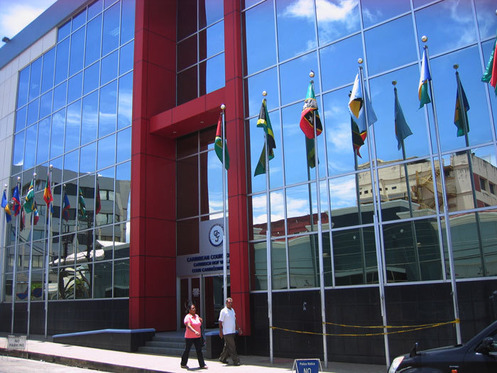
A judge with the Trinidad-based Caribbean Court of Justice (CCJ) says his recent comments about the need to re-examine the trust fund that had been established to fund the court may have contributed to conveying a inaccurate perception of the state of funds available for court operations.
Last week, Justice Ralston Nelson told the Caribbean Media Corporation (CMC) that he believed that the time had come for a review of the US$100 million initiative given the changing global economic and financial environment. He stated, “I think when the sum of 100 million US dollars was arrived at, it was obvious that the data they had considered would not have included the collapse of interest rates plus the collapse of a the majority of financial institutions in 2008.”
“So … any calculations you would have made prior to setting up that fund now have to be revised anyway so that there is that aspect of it…and I think truth to tell is that the operations of the court were not fully looked at,” Justice Nelson added.
But in a brief statement issued late Saturday night, he said upon reviewing the media reports the media reports, “My comments were directed narrowly at the returns in the bond market and at noting that bonds were not producing the kinds of results projected ten years ago. ”
Furthermore, he indicated, “Fortunately, the bond market makes up only one portion of the investment portfolio of the Trust Fund which manages the US$100 million, the income of which is earmarked to fund the operations of the CCJ. The other investment options of the Fund are doing well…”
According to preliminary estimates released, the initial capital investment of US$100 million was surpassed during the course of 2013. The CCJ Trust Fund 2012 annual report had also indicated that despite a precipitous decline in global investment markets during the financial crisis of 2008, the Fund had in fact rebounded over the last few years.
Interestingly, Trust Fund records show returns on investments – net of disbursements, contributions and expenses – reached +15.9 per cent in 2009 and +10.3 per cent in 2010 before declining -1.8 per cent in 2011 and recovering to +10.1 per cent in 2012. The Fund’s long-term target annual rate of return is 8.9 per cent.
In fact, there are projections that the US$100 million initial capital investment will prove to have been surpassed during the course of last year as the 2013 accounts are also expected to reflect returns in excess of 10 per cent. At the end of 2012, the Fund balance was US$93.7 million.
CCJ president Sir Dennis Byron has described use of the CCJ Trust Fund as the best funding mechanism in the world for any court. The Fund had been established amid concerns that judges of the CCJ would be paid by governments which could exert decisive informal pressure on them to deliver judgments favoring their regional governments.
The Caribbean Court of Justice Trust Fund is administered by a Board of Trustees selected from regional bodies and as a consequence, the CCJ is the only integration court of its kind financially independent of the largesse of governments and free from their administrative control.
The CCJ, established in 2001 to replace the London-based Privy Council, also acts as an international tribunal interpreting the Revised Treaty of Chaguaramas that governs the regional integration movement. Additionally, the CCJ has original and appellate jurisdictions. While most of the Caribbean countries have signed on to the original jurisdiction, only Barbados, Guyana and Belize are signatories to the appellate jurisdiction.
In his statement, Justice Nelson said that it is believed that additional governments will abolish appeals to the Privy Council and come into the Court in its appellate jurisdiction. “As litigants gain greater confidence in the Court they will take advantage of the fact that it is much easier to access it than the Privy Council and use it for an increasing range of possibilities. The strategic plan of the court has indicated our intention to initiate activities to promote improvements in the delivery of justice region wide.”
“It is in this context that the court’s expanded operations and responsibilities will result in the need to “top up” the Trust Fund in due course,” he said. “I want to emphasize that the concept of topping up the fund is quite different from rescuing it from depleted resources. I am satisfied that the ending balance of the fund in 2013 is no less than the original fund….,” Justice Nelson added.
Source: Caribbean360