Business
Caribbean Remittances Surge as Global Flows Near $730 Billion
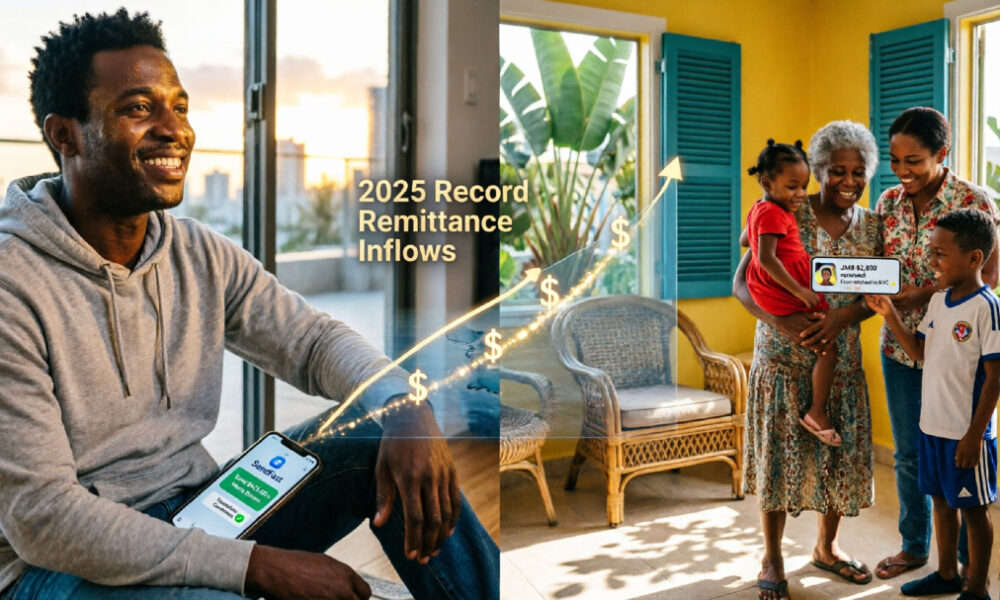
Remittances to the Caribbean and Latin America surged 132 percent between 2016 and 2025, reaching US$168.6 billion, according to the U.N.’s International Fund for Agricultural Development (IFAD). Globally, transfers to low- and middle-income countries nearly doubled to US$728.6 billion. This growth far outpaced the 28 percent rise in migrant populations, exceeding both global official development assistance and foreign direct investment.
Nowhere is this dynamic more pronounced than in Jamaica, where remittances hit a record US$3.49 billion in 2025, equivalent to 15.3 percent of GDP. Yet this financial lifeline is unevenly distributed. Following Hurricane Melissa in late 2025, inflows to the capital, Kingston, surged, while western parishes saw stagnant growth. This geographic divergence highlights a broader vulnerability: heavy reliance on a few urban hubs and the US, which accounts for roughly two-thirds of Jamaica’s inflows.
Dependence on US labor markets leaves the region exposed to shifts in immigration policy or economic downturns. Although current flows remain resilient, involuntary returns threaten households in highly dependent economies like Honduras and El Salvador, where remittances exceed a quarter of GDP.
While three-quarters of these funds cover immediate household needs, the remainder fuels local investment, health care, and education. IFAD notes that fully digital transfers, which cost 4.6 percent on average compared with 7.3 percent for traditional methods, remain underutilized. Cheaper, transparent financial infrastructure is now essential to transform these private survival funds into engines of long-term economic resilience.