Opinion
Caribbean Nations Are Being Asked to Pay for a Climate Failure They Did Not Cause
Rich countries have failed to keep warming in check. Hurricane-battered islands are borrowing to rebuild, and that is a debt trap of someone else’s making.


By Ronald Sanders
The promise is broken. The world pledged in Paris to hold warming to 1.5°C, and the UN Environment Programme now says that breaching that limit is widely regarded as unavoidable, probably within a few years. Even its best-case scenario sees temperatures peaking at 1.8°C. For Caribbean nations, and the small island states that fought to get 1.5°C written into the Paris Agreement, this is the loss of a safeguard on which their economies, and in some cases their very existence, depend.
The cruelty lies in who pays. Caribbean states contributed almost nothing to the emissions that caused this crisis. Yet they are already borrowing heavily to repair its damage. Having failed to prevent the breach, the big emitters should not now send the bill to the countries least responsible for it.
Why 1.5°C Mattered In the Caribbean
In 2015, small island states pushed for 1.5°C because they understood that the gap between it and 2°C could mean life or death. Each extra fraction of a degree raises the risk from rising seas, ferocious storms, dying reefs and vanishing land. The Paris deal, I argued at the time, would be judged on two tests: whether warming stayed below 1.5°C, and whether wealthy countries paid enough for mitigation and adaptation. Eleven years on, the first test is being failed and the second is barely being met.
To be fair, the European Union and its members are the largest public providers of international climate finance. They contributed €31.7 billion (US$36.34 billion) in 2024 and mobilized another €11 billion (US$12.64 billion) from private sources. Even so, that falls short of what vulnerable countries need.
How a Hurricane Becomes a Debt Crisis
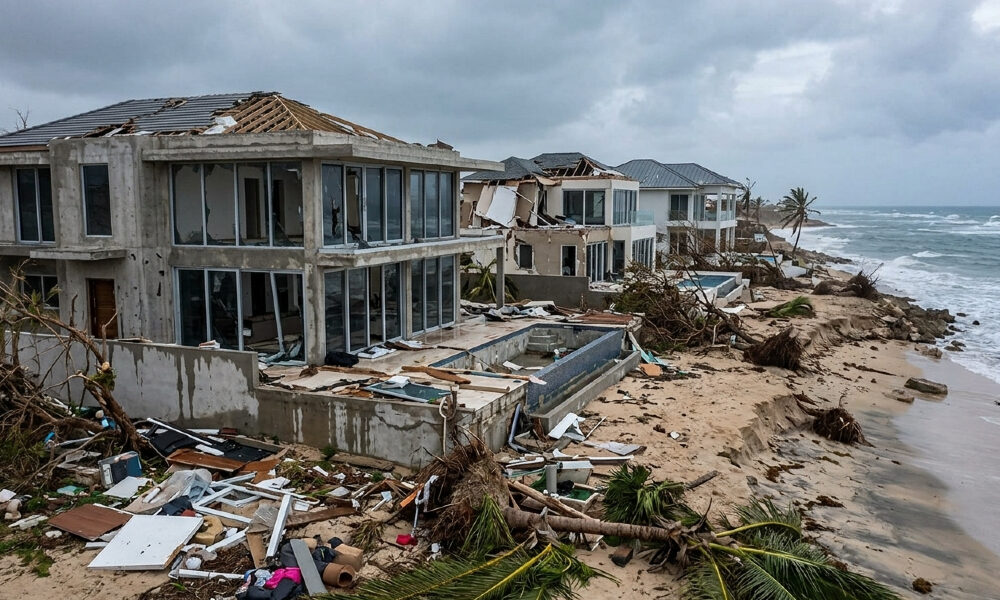
The mechanism is simple and brutal. A storm flattens roads, schools, hospitals, power grids and homes. Governments must rebuild. If grants and cheap loans are unavailable, they borrow. The debt payments then drain money that could have gone to resilience and development, leaving the country weaker for the next storm.
Dominica shows the scale. Hurricane Maria’s damage and losses in 2017 came to about 226 percent of its 2016 GDP. Few economies anywhere could absorb a blow like that without lasting harm.
The global financial system makes matters worse. Many small island states are shut out of concessional financing because their per-capita incomes are deemed too high. A country can thus be labeled too rich for cheap development money while a single storm can erase years of accumulated wealth. That is an accounting quirk with life-altering consequences.
Caribbean governments carry duties of their own. They must enforce tougher building codes, manage water better, protect coastlines, expand renewable energy and take disaster preparedness seriously. But those obligations do not erase the unequal origins of the crisis, and no small economy can fund repeated reconstruction alone.
The Emissions No One Counts
The ledger is incomplete in another way. A 2026 systematic review of 263 studies and 36 reports cites estimates that militaries account for about 5.5 percent of global greenhouse gas emissions. If the world’s armed forces were a single country, they would rank as roughly the fourth-largest emitter. Yet less than a tenth of military and conflict-related emissions appears in international reporting. Researchers at Queen Mary University of London, Lancaster University and the Climate and Community Institute estimated that the first 14 days of the 2026 war involving the United States, Israel and Iran alone released more than 5 million metric tons of carbon dioxide equivalent. Whatever the strategic case for such conflicts, the emissions enter the same atmosphere, and the consequences fall on distant places like the Caribbean.
The Law Is Catching Up
Legal ground is also shifting. In 2024, the International Tribunal for the Law of the Sea found that human-caused greenhouse gas emissions count as pollution of the marine environment under the UN Convention on the Law of the Sea. In July 2025, the International Court of Justice confirmed that states must protect the climate system from significant harm, and that breaches can trigger state responsibility and reparation where legal conditions are met.
These advisory opinions do not deliver compensation automatically. Causation, attribution and quantification remain unresolved. But climate commitments now rest on authoritative legal findings, and the financial response should reflect that.
What Should Change
- Grants first. Adaptation and reconstruction in highly vulnerable small economies should be financed mainly through grants and deeply concessional funds, not commercial loans.
- Pause clauses as standard. Debt contracts should automatically suspend repayments after major climate disasters.
- A better yardstick. International financial institutions should adopt the Multidimensional Vulnerability Index, so that access to cheap finance reflects exposure to shocks rather than income alone.
- A properly funded loss-and-damage fund. The Fund for Responding to Loss and Damage needs resources in proportion to the problem it was built to address.
- Relief where debt is climate-driven. Restructuring or forgiveness should be considered where repeated disasters have swollen sovereign debt.
None of this is charity. It is a fair response to unequal responsibility for a shared problem. The principle is plain: no vulnerable country should sink deeper into debt because it must repeatedly rebuild after damage caused largely by others.
Not a Reason To Give Up
Passing 1.5°C does not make further action pointless. It makes it more urgent. Big emitters must cut faster, and every country, small states included, must build resilience where it can. But the terms of the debate have changed. For years, vulnerable nations were asked to trust that emissions would fall, that finance would grow and that 1.5°C would hold. That trust was not repaid.
The Caribbean should own what it can and must do. It should not quietly accept a system that forces it to borrow its way through a crisis it did little to create. The world is failing to hold the line at 1.5°C. Small states should not be made to pay for it.
Ronald Sanders is Antigua & Barbuda’s Ambassador to the US and the OAS, and the Chancellor of The University of Guyana