Opinion
Carbon Markets Are Not Climate Solutions for Africa – They Are Dependency, Redesigned


By Apollo Buregyeya
There is a quiet dishonesty embedded in the way carbon credits are marketed to Africa. The pitch sounds generous: climate finance flows south, conservation is rewarded, and the continent is elevated to partner status in humanity’s greatest collective challenge. The reality is far less flattering. In practice, carbon markets too often permit the world’s heaviest emitters to continue polluting while compensating poorer nations with a fraction of the true cost of carbon – and calling it progress.
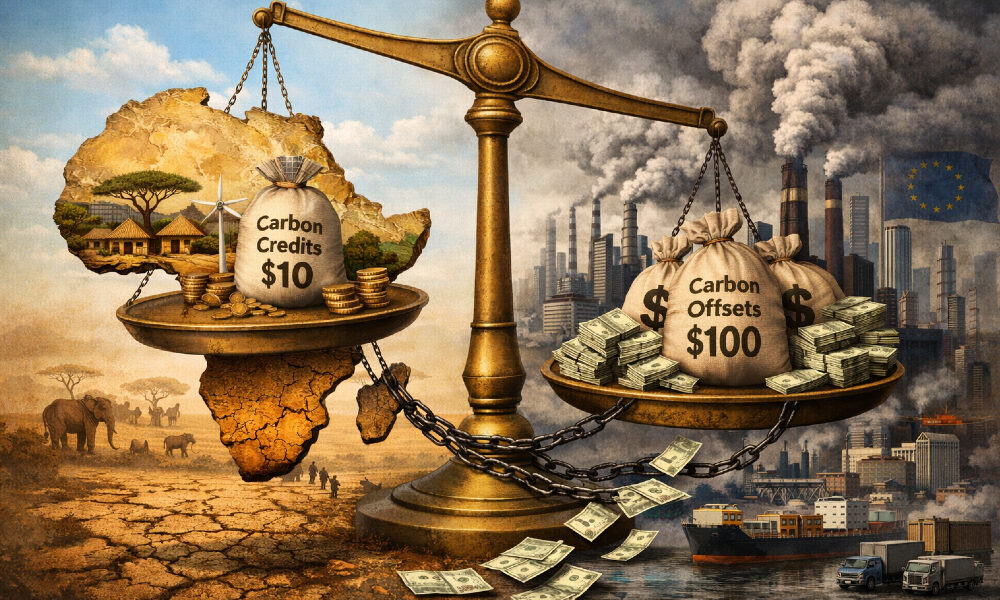
The arithmetic alone should give pause. Credits generated across the Global South typically trade between US$5 and US$20 per metric ton of CO₂. Meanwhile, under the European Union’s Emissions Trading System, carbon has recently commanded between €60 (US$69) and €90 (US$104) per ton, with non-compliance penalties exceeding €100. That gap is not an accident of market inefficiency. It is a feature, not a bug – a structural arrangement that converts cheap African restraint into a convenient accounting remedy for expensive European emissions.
The pollution does not disappear. The industrial systems that produced it continue largely unchanged. What improves is the reporting.
A Performance of Sustainability
What makes this arrangement particularly corrosive is that it does not operate without local enablers. It is sustained by policymakers eager to align with global sustainability narratives without interrogating their economic implications. It is amplified by technocrats fluent in the language of net-zero transition but silent on questions of production costs, industrial capacity, and household affordability. It is institutionalized by development frameworks that reward the appearance of transformation over its substance.
The result is a performance of sustainability – not its practice. Frameworks are adopted, reports are produced, commitments are announced at international forums, and the core questions go unasked. Does this reduce the cost of production? Does it expand access to infrastructure, housing, and industry? Does it build local capacity in ways that compound over time? When the answer to each is no, something has gone badly wrong with the framing.
Africa does not need sustainability as permission to remain poor. It needs sustainability as a tool to industrialize affordably, reduce structural costs, and expand economic access to those currently locked out of it.
Africa Is Already Living Within Planetary Limits
Consider Uganda. The average Ugandan emits approximately 1.2 metric tons of CO₂ per year. The per-capita threshold broadly associated with Paris Agreement targets sits at around 2.3 metric tons. In other words, the ordinary Ugandan is already living within the emissions envelope the entire world claims to be racing toward. The question that demands an answer – and rarely receives one – is: what, precisely, is Africa being asked to fix?
This is not a rhetorical flourish. It points to a structural contradiction at the heart of global climate governance. The economies that industrialized across two centuries of virtually unchecked emissions are now designing the rules of decarbonization. Through carbon markets and related compliance mechanisms, they purchase restraint cheaply from the Global South to offset their own continued production. The implicit bargain is stark: they industrialized first; they now expect others to decarbonize before industrializing at all.
The Real Opportunity – and the Real Risk
None of this means that low-carbon technologies are the enemy. Quite the opposite. In much of Sub-Saharan Africa, energy is expensive, unreliable, and deeply embedded in the cost of nearly everything. Because infrastructure systems remain fragile and externally shaped, commodity prices are heavily sensitive to embodied energy costs. From cement to cold-chain logistics, the energy signal drives unaffordability across entire value chains.
This is precisely why low-energy and low-carbon technologies hold genuine economic promise for the continent – not as environmental concessions, but as industrial strategies. Reduced energy demand lowers production costs. Lower costs improve affordability. Affordability expands access. That is the pathway to authentic industrialization, and it happens to align with decarbonization.
The danger lies not in low-carbon development per se, but in accepting it through imported frameworks designed elsewhere, for other purposes, that restrict production, deepen aid dependency, and export value outward. Sustainability adopted on those terms is not a development strategy. It is a sophisticated repackaging of the same extractive logic that has structured Africa’s relationship with the global economy for generations.
The Language Must Change
Africa does not need sustainability as permission to remain poor. It needs sustainability as a tool to industrialize affordably, reduce structural costs, and expand economic access to those currently locked out of it. The two goals are compatible – but only if African governments, institutions, and intellectuals insist on defining the terms themselves, rather than accepting frameworks pre-built in Brussels or Washington.
Carbon markets, in their current form, too often reward restraint without enabling production. They offer visibility without transformation. They allow the world to feel better about a problem while doing little to change the systems that created it – and even less to develop the economies being asked to carry the cost.
That is not climate justice. It is dependency, redesigned with better branding.
Apollo Buregyeya, Ph.D., is a civil engineer and entrepreneur focused on developing sustainable African industries that leverage local mineral resources to improve living standards. He is the founder and CEO of Eco Concrete Ltd, a construction company specializing in innovative solutions tailored to the African environment. Committed to resource ownership and appropriate technology for value creation, he also teaches at Makerere University in Kampala, Uganda.