Editorial
Another Governance Vacuum, Now in Mali
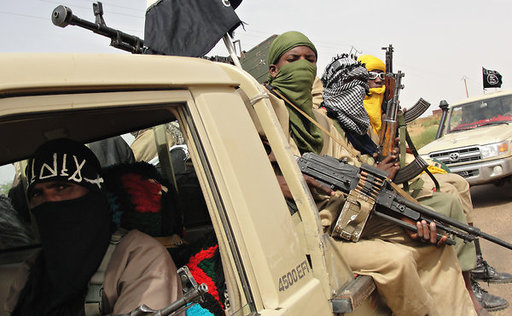
Islamists in Northern Mali. Courtesy of the New York Times. 2013
Broken Social Contracts
On top of the colorful bands of rebels and warlords that inadvertently occupy them, governance vacuums in areas as small as Djibouti and as vast as the jungles of the Democratic Republic of Congo not only contribute to modern day concepts such as ‘ the failed state;’ but especially endanger human security – simply because of the absence of an effective social contract.
At its most effective, a social contract stipulates that if a leader does not govern equitably, the people can remove him from power. John Locke’s ‘Second Treatise of Government’ of 1689 goes even further: People are obligated to, and, do, in fact, have a fundamental right to revolt against leadership if they are not getting what they want.
These social contract aspects, for the most part, worked for early civil insurrection – the American rebellion against the British; for the Chinese when Mao brought people together, and the Bolsheviks bore the former Soviet Union. But today, any piece of ungoverned real estate – be it on land, sea, or air – will lead to the dire straits of the Somali pirate kind and the immeasurable misery in various East, Central and Southern Africa refugee camps.
And with the failure of the Mali government in Bamako to effectively husband its massive territory, the unbearably hot parts of the Sahara desert are now just as dicey as the Indian Ocean was at the height of the Somali pirate empire.
The Crisis in Mali, unfortunately, happens in a very predictable fashion. Making the execution of social contract theory more complex are the formal or informal alliances that exist within this imperfect global dynamic of fully formalized sovereign nations. The people of Mali have tried to speak out – like the Tuareg have done since early in the 20th century – but more factors including post colonial elements of inverted economies and dictatorial tendencies – have come to pass. And so, we have this current need for equilibrium: There’s a defacto head of state, Dioncounda Traore and a whole host of illustrative characters vying for either his head or Sundiata Keita‘s throne; among whom is Iyad Ag Ghaly, leader of al-Qaeda off-shoot Ansar Dine.
Now, just as we’d advocate that Sudanese President Omar al-Bashir be held responsible for crimes against his own wards in Darfur and present day South Sudan, Malians may not be as well served by Mr. Ghaly if he is as closely associated with terrorists as he is rumored to be. Even the Russians underline how little world favor terrorism curries. Besides with drones effectively decimating al-Qaeda’s terrorist ranks in the hotspots of the Middle East, internal dynamics once again conspire to, like we have mentioned before, destabilize the plexus upon which global dynamics rest. The Americans are practically raring to go if al Qaeba threatens US national security – and the French have already received their taste of battle in Mali.
Simply, this scenario could, unless delicately handled, morph into something much bigger – considering the power kegs around Mali’s oil, huge mineral deposits and especially, the presence of what seems like jihad-ready, battle-hardened conscripts – ripe for an assignment from God.
God’s Own Army
Recently, rebels from Mali launched an excursion into Algeria – taking 650 hostages. While the trigger happy Algerians ensured a tragic end for at least 37 foreign workers and all hostage-takers, the Mali situation also exacerbates apparent vacuums in the social fabrics of Niger, Libya, Burkina Faso, Mauritania, both Sudans, Chad and Nigeria which all have very low levels of living standards for an overwhelming majority.
We can only urge that a solution be exigently sought. Africa does not need any more catastrophic humanitarian conditions just as countries like Ghana and Nigeria are struggling to stand up and be counted amongst global economic stars. Another crisis only adds to the altruistic but dangerous cynicism many ill-informed potential investors already bear towards Africa.
To this, The Economist rhetorically asks: If Guinea, Sierra Leone, Liberia and Ivory Coast shared rebels like the flu for years, and that the Rwanda genocide of 1994 sparked the Congolese civil war, wouldn’t the presence of islamists and jihadists in Mali not cause even more wanton misery to the region? This conjures up gloomy images picture for ordinary Malians in refugee camps; losing their livelihoods while facing those aforementioned low standards of living.
And there’s another dynamic: The Economist reliably informs us that many Malians, even those in remote areas, find collegiality with those extreme moslems – even dreaming of a global jihad. Many are Moslems, anyway, and therefore, if Malian jihadists and al Qaeda are bedfellows with northern Nigerian Islamic extremists, for instance, then dark days for African investment and for those associated with foreign aspects – like the late Malian hostage takes – are ahead.
But most of all, too many unfulfilled social contracts ultimately led to the 1990’s bombs in Kenya and Tanzania. Recently, Ugandans witnessed their own version of explosive terrorism. While all bombs were, somehow, aimed at the Americans, scores of innocent East Africans were collateral damage. Today, anyone associated with America, especially, can also be a target and used to send a message. Portentously, ungoverned hot spots in Africa are worse than vicious cycles: A people is so wretched; disconcerted, vulnerable and ripe enough to find solace in strident philosophy, made easier to swallow by religion. John Locke would have covered his head in shame, in pain, in helplessness.
The Editorial Board,
The Habari Network
To respond to this editorial, please write to our Editor – editor@thehabarinetwork.com