Opinion
Capital Pauses Where Clarity Stops: Africa’s Investment Challenge Isn’t About Money


By Davida Ademuyiwa
Africa’s investment challenge has never been about the absence of opportunity. Nor, contrary to popular perception, has it primarily been about the availability of capital.
Development finance institutions, sovereign wealth funds, private investors, and family offices have all allocated substantial resources to the continent. The money exists.
What remains elusive is the clarity required to deploy it.
Strong projects across Africa routinely stall – not because their underlying potential has evaporated, but because the fundamentals of decision-making, risk assessment, and execution have become obscured. In boardrooms from London to Singapore, investment committees scrutinize African opportunities with the same rigor they apply elsewhere.
Yet time and again, promising ventures languish in due diligence limbo or are quietly shelved.
The Clarity Deficit
The obstacle is rarely the opportunity itself. Instead, uncertainty paralyzes capital at the point of decision.
This uncertainty manifests in several predictable forms that experienced investors have learned to recognize immediately.
First, there is the question of authority. In too many African projects, it remains genuinely unclear who holds the power to make binding commitments.
Organizational charts may exist, but they often fail to reflect the actual loci of decision-making. When investors cannot confidently identify their counterparty’s true authority, negotiations stretch interminably or collapse entirely.
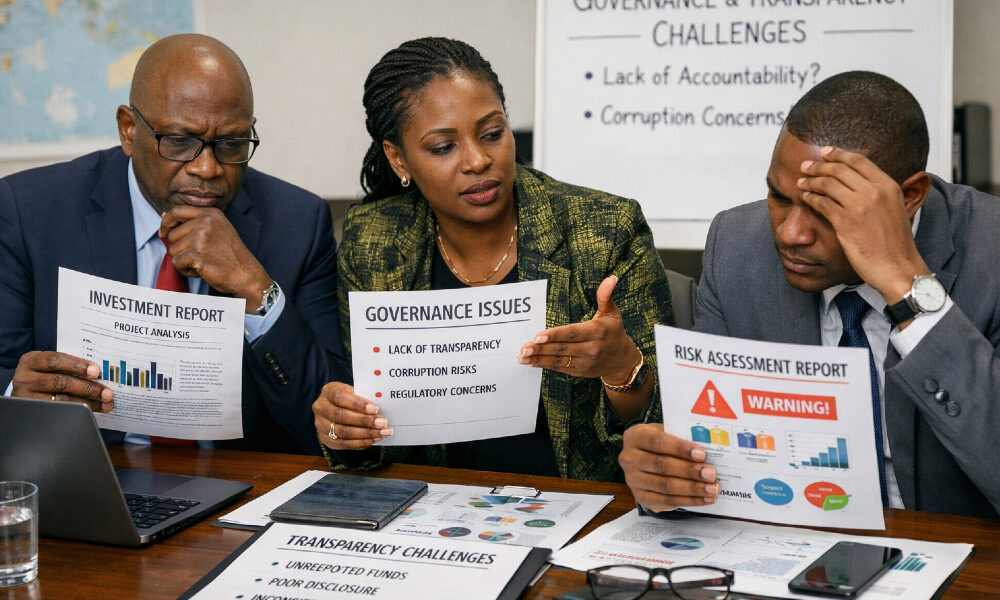
Second, governance structures frequently lack definition. Well-intentioned partnerships stumble when roles, responsibilities, and accountability mechanisms remain ambiguous.
Investors accustomed to transparent corporate frameworks find themselves navigating opaque arrangements where crucial governance questions have never been explicitly answered.
Third, political and commercial risks become dangerously entangled. Sophisticated investors understand that both categories of risk exist in emerging markets.
What they struggle with is the failure to properly separate and price these risks. When commercial viability depends on political relationships that could shift with the next election – or the next ministerial reshuffle – capital understandably hesitates.
Finally, timelines often strain credulity. Projects presented with aggressive schedules that ignore regulatory realities, infrastructure constraints, or institutional capacity inevitably trigger skepticism.
When timelines subsequently shift without adequate explanation, whatever trust existed erodes further.
The Confidence Equation
When these fundamental questions lack clear answers, capital invariably pauses. This is not a reflection of Africa’s potential, which remains extraordinary across numerous sectors and geographies.
Rather, it reflects a basic principle of investment: clarity precedes confidence, and confidence precedes commitment.
Investors can tolerate substantial risk. What they cannot tolerate is uncertainty about the nature and magnitude of that risk.
A clearly defined 40 percent equity stake in a transparent structure is infinitely more attractive than an ambiguous “strategic partnership” promising outsized returns through unspecified mechanisms.
What Moves Forward
The projects that successfully attract capital are rarely the largest or most ambitious. They are, however, the clearest.
They feature governance structures that would be recognizable to any international investor. They demonstrate realistic timelines developed with genuine knowledge of local constraints.
They separate commercial viability from political dependency. They identify decision-makers with actual authority and empower them accordingly.
This is where outcomes are ultimately decided – not in the grand vision or the size of the market opportunity, but in the unglamorous mechanics of clear governance, realistic planning, and transparent risk allocation.
Africa’s investment challenge, then, is less about attracting capital than about creating the conditions for its deployment. The opportunity is real. The capital exists.
What remains is the imperative for clarity – in governance, in risk assessment, in timelines, and in authority. Until that clarity emerges, capital will continue to pause precisely where it stops.
For African entrepreneurs, policymakers, and project developers, the implication is straightforward: the path to investment runs through transparency. Not transparency as a buzzword or a compliance exercise, but transparency as the foundation of every structure, timeline, and commitment.
In a competitive global market for capital, clarity itself has become the most valuable currency.
Davida Ademuyiwa is a UK politician and founder of DaviGlobal International Trade & Investment. She facilitates cross-border investment and connects capital with scalable ventures across the UK, Europe, the Middle East, and Africa. She also serves as Regional Ambassador for the Conservative Policy Forum in the East of England, contributing to grassroots policy dialogue alongside her work in global trade and investment.