A Diaspora View of Africa
Can AGOA overcome African doubts?



By Gregory Simpkins
Since its signing into law in 2000, the African Growth and Opportunity Act (AGOA) has been the main trade program for the United States with eligible countries in Africa. From its inception, it has not been as well understood as it should have been by businesses on either side of the Atlantic Ocean. In fact, it has been operated as a government-to-government program when it should always have been a business-to-business venture. This accounts for its inability thus far to maximize trade potential, and by focusing on the role of governments, AGOA becomes involved in international politics in a way that does not promote trade.
In a media briefing on the sidelines of the AGOA forum held in Johannesburg in early November, Wamkele Mene, Secretary General of the African Continental Free Trade Area (AfCFTA), said the United States of America’s African Growth and Opportunity Act (AGOA) initiative and the AfCFTA can be complementary and supportive trade initiatives.
“An example of how that alignment can take place is if you look at the protocol on investment which establishes enhanced legal rights for investors but also enables countries to regulate investment inflows in the public interest,” Mene explained.
“Similarly in the area of intellectual property rights. The United States Trade Representative (USTR) under Ambassador Katherine Chi Tai has been very clear that they support reforms of the global patent system so that it is at the service of public health and at the service, in our case as the continent, at the service of industrial development and job creation.
These are some of the principles, we believe, should be considered where we are to have a discussion about trade and investment between AGOA eligible countries and the United States. These are some of the complementarities [between AGOA and the AfCFTA] that can be explored,” he said.
Certainly, AGOA could be quite helpful in more broadly expanding trade between US and African businesses, especially small and medium enterprises (SMEs) that are the world’s drivers of job creation. Unfortunately, the government-to-government focus of AGOA management in the US frustrates this prospect by minimizing the value of SMEs in the United States and Africa establishing and maintaining ongoing commercial relationships. That cannot take place if countries are suspended for political reasons due to their governments’ actions, which eliminates the opportunities for SMEs to benefit from their connections with US counterparts.
There are justifiable reasons to sanction those in African governments and their cronies who violate human rights, but the US government has a tool – the Global Magnitsky Act – that allows for individual punishments for wrongdoers without depriving innocent companies in such countries of the commercial benefits of AGOA. At the very least, there should be exemptions for companies found to be innocent of the violations that led to the AGOA suspensions in the first place. At the Zambia AGOA Forum in 2011, I met companies from Zimbabwe, which had not been included in AGOA from its inception, who had been forced to relocate to Zambia to remain competitive in trade with the United States.
In 2022, Ethiopia, Guinea and Mali were suspended from AGOA due to actions taken by each of their governments in violation of the AGOA Statute, said the USTR in a statement at the time. Just prior to the 2023 AGOA Forum, the US government suspended Uganda, Niger, Gabon and the Central African Republic. Such suspensions have human costs not being incorporated into these decisions.
For example, the BBC reported that Ethiopia had traded under the program since 2000, with some 200,000 people, mostly young women, directly employed in the two most successful exporting industries under the AGOA: clothes and leather. Ethiopia’s exports to the US had grown from US$28 million in 2000 to about US$300 m in 2021, nearly half of it under AGOA.

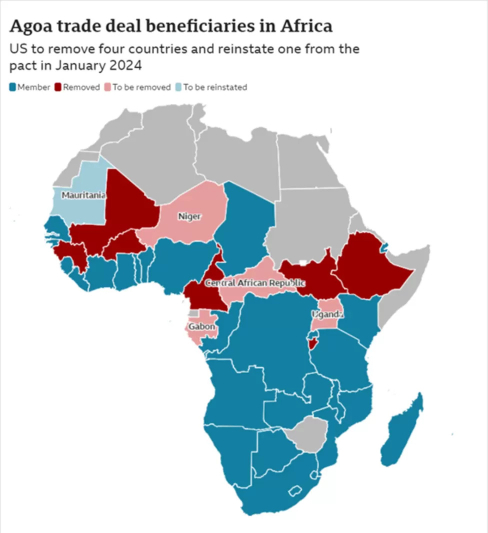
Image source: AGOA via BBC
However, the country’s suspension from AGOA saw about 100,000 people lose their jobs, Ethiopia’s former chief trade negotiator Mamo Mihretu told the BBC. The majority, he said, were women working in textile factories in the southern part of the country and not connected to the conflict in the north.
The impact of sanctions on AGOA
An April 2023 World Bank Group policy paper entitled “Uncertainty in Preferential Trade Agreements: Impact of AGOA Suspensions on Exports“, presented the problems caused by what some would consider arbitrary suspensions from AGOA.
“The suspension of AGOA or the threat of suspension introduces uncertainty about the viability of the program and could discourage investment in industries engaged in exports of AGOA eligible products. In its most recent extension in 2015, additional conditions were put in place that could adversely affect the certainty and continuity of the AGOA program. In addition to the annual monitoring and review of eligibility of each beneficiary country, the AGOA Extension and Enhancement Act of 2015 states that ’any interested person, at any time’ can file a petition suggesting a failure of country ’compliance’ (US Congress, 2015),” the report pointed out.
In fact, new legislation being proposed by US Senator Chris Coons is circulating in a discussion draft of a bill to renew the AGOA for 16 years that also would require an immediate “out-of-cycle” review of South Africa’s eligibility for AGOA. That could lead to South Africa being removed next year from AGOA.
However, South Africa was the largest exporter in the agreement according to year-end statistics from 2021. It generated about US$2.7 billion in revenue, mostly from the sale of vehicles, jewelry and metals. Nigeria was second with revenue of more than US$1.4 billion, mostly oil, while Kenya came third with about US$523 million, according to statistics from the US International Trade Commission (ITC) and US Department of Commerce. Other countries such as Eswatini, Ethiopia, Lesotho, Malawi and Mauritius also have massively increased their exports to the US under AGOA. Hundreds of thousands of jobs have been created across the continent, although there are no precise figures. It also reportedly supports nearly 120,000 jobs in the US.
When AGOA was extended for 10 years back in 2015, the rationale was that US buyers needed certainty before making major sourcing decision on African products. The uncertainty of doing business in Africa is not helped by broad sanctions aimed at governments and individuals but also punishing companies that weren’t involved in such calculations. This increase in AGOA suspensions undoes the benefit of the 10-year extension, and current and proposed legislation will increase that uncertainty – not only for African companies and workers, but also for American companies and workers.
Dion George, South African Member of Parliament and Democratic Alliance Shadow Minister of Finance, issued a statement at the conclusion of the AGOA Forum citing the importance of extending AGOA but initiating a reform of the trade process.
“As the forum concluded, the urgency of confirming AGOA’s renewal at the earliest opportunity was underscored. A timely resolution will allow us to delve into the evolution of AGOA with the depth and consideration it warrants. This requires the consent of the US Congress at a time when South Africa’s conduct has brought its relationship with the US into question. Securing an advantageous position for South Africa is imperative and will require concerted effort. The DA remains steadfast in this pursuit,” he stated.
Zainab Usman, Director of the Carnegie Endowment for International Peace’s Africa Program, summed up the recommended actions for AGOA following the forum:
- Investment promotion,
- Alignment with AfCFTA,
- Enabling African companies to be more export-ready,
- Platforms to connect government to business and business to business efforts and
- Energizing trade in underutilized sectors such as minerals, pharmaceuticals and digital trade.
There are those in Africa who have long accused the United States of bullying developing countries such as those in Africa. Too-broad sanctions on African countries that hurt small companies and workers more than those the sanctions target does seem like bullying when there are alternative actions in place to punish wrongdoers without all the collateral damage.
In the impending reauthorization of AGOA before its expiration in 2025, there needs to be a serious rethinking of how to broaden and confirm its benefits to more companies and workers in the United States and African countries even while levying well-deserved punishment for those who rampantly violate the human rights of their citizens.
Gregory Simpkins, a longtime specialist in African policy development, is the Principal of 21st Century Solutions. He consults with organizations on African policy issues generally, especially in relating to the U.S. Government. He further acts as a consultant to the African Merchants Association, where he advises the Association in its efforts to stimulate an increase in trade between several hundred African Diaspora small and medium enterprises and their African partners.