Owusu on Africa
Cameroon’s Military Reshuffle Raises a Deeper Question: Who Is Really in Charge?
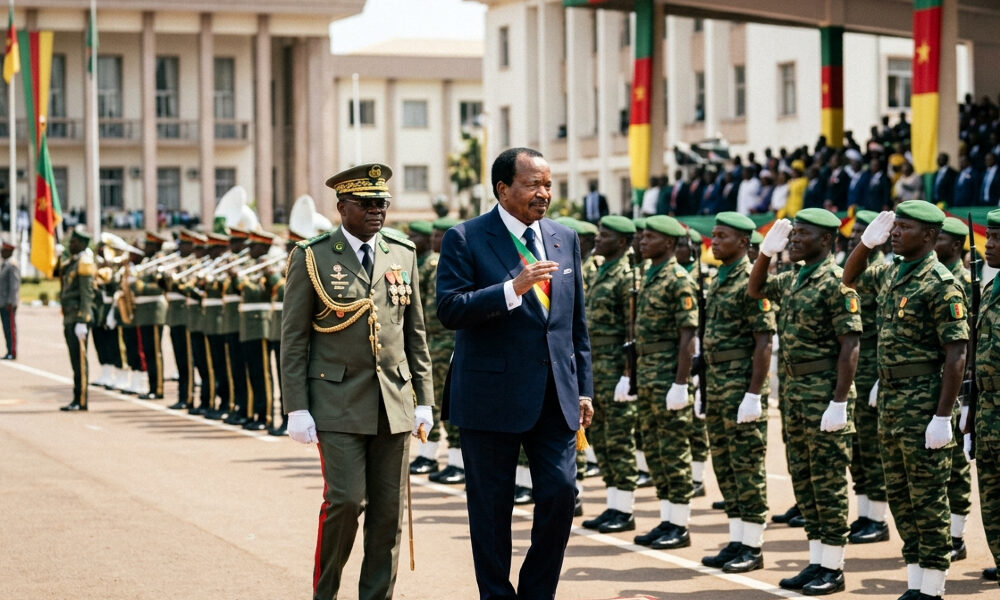
Paul Biya has ruled Cameroon for 43 years, much of it lately from Europe. His sudden overhaul of the military’s top brass suggests a succession crisis is closer than his government wants to admit.


By Fidel Amakye Owusu
Africa’s coup wave has an unglamorous cause-and-effect that its architects rarely advertise: the plotters are usually insiders. In Gabon in 2023, it was not a rival warlord or a street uprising that toppled Ali Bongo, but his own cousin, the general commanding the Republican Guard.
That lesson has not been lost on the region’s remaining strongmen. Several governments that watched juntas seize power in Niger, Mali, and Gabon have since reshuffled their military commands, calculating that loyalty has a shelf life and that the officers standing closest to the president are also the ones best positioned to remove him.
Cameroon has now joined that list – decades late, some would say, but not without reason.
An Unusual Kind of Governing
President Paul Biya, 92 and the world’s oldest head of state, has spent much of the past several months abroad, reportedly in Europe and, by most informed accounts, closer to his physicians than to his cabinet. His recent decision to reshuffle the country’s senior military commanders is unlikely to be his own doing in any meaningful sense.
But that almost misses the point. Whoever engineered the shake-up, and whatever they intended by it, the reshuffle has forced Cameroon’s succession question into the open – a question the ruling party has spent years trying to keep behind closed doors.
The timing is telling. The announcement followed closely on the heels of a closed-door gathering of the ruling Cameroon People’s Democratic Movement’s senior leadership, convened as speculation over Biya’s succession has moved from private murmurs to public reporting.
Several names circulate as potential heirs. None has been confirmed. And the president, now serving an eighth term, has given no indication of when – or whether – he intends to relinquish it.
Three Plausible Explanations
Strip away the official silence, and three explanations for the reshuffle stand out, none of them mutually exclusive.
The first is simple self-preservation. A ruling elite watching coups fell fellow strongmen across the region has every incentive to pre-empt its own version of the Gabon scenario, particularly as public unease over an absentee president grows louder. Reassigning commanders is a low-cost way of disrupting any officer’s ability to build the kind of entrenched loyalty that made Gabon’s putsch possible.
The second is transition management. Cameroon’s constitution was amended in April to create a vice-presidency – a position that does not exist under the country’s traditional line of succession, which places the head of the legislature next in line during a presidential absence. The vice-presidency remains vacant, though rumor persistently points to one name: the president’s own son. If that appointment is coming, a reshuffled and freshly loyal military command would make the announcement, and any backlash to it, considerably easier to manage.
The third possibility is more troubling for the ruling party: that fear of an internal military move against the regime, rather than confidence in its own strength, is what is driving the decision. An absent, nonagenarian president is precisely the kind of vacuum that ambitious officers elsewhere in Africa have proven willing to fill.
A Familiar Script in Central Africa
Sons inheriting power from their fathers is well-trodden ground in Central Africa.
Joseph Kabila succeeded his father, Laurent, in the Democratic Republic of Congo. Ali Bongo succeeded his father, Omar, in Gabon. In Equatorial Guinea, President Teodoro Obiang’s son already serves as vice president, next in line by design. The pattern is notable less for its frequency than for how it has recently ended: both Kabila and Bongo were eventually forced from office, the latter by the very security establishment meant to protect him.
That history should give Cameroon’s ruling party pause. Engineering a hereditary transition is one thing; making it stick is another.
The Question Biya Cannot Answer
It is entirely possible that Biya himself has little idea the reshuffle even took place. That uncertainty is itself the story. Cameroon is being governed, in practice if not in name, by a circle of officials managing the affairs of a leader who is largely absent from them.
The military reshuffle looks less like a routine personnel decision than the opening move in a succession drama that Cameroonians have been denied any real say in – and one that, if the region’s recent history is any guide, may not unfold on the ruling party’s preferred timeline.
Fidel Amakye Owusu is an International Relations and Security Analyst. He is an Associate at the Conflict Research Consortium for Africa and has previously hosted an International Affairs program with the Ghana Broadcasting Corporation (GBC). He is passionate about Diplomacy and realizing Africa’s global potential and how the continent should be viewed as part of the global collective.