Opinion
BRICS Realignment: A Strategic Opening African Businesses Cannot Ignore
A bloc once dismissed as an acronym in search of a strategy is now building the payment systems, banks, and trade corridors that will define the next era of South-South commerce.



By Jacqueléne Coetzer
Every so often, a shift in the architecture of global trade arrives quietly, dressed up as a summit communiqué or a currency swap agreement, and only later reveals itself as history. BRICS is one of those shifts.
What began in 2009 as a loose grouping of Brazil, Russia, India, China, and South Africa has become something far more consequential: an expanding coalition of emerging economies actively building an alternative to the Western-dominated system of trade, finance, and diplomacy. For African companies still calibrating their strategies around Washington, Brussels, and the dollar, the message is increasingly hard to ignore. The center of gravity in world commerce is moving, and it is moving toward them.
From Acronym to Architecture
BRICS was once easy to dismiss as a talking shop, a grouping with more symbolism than substance. That characterization no longer holds. The bloc has expanded into what analysts now call BRICS+, a widening circle of aligned partners united less by geography than by a shared appetite for a multipolar world and, increasingly, for de-dollarization. The United Arab Emirates, Egypt, Iran, Ethiopia, and Saudi Arabia have joined or been invited; Argentina’s re-entry is pending; and Indonesia, Nigeria, Türkiye, and Mexico have all signaled interest. Taken together, this is no longer a bloc of five. It is a growing coalition that collectively represents a substantial and rising share of the world’s population, resources, and economic output.
For African businesses, the significance is not abstract. BRICS is constructing new payment systems that do not require dollars, building trade corridors that bypass Western intermediaries, and accelerating South-South trade approvals that once moved at the pace of Western sanctions and compliance regimes alike. Anyone still calibrating strategy solely around Western markets risks missing what may be the most consequential realignment in global economics since the founding of the World Trade Organization.

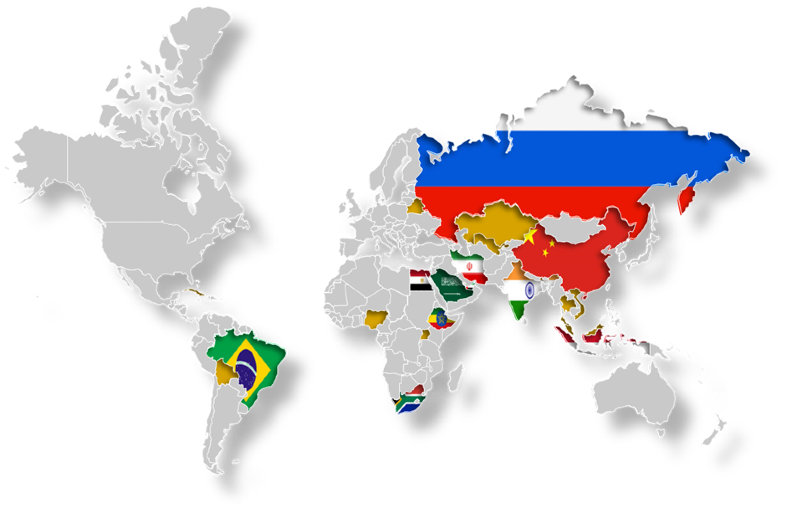
Map of BRICS and BRICS+ members identified by their national flags
A Different Kind of Offer
Where BRICS differentiates itself most sharply from the postwar Western order is in what it does not ask for. Its member states have built their appeal around principles of non-interference and mutual respect, explicitly declining to attach demands for regime change or political reform to trade and aid – a model that appeals to governments and companies wary of the conditionalities long attached to Western assistance. The bloc has also positioned itself as a platform for African-led development and independent policymaking, and it has thrown its weight behind reform of the UN Security Council, the IMF, and the World Bank, including a push to secure Africa a permanent seat at the table.
Whether that vision fully materializes is, of course, an open question: institutions built on decades of accumulated power rarely reform themselves quickly, and BRICS’s own internal cohesion is far from guaranteed. But the narrative itself is doing real work. It offers African governments and firms a framework for engagement that does not begin with the assumption that Africa is a supplicant.
Why Diversification Matters Now
For African economies long tethered to Western capital and Western demand, BRICS offers something increasingly valuable: optionality. Deeper engagement with the bloc reduces overreliance on Western markets, insulates trade relationships from the unpredictability of shifting American foreign policy, and encourages multi-currency trade in the yuan, the rupee, and the ruble rather than the dollar alone. It also widens access to alternative supply chains and sources of investment that, until recently, were simply not on the table.
The practical machinery behind this shift is advancing quickly. The New Development Bank, the BRICS-founded lender headquartered in Shanghai, is pushing local-currency loans and infrastructure co-financing with African partners. Trade corridors are taking shape in specific sectors: Russian mining investment in southern Africa, Indian pharmaceutical trade with East Africa, and Chinese industrial zones across West Africa. A cross-border payment platform linking Russia, India, and China is already in testing. And BRICS has moved to align its priorities more closely with the African Union’s Agenda 2063, the continent’s own long-term development blueprint – a signal that the bloc wants to be seen as a partner in Africa’s plans rather than merely a source of financing for them.
Where the Opportunities Actually Are
Strip away the geopolitics, and the practical case for African companies is straightforward. BRICS countries want non-Western suppliers, which means new customers for exporters willing to trade in local currencies and sidestep dollar volatility altogether. The New Development Bank is actively funding projects across BRICS countries, and China, Russia, and India have all stepped up direct funding for African infrastructure, trade, and women-led enterprises. Manufacturers can source inputs more cheaply from India, China, and Russia, and partner with logistics providers unencumbered by IMF-style conditions.
There is also a reputational dividend. Positioning a company as BRICS-aligned signals strategic neutrality and, with it, access to a wider set of opportunities, particularly for African exporters, consultants, technology developers, and wellness and healthcare brands looking to diversify beyond saturated Western markets. Small and medium-sized enterprises stand to benefit disproportionately: supplier partnerships in manufactured goods, agri-processing, cosmetics, logistics, and technology; e-commerce access through BRICS digital platforms; innovation grants and co-funding for youth- and women-led ventures through the New Development Bank and the BRICS Women’s Business Alliance; and a growing calendar of BRICS trade expos and procurement fairs, particularly in India, China, and Russia.
The demand signals from individual member states are already distinct and worth studying separately. China remains the continent’s largest infrastructure investor, financing projects such as Kenya’s Mombasa-Nairobi railway and Ethiopia’s rail link to Djibouti, and continues to import African metals, energy, and agricultural products in pursuit of long-term supply security.
India is focused on agriculture, pharmaceuticals, IT, and skills transfer, and is diversifying its supplier base for minerals, fertilizers, and healthcare products.
Russia is deepening ties in energy, mining, defense, and nuclear collaboration, while importing African food, chemicals, and logistics services as it builds new energy partnerships.
Brazil brings agricultural expertise and food-security cooperation, buying African coffee, cocoa, and processed foods as it expands its own agro-industrial reach. South Africa, meanwhile, functions as a gateway – the regional hub through which much of this activity is intended to flow.
The Risks Worth Naming
None of this is a reason for uncritical enthusiasm. China’s outsized economic weight within BRICS risks tilting the bloc’s priorities in its own favor and creating new dependencies that look uncomfortably similar to the ones African economies are trying to escape. Internal tensions, most visibly between India and China, could limit how cohesively the bloc actually functions. And some BRICS-financed projects have already drawn scrutiny over debt sustainability and transparency – echoes of criticisms long leveled at Western lenders too.
The sensible response is not to treat BRICS as a monolith to be embraced wholesale, but to engage strategically: build relationships across multiple BRICS economies rather than betting everything on one, and negotiate terms with the same rigor African companies would apply to any other counterparty.
Getting It Right
Companies entering this landscape make some predictable mistakes. The first is assuming BRICS is fundamentally anti-Western, when it is more accurately understood as pro-alternative – a bet on optionality rather than opposition.
The second is treating BRICS as a single market with a single rulebook, when each member state operates independently, with its own regulatory environment, business culture, and expectations.
The third is showing up without local partners or cultural fluency, a shortcut that rarely survives contact with any unfamiliar market.
The fourth is assuming that because a partner is non-Western, compliance somehow matters less; it does not. And the fifth is failing to prepare for differences in language, payment infrastructure, and certification standards that can quietly derail an otherwise promising deal.
The Bigger Picture
It is tempting to file BRICS under geopolitics and move on. That would be a mistake. For African companies, it is fundamentally a market-access story – one about new customers, new financing, and new supply chains opening at precisely the moment Western markets have grown more volatile and, in places, more restrictive.
Africa’s economic future will not be settled exclusively in Washington or Brussels. Increasingly, it is being negotiated in Addis Ababa, New Delhi, São Paulo, and Johannesburg as well. Companies that recognize this early – and that engage with the requisite diligence, patience, and realism about the risks – stand to gain the most from a genuinely multipolar trading system. Those that wait for certainty may find the best opportunities already claimed.
Jacqueléne Coetzer is a strategic trade and market analyst specialising in African and emerging markets. Her work focuses on structuring cross-border commercial relationships, connecting buyers and sellers, and facilitating trade across key sectors including commodities, diagnostics, and premium agricultural products. Her writing explores the realities behind global trade architecture, BRICS, and African economic development – not from a theoretical lens, but from active market engagement and transaction-level insight.