Opinion
BRICS: Beyond Politics, the Trade Architecture Matters – Delhi Declaration and Summit Analysis


By Jacqueléne Coetzer
Everyone wants to talk about what BRICS means for the world. Far fewer people are asking what BRICS actually means for business.
The New Delhi Declaration, adopted unanimously at the XVIII BRICS Summit on 12-13 September 2026, is an enormous document. I have therefore approached it from the perspective that matters most to my Market Entry Series – What does the emerging BRICS architecture actually mean for trade, investment and African businesses?
The answer is considerably more interesting than another debate about whether BRICS is “anti-Western”, a challenge to the dollar, or an emerging geopolitical bloc. Read properly, the Declaration is a map of where the architecture behind international commerce is being built.
An Expanding Bloc Building Practical Infrastructure
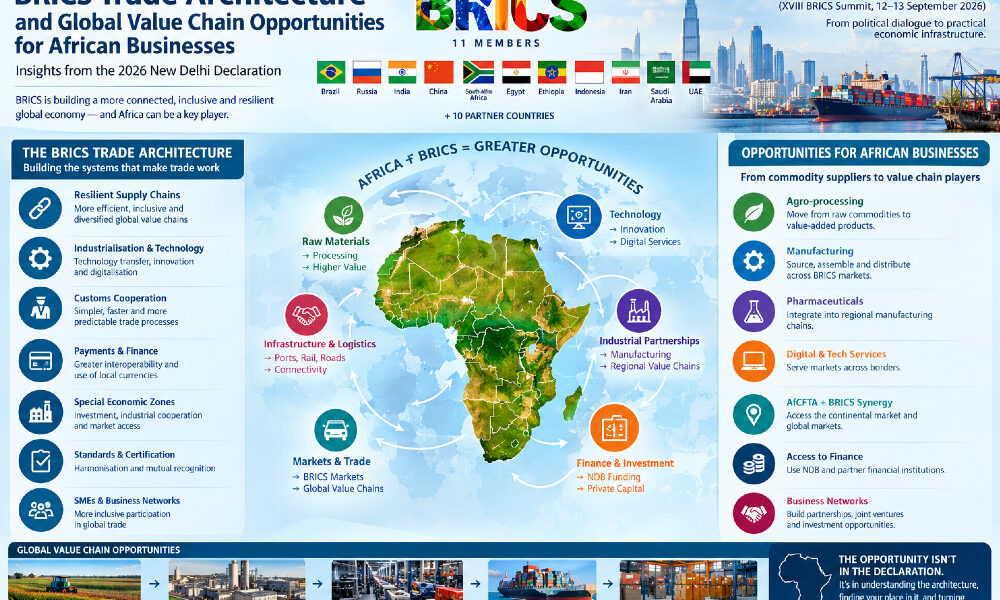
BRICS now comprises 11 members – Brazil, Russia, India, China, South Africa, Egypt, Ethiopia, Indonesia, Iran, Saudi Arabia and the United Arab Emirates – together with 10 partner countries. The grouping spans Africa, Asia, the Middle East, Europe, Latin America and the Caribbean. But size is not the most interesting part.
The interesting part is what the members are trying to build around that size. The Delhi Declaration repeatedly addresses resilient supply chains, global value chains, industrialisation, technology transfer, digitalisation, customs cooperation, standards, payments, Special Economic Zones, SMEs, investment and business-to-business cooperation. The trajectory is increasingly towards practical economic infrastructure rather than political statements alone. This matters because international trade does not happen simply because somebody wants to buy something – It happens because payment systems work, customs work, logistics work, standards can be met, finance is available, documentation is accepted, infrastructure exists and counterparties can be trusted. And that is the real significance of Delhi.
From Raw Materials to Value Chains
BRICS is increasingly working on the systems behind the transaction. Consider global value chains. The Declaration supports more resilient, efficient and inclusive value chains, including digitalization, trade facilitation, infrastructure, productive capacity, technology transfer and intellectual-property protection. For African businesses, this raises a fundamentally different question from “Who will buy our commodities?” – A far better question is: Where can Africa capture more value? A mineral producer could move into processing. An agricultural producer could move into agro-processing. A pharmaceutical company could integrate into a regional manufacturing chain. A technology business could provide services across borders. A South African manufacturer could source components from one BRICS market, manufacture or assemble in another and distribute into a third.
This is where BRICS intersects with the African Continental Free Trade Area (AfCFTA). AfCFTA is building the African continental market through trade facilitation, regional value chains, industrialization, digital trade and investment. BRICS is increasingly creating external connections around markets, finance, technology, investment and supply chains. The intersection between the two architectures could become particularly important for African businesses seeking to move from commodity suppliers into higher-value regional and global value chains.
Where Political Commitment Meets Commercial Reality
The same principle applies to Special Economic Zones, customs and payments. The Declaration identifies SEZs as mechanisms for trade, investment, industrial cooperation and integration into global value chains. For an investor or manufacturer, that means market entry should not necessarily be assessed only at country level. The relevant question may be which economic zone offers the infrastructure, logistics, regulatory environment and cost structure required for the business model. Payments are equally important, although here businesses need to separate political rhetoric from operational reality. The Declaration supports greater interoperability between payment and messaging systems and increased use of local currencies for trade and investment settlement. It does not create a BRICS currency or a single BRICS payment system.
Banks, liquidity, foreign-exchange mechanisms, compliance systems and settlement infrastructure still have to make any alternative payment route operational. That distinction is critical. A declaration is not a transaction. A commitment to payment interoperability does not mean that your bank can process the payment tomorrow. Cooperation on standards does not automatically mean that your certificate will be recognized. Customs cooperation does not eliminate national requirements.
NDB financing does not mean that every private project qualifies for funding. There is a considerable distance between a political commitment and a completed commercial transaction. That distance is exactly where competent market-entry strategy becomes valuable.
For African businesses, therefore, BRICS should not be viewed simply as another collection of export destinations. It can potentially be approached as a wider commercial ecosystem encompassing markets, investment, technology, industrial partnerships, finance, payment infrastructure, customs cooperation, standards, SEZs, innovation and business networks.
The strategic question becomes: Can Africa use its continental market as a production base while connecting into BRICS markets, technology, finance and value chains? That is a much more ambitious proposition than simply exporting raw materials.
And it brings us back to the point I make repeatedly throughout this series – The opportunity is not created by a declaration. The declaration tells us where the architecture is being built. The businesses that understand that architecture – and work out where they can enter it – are the ones that can turn geopolitical change into commercial opportunity.
And to answer the questions that many have: No, BRICS is not anti-Western, it provides alternatives for countries of the Global South. It encourages payments and investments in local currencies to lower the costs of international trade and to eliminate friction. And, yes, it is a rising geopolitical block in which all member states are treated as equals and where the sovereignty of all members (and all states for that matter of fact) is respected.
BRICS is therefore worth watching, but more importantly, it is worth understanding.
Jacqueléne Coetzer is a strategic trade and market analyst specialising in African and emerging markets. Her work focuses on structuring cross-border commercial relationships, connecting buyers and sellers, and facilitating trade across key sectors including commodities, diagnostics, and premium agricultural products. Her writing explores the realities behind global trade architecture, BRICS, and African economic development – not from a theoretical lens, but from active market engagement and transaction-level insight.